Daftar Isi Show
| Characteristic | Detail |
| Genus | Rotala |
| Species | Rotala sp. “Vietnam” |
| Family | Lythraceae |
| Origin | Southeast Asia (Vietnam) |
| Common Name | Rotala Vietnam |
| Light Requirement | Medium – High (±80–150 µmol m⁻² s⁻¹ / PAR) |
| Optimal Temperature | 22–28 °C |
| Growth Rate | Moderate to Fast |
| Placement | Midground to Background |
| Plant Height | ±15–35 cm |
| Ideal pH | 5.5–7.0 |
| Water Hardness | GH 3–8 dGH; KH 1–4 dKH |
| CO₂ Requirement | Medium – High |
| Propagation | Stem cutting |
Additional Information
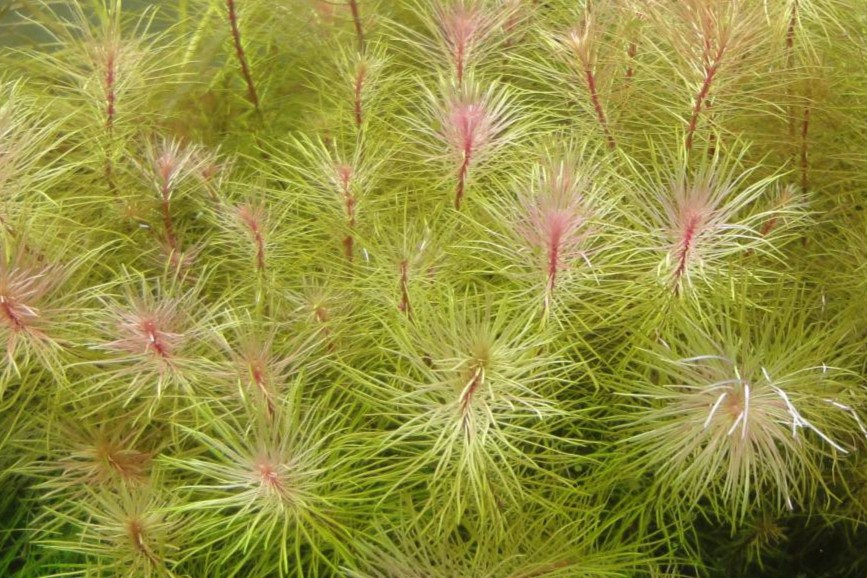
Rotala sp. ‘Vietnam’ is an aquatic stem plant belonging to the genus Rotala, highly regarded in the aquascaping community for its narrow leaf architecture and dense stem arrangement. Morphologically, the foliage is lanceolate to linear in shape with vibrant bright green coloration that can show subtle yellow or soft reddish undertones under high light intensity and stable nutrient conditions.
In aquascape design, this species is frequently positioned across midground and background areas to introduce fine texture and a natural aesthetic. Its upright growth pattern and strong propensity to branch following a trim make it suitable for both Nature Style and Dutch-style aquascapes requiring dense, well-defined plant groups.
Its natural habitat comprises shallow water environments in Southeast Asia, particularly Vietnam, characterized by soft water parameters and gentle currents. These adaptive origins explain its clear preference for stable water conditions rich in dissolved nutrients.
Explanation of the Term ‘sp.’
In botanical taxonomy, the abbreviation “sp.” is utilized when an organism is identified down to its genus level, but its exact species name remains undetermined or formally unpublished. In the case of Rotala sp. ‘Vietnam’, “sp.” indicates membership within the genus Rotala without a formal scientific species designation. The geographic descriptor “Vietnam” is applied within the aquascaping trade to distinguish this visually distinct morphological variant from other populations, even though it lacks formal classification in botanical literature.
Care and Requirements
Growth Characteristics
This plant exhibits upright vertical growth with strong stem integrity, branching laterally whenever pruned. Internodes stay noticeably tighter under high light intensity, producing a compact, bushy canopy. It responds dynamically to dissolved carbon availability, particularly in densely planted layouts where light competition is present.
Lighting
Lighting requirements fall into the medium to high category, with a realistic optimal PAR range between 80 and 150 µmol m⁻² s⁻¹ at leaf level. Under low to moderate light, growth continues but internodes stretch, resulting in leggy stems and plain green leaf coloration. Higher light levels encourage tightly packed foliage, sturdier stems, and enhanced color saturation.
CO₂ and Carbon
Rotala sp. ‘Vietnam’ can survive without CO₂ injection in low-tech aquariums, though peak visual performance requires a stable carbon supply. In high-tech aquariums, consistent CO₂ injection maintains rapid growth rates, increases bush density, and prevents lower leaf shedding. Carbon demand transitions toward high as lighting intensity increases.
Nutrition
A balanced availability of macronutrients and micronutrients plays a crucial role in sustained growth. Micronutrient deficiencies often manifest as pale, bleached new growth, whereas macronutrient imbalances cause uneven stem development. Long-term nutritional stability is far more critical than periodic, heavy fertilizer dosing.
Water Parameters
This species prefers slightly acidic to neutral water conditions with an ideal pH range of 5.5 to 7.0. Low to moderate water hardness between 3 and 8 dGH and 1 and 4 dKH supports efficient nutrient uptake. Parameter stability remains more important than aiming for exact numbers, as sharp water chemistry fluctuations induce physiological stress.
Substrate
Both active nutrient soils and inert substrates can be used, with a clear preference for substrates that facilitate fine root growth. While the root system of Rotala sp. ‘Vietnam’ is relatively simple, a nutrient-rich substrate accelerates initial establishment and supports overall stem health.
Propagation
Propagation is easily accomplished using standard stem cuttings. Healthy stems are cut and replanted directly into the substrate. Routine pruning serves a dual purpose as both a propagation method and a canopy shaping technique that stimulates abundant lateral branching.
Conclusion
Rotala sp. ‘Vietnam’ is a fine-textured aquatic stem plant offering great layout versatility in planted aquariums. Thriving in medium to high-tech environments, it delivers its best coloration and growth habit under bright lighting and steady CO₂ delivery. Its primary aesthetic value stems from its narrow, delicate foliage and its ability to form dense, structural bushes across midground and background zones.