Daftar Isi Show
| Characteristic | Detail |
| Genus | Rotala |
| Species | Rotala mexicana ‘Goias’ (cultivar) |
| Family | Lythraceae |
| Origin | Central and South America (aquascape hobby selection from Goiás region, Brazil) |
| Common Name | Rotala mexicana Goias |
| Light Requirement | Medium to High (±80–180 µmol m⁻² s⁻¹ / PAR) |
| Optimal Temperature | 22–28 °C |
| Growth Rate | Moderate |
| Placement | Midground – Background |
| Plant Height | ±20–35 cm (in aquarium) |
| Ideal pH | 5.5–7.2 |
| Water Hardness | GH 1–8 dGH; KH 0–4 dKH |
| CO₂ Requirement | Medium to High |
| Propagation | Stem cutting and top replanting |
Additional Information
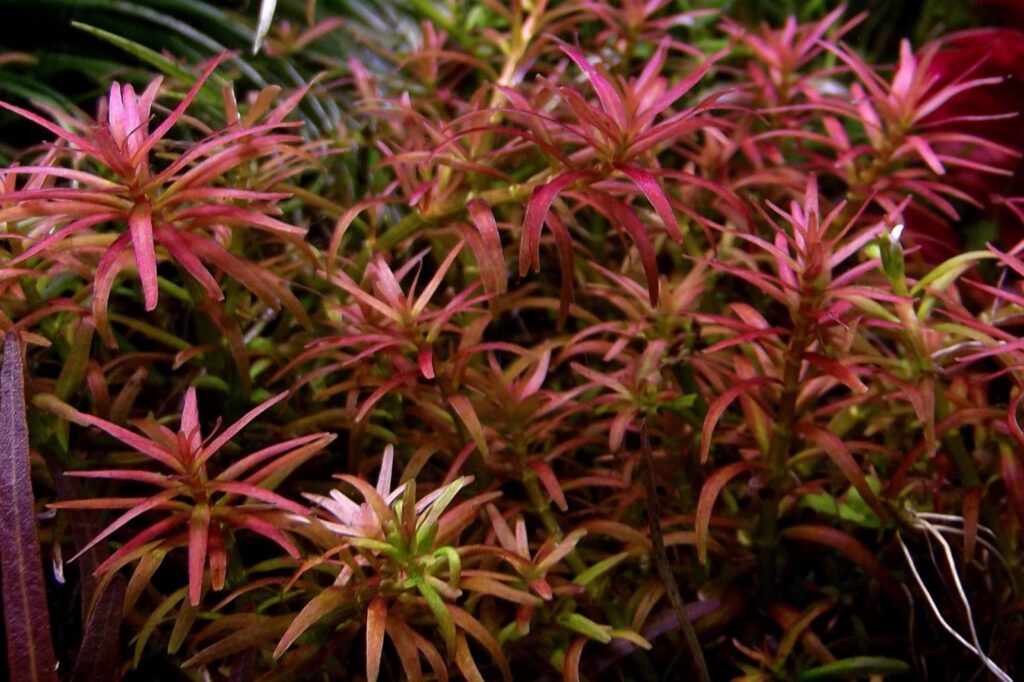
Rotala mexicana ‘Goias’ is a selected cultivar of Rotala mexicana prized for its delicate foliage and vibrant pinkish to purplish-red coloration under optimal growing conditions. The plant features slender stems lined with tiny opposite leaves, offering a noticeably finer visual texture compared to broader-leafed species such as Rotala rotundifolia.
Visually, Rotala mexicana ‘Goias’ displays a soft color gradient ranging from green to pink under moderate lighting, shifting into a deeper, richer red under higher light intensity. Its ultra-fine foliage texture makes it a popular choice for midground or background zones, where it introduces visual depth and soft tonal transitions into aquascape layouts.
In its natural habitat, Rotala mexicana grows in shallow waters, marshes, and river margins. The ‘Goias’ selection retains the adaptive resilience of its parent species while demonstrating a heightened color response to light and carbon availability within aquarium environments.
Care and Requirements
Growth Characteristics
Rotala mexicana ‘Goias’ grows as an upright vertical stem plant with an active tendency to form lateral side branches following a trim. Pruning terminal shoot tops stimulates secondary branching, allowing the plant to develop into a bush of moderate to high canopy density.
Its response to light and carbon is strong. Under optimal conditions, internodal spacing remains short, producing tightly packed leaves with rich pink to purplish-red tones. Under low lighting or limited carbon, stems stretch upward and foliage shifts toward green or reddish-green.
Lighting
Lighting demand falls into the medium to high category, with an estimated optimal PAR range of 80 to 180 µmol m⁻² s⁻¹ at leaf level. Under medium lighting, the plant maintains stable growth with a blend of green and soft pink hues. High light levels intensify the red pigmentation and create a much denser bush structure. Under lower lighting levels, the plant will still survive, but longer internodes and muted colors will reduce its visual impact in aquascape layouts.
CO₂ and Carbon
Rotala mexicana ‘Goias’ achieves its best performance in aquariums with a reliable CO₂ supply. In non-CO₂ injected setups, the plant can grow adaptively, but achieving dense bush structures and rich red coloration becomes difficult. High-tech setups with consistent carbon injection yield predictable growth rates and stable pigment expression.
Nutrition
This plant requires a balanced regime of both macro and micronutrients. Excessively high nitrogen levels can suppress red coloration, whereas micronutrient deficiencies lead to stunted growth and leaf deformation. Maintaining a steady, stable nutrient supply is vital for preserving canopy density and coloration, particularly under strong lighting.
Water Parameters
The ideal pH range sits between 5.5 and 7.2, paired with soft to moderate water hardness (1–8 dGH and 0–4 dKH). An optimal temperature range of 22 to 28 °C supports steady growth. Long-term parameter stability is essential for maintaining consistent leaf structure and color intensity, especially in high-tech systems.
Substrate
A fine granular substrate with moderate nutrient content supports adventitious root anchoring at lower stem nodes. A stable substrate bed holds stems upright and facilitates dense bush formation, while sufficient depth simplifies the replanting of shoot cuttings following routine maintenance.
Propagation
Propagation is easily accomplished using standard stem cuttings. Healthy shoot tops are trimmed and replanted directly into the substrate bed. This technique is routinely used in aquascaping to maintain canopy density and refresh aging lower stem sections.
Conclusion
Rotala mexicana ‘Goias’ is a refined aquatic stem plant valued for its fine leaf texture and responsive pink to purplish-red coloration. It thrives best in medium to high-tech aquariums equipped with moderate to high lighting, consistent CO₂ injection, and soft water chemistry. Positioned across midground to background zones, it excels at creating smooth color transitions, adding visual depth, and offering a delicate texture that contrasts beautifully against broad-leafed flora.