Daftar Isi Show
| Characteristic | Detail |
|---|---|
| Genus | Syngonanthus |
| Species | Syngonanthus sp. ‘Lago Grande’ |
| Family | Eriocaulaceae |
| Origin | South America (Amazon Basin, Brazil) |
| Common Names | Hatpins, Tonina Uaupes, Pipewort |
| Lighting Requirement | High (±90–150 µmol m⁻² s⁻¹ / PAR) |
| Optimal Temperature | 20–28 °C |
| Growth Rate | Medium |
| Placement | Midground / Background |
| Plant Height | 10–30+ cm |
| Ideal pH | 4.5–6.5 |
| Water Hardness | 1–5 dGH; 0–2 dKH |
| CO₂ Requirement | High |
| Propagation | Stem cuttings |
Additional Information
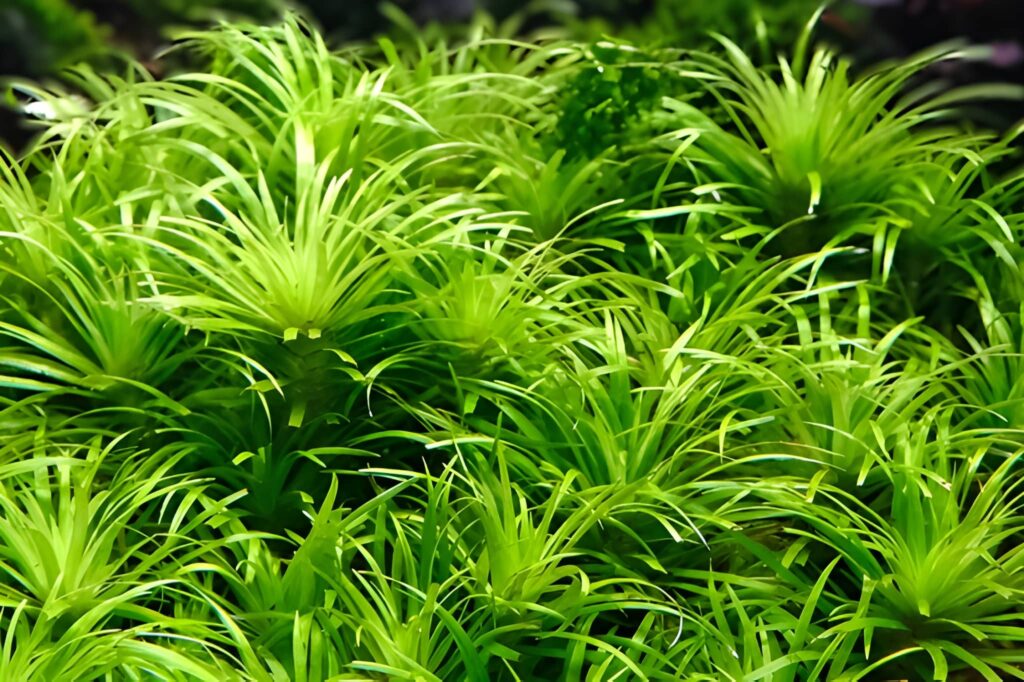
Syngonanthus sp. ‘Lago Grande’ represents one of the most distinctive members of the Eriocaulaceae family commonly referred to in the aquascaping community as “star plants.” This designation reflects the radial leaf arrangement that forms a star-like or needle-cluster appearance with a highly symmetrical structure.
Morphologically, the species is defined by its exceptionally fine vegetative structure. The leaves are linear to narrowly lanceolate, extremely thin, and needle-like, densely arranged along an upright stem. This high leaf density combined with a delicate texture produces a light, airy visual impression, making it an effective contrast element against broader-leaved aquatic plants within an aquascape.
When compared to related taxa such as Syngonanthus macrocaulon (‘Belem’), ‘Lago Grande’ exhibits a more pronounced apical structure. Its crown tends to be sharper and oriented upward, forming a more rigid and defined silhouette. In contrast, ‘Belem’ typically displays more downward-curving leaves, resulting in a softer, umbrella-like form.
The natural habitat of this plant lies within the Amazon Basin, particularly in Brazilian blackwater systems. These environments are characterized by extremely soft water, low mineral content, and a high concentration of dissolved organic compounds such as humic and fulvic acids. The species is typically found in shallow, seasonally flooded marginal zones with acidic sandy substrates poor in carbonate content. Such environmental conditions have driven specialized physiological adaptations, especially in carbon uptake, where dissolved CO₂ serves as the primary carbon source due to the limited availability of bicarbonates.
In aquascape design, Syngonanthus sp. ‘Lago Grande’ functions as a strong accent plant in midground to background compositions. Its intense bright green coloration is frequently used to offset red stem plants and to introduce sharp textural contrast. Dense group planting enhances its radial crown structure, creating compact vertical clusters with high visual complexity. The species is also a defining element in “Tonina-style layouts,” where multiple Eriocaulaceae species are arranged to simulate intricate, forest-like underwater vegetation.
Requirements and Care
Growth Characteristics
The growth pattern of Syngonanthus sp. ‘Lago Grande’ is fundamentally vertical, with moderate apical dominance. The main stem grows upright toward the water surface and, under favorable conditions, produces lateral shoots from leaf axils along the stem. This behavior enables the formation of dense clusters from a relatively small number of initial stems.
Its growth rate is classified as medium but remains consistent enough to require routine trimming. Under optimal conditions, maintenance pruning is typically necessary every two to three weeks to preserve structure and prevent excessive lower stem shading.
The plant’s response to environmental factors, particularly light and carbon availability, is clearly reflected in crown development. Under ideal conditions, internodes become tightly spaced and the apical structure expands fully. Conversely, deficiencies result in stunted growth, deformed leaves, or irregular morphology. Lower stem sections are especially prone to degradation when deprived of light or adequate water circulation, making thinning and replanting essential maintenance practices.
Lighting
This species falls into the high light category, requiring approximately ±90–150 µmol m⁻² s⁻¹. Such intensity is necessary to maintain compact growth and prevent excessive internode elongation.
Under insufficient lighting, the plant tends to exhibit elongated stems, reduced leaf density, and loss of its characteristic radial structure. In contrast, optimal lighting enhances its bright green coloration and promotes dense, well-defined crown formation. High light intensity also increases photosynthetic activity, often visible through active oxygen production on leaf surfaces.
It is critical that high lighting is balanced with stable CO₂ injection and nutrient availability. Imbalances between these factors significantly increase the risk of algal growth, particularly on the plant’s delicate leaf surfaces.
CO₂ and Carbon
Dissolved CO₂ availability is a critical requirement for this species. Syngonanthus sp. ‘Lago Grande’ is not adaptable to low-tech systems without CO₂ injection, as it lacks efficiency in utilizing bicarbonate as a carbon source.
In high-tech setups, optimal performance is achieved with consistently high and stable CO₂ concentrations. Even minor fluctuations can induce physiological stress, often observed as apical melt or halted growth.
The species also serves as a sensitive indicator of system stability. Declines in CO₂ levels are quickly reflected in the plant’s condition, making it a reliable visual reference for monitoring aquarium performance.
Nutrients
Nutritional requirements include a full spectrum of macronutrients and micronutrients in balanced proportions. Iron plays a particularly important role in maintaining leaf coloration and structural integrity. Deficiency is typically expressed as chlorosis in new growth.
While the plant absorbs nutrients through the water column, root uptake also contributes to long-term stability. Therefore, substrate nutrient availability remains relevant. Nutrient balance is essential, as excesses may destabilize the system and increase susceptibility to algae.
Calcium and magnesium are still required despite the plant’s preference for soft water. Deficiencies in these elements can lead to deformities in developing tissues.
Water Parameters
This species exhibits a strong preference for very soft water conditions. The ideal range is 0–2 dKH and 1–5 dGH. Increases beyond this range, particularly in KH, often disrupt metabolic processes and inhibit growth.
Optimal pH ranges from 4.5 to 6.5, where micronutrient availability is maximized. Stability of parameters is significantly more important than achieving exact numerical values. Sudden fluctuations in pH or temperature can trigger stress responses and progressive tissue degradation.
Substrate
The use of active substrate is strongly recommended due to its ability to buffer pH and KH while maintaining an acidic root environment. Such substrates also typically contain baseline nutrients that support early plant establishment.
Porous substrate structure facilitates internal water circulation, preventing the accumulation of toxic gases. Inert substrates containing carbonate materials should be avoided, as they gradually increase alkalinity.
In certain setups, the addition of organic material such as peat can further stabilize conditions by mimicking natural blackwater environments.
Propagation
Propagation is performed vegetatively through stem cuttings. Apical sections of approximately 4–6 cm can be trimmed and replanted to produce new individuals.
Shorter cuttings generally adapt more efficiently and result in more compact growth forms. The remaining lower stem typically produces lateral shoots, which can later be separated once sufficiently developed.
Replanting should be conducted carefully to avoid damage to the relatively soft stem structure. Removing lower leaves prior to planting is recommended to prevent decay within the substrate.
Conclusion
Syngonanthus sp. ‘Lago Grande’ is a high-complexity aquascape plant that combines delicate visual characteristics with highly specific technical requirements. Its fine, needle-like leaves and radial crown structure provide a distinctive aesthetic, particularly in midground to background compositions.
The species is best suited for high-tech systems with precise control over water parameters, especially low KH, acidic pH, high lighting, and stable CO₂ injection. Under optimal conditions, it forms dense, structured clusters with a refined and natural appearance.
Overall, successful cultivation of Syngonanthus sp. ‘Lago Grande’ reflects not only aesthetic achievement but also a high level of technical proficiency in managing the biological and chemical dynamics of an aquatic system.