Daftar Isi Show
| Characteristic | Detail |
| Genus | Rotala |
| Species | Rotala wallichii |
| Family | Lythraceae |
| Origin | South Asia and Southeast Asia (India, Bangladesh, Thailand) |
| Common Name | Whorled Rotala, Fine Leaf Rotala |
| Light Requirement | High to Very High (±120–250 µmol m⁻² s⁻¹ / PAR) |
| Optimal Temperature | 22–28 °C |
| Growth Rate | Moderate to Fast in high-tech systems |
| Placement | Background |
| Plant Height | ±20–60 cm |
| Ideal pH | 5.5–7.0 |
| Water Hardness | GH 1–6 dGH; KH 0–3 dKH |
| CO₂ Requirement | High |
| Propagation | Stem cutting |
Additional Information
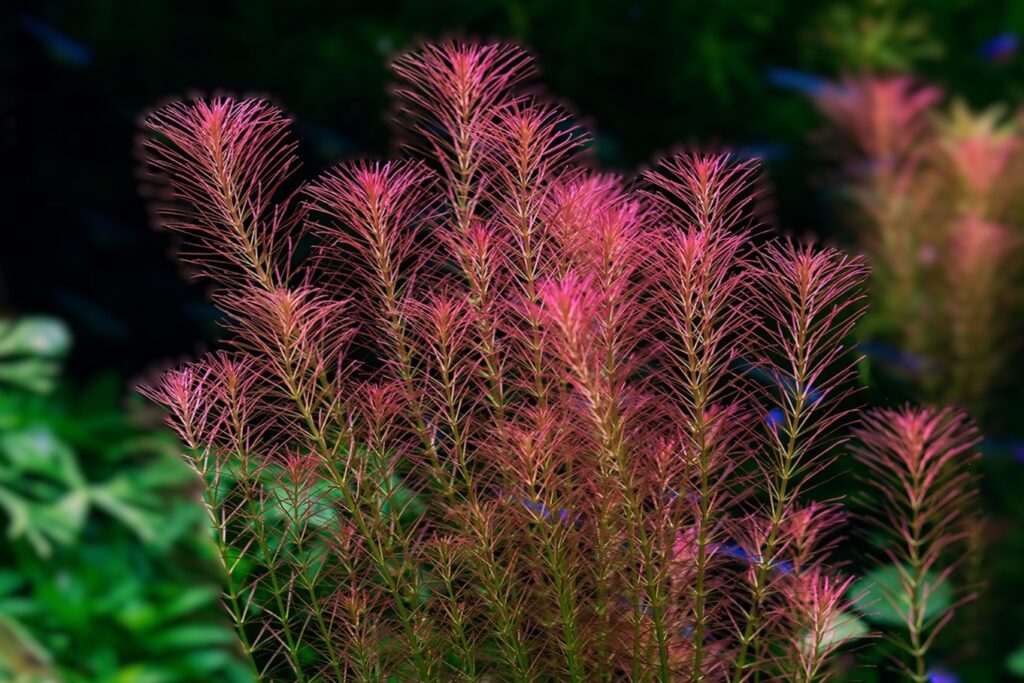
Rotala wallichii is an aquatic stem plant characterized by extremely fine, needle-like filiform leaves arranged in whorls along its stems. This distinct morphology produces a delicate visual texture that contrasts sharply against broad-leafed aquatic flora and rugged hardscape structures.
In aquascaping design, Rotala wallichii is positioned as a background species to establish dense, high-impact plant masses featuring vibrant pink to deep red coloration. Its pigmentation and overall canopy density are governed heavily by light intensity, dissolved carbon availability, and micronutrient stability, making this species a classic bio-indicator for overall high-tech aquarium performance.
Care and Requirements
Growth Characteristics
Rotala wallichii exhibits an upright vertical growth habit while developing lateral branches following a trim. Internodal spacing remains short under high light and abundant carbon, allowing routine pruning to build dense, bushy clusters. Under low lighting or limited carbon, stems stretch out, leaf density thins, and the structural appearance becomes loose and leggy.
Lighting
Lighting requirements fall into the high to very high category, with optimal performance occurring within a PAR range of 120 to 250 µmol m⁻² s⁻¹ at leaf level. Within a medium PAR range of 60 to 90 µmol m⁻² s⁻¹, the plant grows vegetatively but retains a predominantly green coloration with elongated internodes and sparse leaf density. Between 100 and 150 µmol m⁻² s⁻¹ PAR, internodes shorten, side branching increases, and anthocyanin pigmentation begins to express, representing the ideal balance between system stability and visual impact. At high to very high levels between 150 and 250 µmol m⁻² s⁻¹ PAR, the foliage achieves maximum density with intense pink to red hues, though carbon and nutrient demands rise significantly. Light levels exceeding 250 µmol m⁻² s⁻¹ PAR require precise parameter management to prevent physiological stress or algae outbreaks.
CO₂ and Carbon
Carbon demand is high, as Rotala wallichii is exceptionally sensitive to dissolved CO₂ levels. Pressurized CO₂ injection is strongly recommended to maintain tight internodes, dense foliage, and vibrant red coloration. While the plant can adaptively survive in non-CO₂ injected aquariums, growth rates slow considerably, the structure grows sparse, and red pigments fail to develop. Fluctuations in carbon delivery frequently trigger shoot tip melting and stunted growth.
Nutrition
This species requires a balanced supply of macronutrients—nitrogen, phosphorus, and potassium—alongside micronutrients such as iron, manganese, boron, and trace minerals across both the water column and root zone. Micronutrient deficiencies quickly present in young foliage as chlorosis or translucent tissue, whereas macronutrient imbalances diminish overall growth density. Consistent daily nutrient availability is far more critical than periodic, heavy fertilizer doses.
Water Parameters
Rotala wallichii achieves maximum stability in soft water conditions with low carbonate hardness. A slightly acidic to neutral pH range of 5.5 to 7.0 supports efficient micronutrient uptake and overall plant physiology. Low to moderate general hardness prevents micronutrient precipitation and aids nutrient absorption. Extreme water parameter shifts can cause growth stagnation and severe shoot degradation.
Substrate
The plant features a delicate root system that responds exceptionally well to nutrient-rich substrate beds. Active aquasoils with high cation exchange capacity help buffer nutrients directly around the roots. While Rotala wallichii can be grown in inert substrates backed by column fertilization, overall root growth and canopy density remain superior in nutrient-dense active soils.
Propagation
Propagation is easily carried out through standard stem cuttings. Healthy terminal shoot tips can be trimmed and replanted directly into the substrate to establish new stems. Routine pruning stimulates abundant lateral branching, which is essential for developing and maintaining dense, high-volume bushes in background areas.
Conclusion
Rotala wallichii is a demanding background stem plant that requires intense lighting, steady CO₂ injection, and strict nutrient and water chemistry stability. It delivers its peak visual performance in high-tech aquariums, whereas its potential remains severely limited in low-tech environments. Aesthetically, it provides an unmatched fine texture and striking color contrast, making it a highly prized species in modern aquascaping layouts.