Daftar Isi Show
| Characteristics | Detail |
|---|---|
| Genus | Hygrophila |
| Species | Hygrophila pinnatifida |
| Family | Acanthaceae |
| Origin | India (Karnataka, Uttara Kannada) |
| Common Name | Hygrophila pinnatifida ‘UK’ |
| Light Requirement | Medium–high (±70–140 µmol m⁻² s⁻¹ / PAR) |
| Optimal Temperature | 22–28 °C |
| Growth Rate | Moderate |
| Placement | Midground–background |
| Plant Height | 12–20 cm |
| Ideal pH | 6.0–7.5 |
| Water Hardness | GH 4–12 dGH; KH 3–8 dKH |
| CO₂ Requirement | Medium |
| Propagation | Stem cuttings or side shoots |
Additional Information
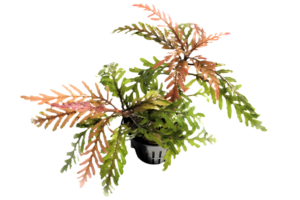
Hygrophila pinnatifida ‘UK’ is a local selection from western India, particularly the Uttara Kannada region. Morphologically, this plant features pinnatifid leaves with deeply indented margins and a relatively coarse texture compared to most stem plants.
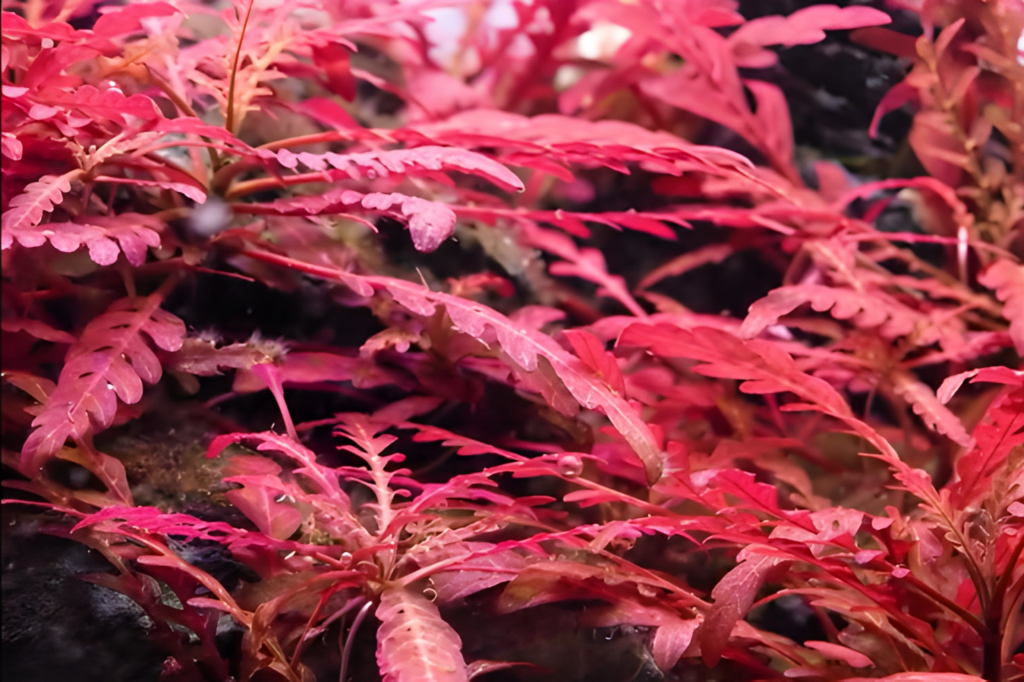
The primary distinguishing characteristic from the standard form lies in its color intensity. The ‘UK’ variant tends to display stronger and more consistent red pigmentation, especially under optimal lighting and nutrient conditions. The underside of the leaves typically shows a deep maroon color, while the upper surface can transition from dark green to reddish-brown tones.
In aquascaping, this plant is commonly used as a midground to background element to create contrast in both texture and color. Its fragmented leaf shape produces a more dynamic visual effect when combined with fine-leaved or small plants. In addition to being planted in the substrate, it can also grow attached to hardscape such as wood and rocks through adventitious roots.
Requirements and Care
Growth Characteristics
This plant grows vertically with active lateral branching, forming a semi-bushy structure. Under optimal conditions, side shoots appear consistently, resulting in a denser appearance.
Its response to light is very pronounced. At higher intensities, growth becomes more compact with shorter internodes. In lower light conditions, stems tend to elongate, leading to a looser structure.
Lighting
The lighting requirement falls within medium to high levels, with an intensity range of approximately 70–140 µmol m⁻² s⁻¹.
At the higher end of light intensity, red coloration becomes more dominant and color saturation increases significantly. Leaves also tend to be smaller and denser. Under medium conditions, the plant remains stable but displays more greenish-brown tones.
If light intensity is too low, the plant loses the characteristic red coloration of the “UK” variant, and growth becomes elongated with reduced density.
CO₂ and Carbon
Hygrophila pinnatifida ‘UK’ is classified as a medium CO₂-demand plant. It can survive without CO₂ injection, but visual performance and growth rate will be limited.
In systems with stable CO₂ injection, the plant shows increased branching, faster growth, and stronger red color expression. CO₂ stability becomes particularly important in high-light systems to maintain metabolic balance.
Nutrients
Nutrient requirements include both macro and micronutrients in balanced proportions. Nitrogen, phosphate, and potassium support vegetative growth, while micronutrients such as iron play a role in color pigmentation.
Nutrient deficiencies, especially potassium, may appear on older leaves as spots or small holes. Consistency in nutrient supply is more important than high-dose fluctuations.
Water Parameters
Hygrophila pinnatifida ‘UK’ is relatively tolerant of parameter variations as long as conditions remain stable. The ideal pH range is 6.0–7.5 with a temperature of 22–28 °C.
Moderate water hardness (GH 4–12 dGH; KH 3–8 dKH) supports proper nutrient uptake. Drastic fluctuations can cause stress and inhibit growth.
Substrate
This plant can grow well both in substrate and as an epiphyte. In nutrient-rich substrates, the root system develops more strongly and supports stable growth.
When used as an attached plant on hardscape, nutrient supply from the water column becomes the primary factor. Rough surfaces such as wood or stone help roots attach more effectively.
Propagation
Propagation is carried out through stem cuttings or separation of lateral shoots. Cut stems can be replanted directly into the substrate or attached to hardscape.
Naturally emerging side shoots can also be separated to produce new plants. This method is relatively stable and easy to apply in aquascaping.
Conclusion
Hygrophila pinnatifida ‘UK’ is a midground–background aquascape plant with strong visual character, particularly due to its more dominant red coloration compared to the standard variant. It performs optimally in high-tech systems with medium–high lighting and stable CO₂ supply, yet remains adaptable in low-tech setups with slower growth and greener tones.
With its unique leaf shape and contrasting coloration, this plant is highly effective for creating visual depth and accents in aquascape layouts, while remaining easy to manage through trimming and vegetative propagation.