Daftar Isi Show
| Characteristic | Detail |
|---|---|
| Genus | Bucephalandra |
| Species / Cultivar | Bucephalandra sp. ‘Blue Patroman’ |
| Family | Araceae |
| Plant Origin | Kalimantan, Indonesia (Endemic to Borneo) |
| Trade Name / Accession | Bucephalandra ‘Blue Patroman’ (Loss ID Trade Strain) |
| Light Requirements | Moderate to High (±50–150 µmol m⁻² s⁻¹ PAR) |
| Optimal Temperature | 24–27 °C (Highly Stable) |
| Growth Rate | Slow to Moderate |
| Planting Area | Foreground / Midground (Attached to Hardscape) |
| Leaf Size & Shape | Medium (2–4 cm), Thick Oval Shape |
| Ideal pH | 6.0–7.0 |
| Water Hardness | GH 6 – 8 dGH, KH 1- 4 dKH |
| CO₂ Requirements | Moderate to High (Stable Dissolved Injection) |
| Propagation Method | Rhizome Division |
Additional Information
Description and Morphology
Bucephalandra ‘Blue Patroman’ is an epiphytic chlorophyte from the Araceae family that originates from the tropical rainforest ecosystems of Kalimantan. Morphologically, this cultivar develops medium-sized leaves measuring approximately 2 to 4 cm in length, with symmetrical, oval-shaped laminae. The leaf cuticle is particularly thick, providing high mechanical resistance against water currents and physical disturbance from aquatic fauna. The upper surface of the leaf lamina is decorated with fine white spots, known as stomatic dots, which represent natural stomatal pores characteristic of the genus Bucephalandra. These structures produce a subtle pearlescent shimmer when exposed to aquarium lighting.
Color Dynamics and Structural Iridescence
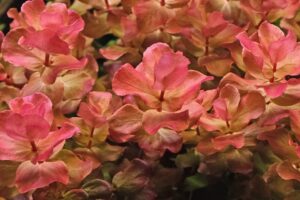
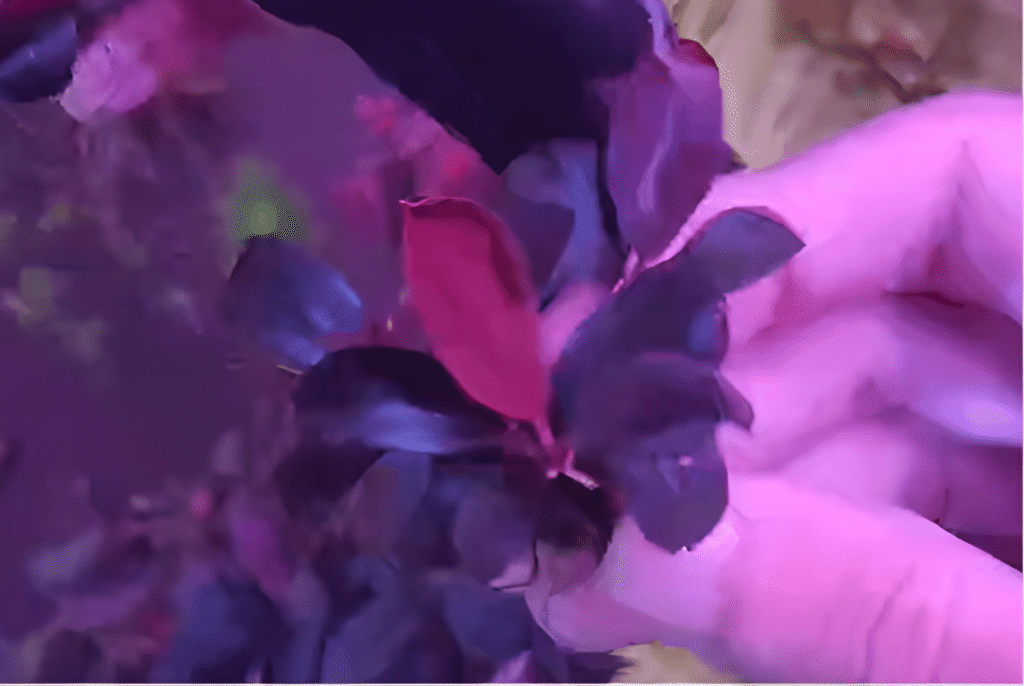
The primary appeal of Bucephalandra ‘Blue Patroman’ lies in its contrasting yet highly stable coloration. New shoots and emerging leaves develop in bright red to deep reddish-purple tones. As the tissues mature, these red pigments gradually shift toward a metallic blue coloration that remains persistent as the leaves mature. This metallic blue appearance is supported by structural iridescence within the epidermal cell layers, or iridophores, where microscopic refraction causes blue and violet wavelengths of light to be reflected. As a result, the coloration remains visually stable even when there are variations in the lighting spectrum.
Function and Aesthetics in Aquascaping
In aquatic landscape design, Bucephalandra ‘Blue Patroman’ is ideally positioned in the foreground to midground area. Its medium-sized oval leaves and pronounced leaf thickness create strong textural contrast when combined with natural rocks, driftwood, or carpets of fine green moss. The dual-color phenotype, with young leaves appearing red and mature leaves developing a metallic blue coloration, creates a dynamic gradient that enhances visual depth and functions as a natural focal point within the aquarium.
Origin, Natural Habitat in Kalimantan, and Acclimatization History
The natural habitat of Bucephalandra consists of basaltic and granite rocks along inland rivers in Kalimantan, where the plant grows as a rheophyte. The original accession of Bucephalandra ‘Blue Patroman’ was obtained from a wild collector in Kalimantan with its varietal identity lost, or loss ID, and without any living leaves. Only a bare rhizome remained.
The domestication and acclimatization process of this cultivar required a gradual three-phase transition that lasted approximately 1.5 years before reaching full phenotypic maturity.
The first phase began with the use of a humidity dome for one full month. A microenvironment with relative humidity maintained at approximately 95–100% stimulated latent growth points on the rhizome, encouraging the development of new shoots without exposing the tissues to dehydration. The second phase involved terrestrial emersed adaptation in a shaded area for one month. During this phase, the adventitious root system developed rapidly, while the rhizome accumulated internal nutrient reserves to strengthen its structure. The third phase consisted of submersion into a controlled aquarium system. A structured transition from emersed to submerged growth helped prevent the extensive melting that can frequently affect specimens transferred abruptly into fully submerged conditions.
Requirements and Care
Growth Characteristics
Bucephalandra ‘Blue Patroman’ exhibits a horizontal creeping growth pattern through its rhizome, which continuously produces anchoring roots. Its growth rate is considered slow to moderate, with new leaves developing approximately once every one to two weeks under optimal conditions. The cultivar demonstrates high morphological resilience, with no significant indication of leaf-size reduction, or stunting, or premature deterioration of mature leaves when biological conditions within the aquarium are properly maintained.
Lighting and Spectral Adaptation
This cultivar demonstrates remarkable phenotypic plasticity and spectral tolerance under various aquarium lighting technologies. Long-term cultivation observations indicate that its metallic blue coloration and leaf thickness remain consistently stable under different types of aquarium lighting fixtures.
| Spectrum / Lighting Type | Leaf Morphological Response | Color & Iridescence Response |
|---|---|---|
| HPL (High Power LED) | Thick leaves with controlled medium size | Stable metallic blue coloration develops |
| Kandila SNEW | Stable leaf size and internode structure | Metallic blue coloration remains consistent |
| Chihiros WRGB 2 Pro | Larger leaves with more vigorous vegetative growth | Deeper metallic blue shimmer with vivid red young leaves |
Full-spectrum lighting with moderate to high PAR levels, approximately 50–150 µmol m⁻² s⁻¹, can increase photosynthetic activity without causing color fading. The balanced availability of red and blue wavelengths in WRGB lighting systems has been shown to optimize the development of protective pigments while increasing the leaf lamina surface area.
CO₂ and Carbon
Although Bucephalandra can survive in aquariums without supplemental carbon, or in low-tech setups, a stable supply of dissolved carbon dioxide at a concentration of approximately 20–30 mg/L is highly recommended for Bucephalandra ‘Blue Patroman’. Consistent CO₂ injection promotes rhizome cell division, supports the development of thicker leaf wax layers, and helps reduce the potential for black algae attachment on mature leaves.
Nutrients
As an epiphytic plant, Bucephalandra efficiently absorbs nutrients directly from the water column through its leaves and hanging roots. Regular liquid fertilization containing macronutrients such as Nitrogen, Phosphorus, and Potassium, together with essential micronutrients, is highly beneficial. Adequate levels of Iron (Fe) and Magnesium (Mg) are particularly important because they are directly involved in the synthesis of anthocyanins, which contribute to the red coloration of young leaves and help maintain chloroplast structures associated with iridescence.
Water Parameters
Stable and relatively cool water conditions are among the most important factors in preventing rhizome rot. Bucephalandra ‘Blue Patroman’ demonstrates its best growth performance within the following range of water parameters.
The water temperature should be maintained consistently between 24 and 27 °C, which provides an optimal range for enzymatic reactions in tropical rheophytic plants. Water acidity, or pH, should remain between 6.0 and 7.0, ranging from slightly acidic to neutral conditions, helping maintain the availability of micronutrients in the water. General Hardness (GH) at approximately 6 – 8 dGH provides sufficient Calcium and Magnesium cations to support the development of thick leaf cell walls. Carbonate Hardness (KH) at approximately 1- 4 dKH provides an ideal buffering capacity against pH fluctuations caused by CO₂ injection.
Substrate
Bucephalandra ‘Blue Patroman’ should never be planted by burying its rhizome in active substrate, aquasoil, sand, or gravel. Submerging the rhizome beneath the substrate can restrict oxygen circulation through the meristematic tissues and trigger anaerobic decomposition.
The correct method is to attach the rhizome directly to a hardscape surface, such as Lava Rock, Seiryu Stone, or driftwood. Attachment can be achieved using a cyanoacrylate-based gel adhesive, temporarily securing the plant with cotton thread or fishing line, or positioning the rhizome within gaps in the rockwork where moderate water flow can reach it. Adventitious roots will naturally develop and grip the hardscape within approximately 2 to 4 weeks.
Propagation
Bucephalandra ‘Blue Patroman’ is propagated through rhizome division. The rhizome should be divided using a sterile knife or pair of plant scissors once the parent section has developed at least 6–8 mature leaves. Each new rhizome division should retain at least 3–4 active leaves together with several adventitious root branches. The divided rhizome can then be attached to a new hardscape, where new lateral growth points will regenerate the plant canopy within approximately 2 to 3 weeks.
Conclusion
Bucephalandra ‘Blue Patroman’ is an exotic rheophytic cultivar from Kalimantan that combines distinctive visual characteristics with exceptional physiological resilience. Through a gradual acclimatization process from a bare rhizome to full submerged adaptation over approximately 1.5 years, this plant has demonstrated a highly stable phenotype. Its medium-sized oval leaves, thick lamina texture, and color transition from young red foliage to persistent metallic blue mature leaves make it a premium collector’s plant.
With stable water parameters of pH 6–7, GH 6 – 8 dGH, KH 1- 4 dKH, and a temperature of 24–27 °C, combined with CO₂ supplementation and full-spectrum lighting, Bucephalandra ‘Blue Patroman’ is an excellent choice for creating a distinctive and visually sophisticated focal point in a planted aquarium.