Daftar Isi Show
| Characteristic | Detail |
|---|---|
| Genus | Syngonanthus |
| Species | Syngonanthus cf. inundatus |
| Family | Eriocaulaceae |
| Origin | South America (Amazon Basin, Brazil) |
| Common Name | Manaus Syngonanthus, Tonina sp. ‘Manaus’ |
| Light Requirement | High (±90–150 µmol m⁻² s⁻¹ / PAR) |
| Optimal Temperature | 22–26 °C |
| Growth Rate | Moderate |
| Placement | Midground – Background |
| Plant Height | ±10–25 cm |
| Ideal pH | 4.5–6.5 |
| Water Hardness | GH 1–5 dGH; KH 0–2 dKH |
| CO₂ Requirement | High |
| Propagation | Top cutting |
Additional Information
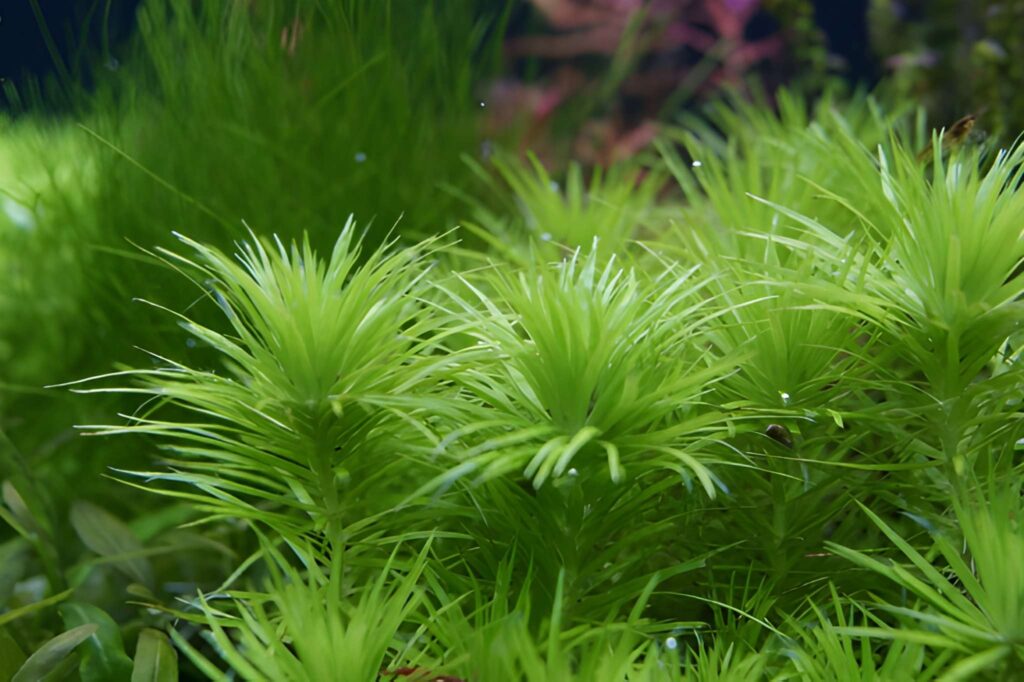
Syngonanthus cf. inundatus is a stem plant from the Eriocaulaceae family, recognized for its distinctive radial crown structure at the apical tip. The leaves are linear to lanceolate and arranged in a dense spiral along the stem, forming a symmetrical and geometrically stable appearance under optimal conditions.
The leaf coloration is typically bright light green with a slight translucency, especially in newly developed tissue. Under high lighting, the crown expands significantly, creating strong visual contrast when placed alongside darker or finer-textured plants.
Its natural habitat is associated with blackwater systems in the Amazon Basin, characterized by extremely soft water, acidic pH, and high concentrations of dissolved organic acids. This ecological background explains its strong dependency on dissolved carbon dioxide as the primary carbon source.
In aquascaping layouts, this species is commonly positioned in the midground to background. Its consistent radial form makes it suitable for creating visual rhythm, perspective lines, and structured focal accents within controlled compositions.
Care and Requirements
Growth Characteristics
This species exhibits vertical growth with a clearly defined stem and an active apical meristem. Growth is primarily linear, with minimal lateral branching, meaning the overall form is heavily dependent on the health of the top section.
Light response is highly pronounced. Under high light conditions, the plant develops a dense rosette with tightly arranged leaves. In lower light environments, etiolation occurs, resulting in elongated stems and reduced crown density.
The lower stem section is particularly sensitive to shading and may deteriorate if light distribution is insufficient.
Lighting
Category: high (±90–150 µmol m⁻² s⁻¹ / PAR)
High-intensity lighting is essential for maintaining structural integrity. Adequate PAR levels promote the formation of a broad, dense, and symmetrical crown.
Below optimal levels, the plant typically shows reduced structural quality, including elongated internodes, smaller crown formation, and loss of radial definition. Even light distribution down to the lower sections is critical to prevent bare stems.
CO₂ and Carbon
Category: high
This species does not perform reliably without CO₂ injection. Its dependency on dissolved carbon dioxide is significant due to the lack of alternative carbon utilization pathways.
In high-tech systems with stable CO₂ levels (±20–40 mg/L), the plant demonstrates consistent and healthy growth. Fluctuations in CO₂ often result in apical damage, including melting and growth stagnation.
Stability in CO₂ delivery is more critical than simply increasing concentration.
Nutrition
Nutrient demand is relatively high and must be maintained in balance. Under high light conditions, macronutrient uptake increases, particularly nitrogen, phosphorus, and potassium.
Iron plays a critical role in maintaining the bright green coloration of the crown. Deficiency typically appears as chlorosis in newly formed leaves.
Micronutrient availability must remain stable, especially in soft water conditions where buffering capacity is limited.
Water Parameters
This plant has a narrow tolerance range and is highly sensitive to parameter fluctuations.
Optimal conditions include pH 4.5–6.5, GH 1–5 dGH, and KH 0–2 dKH, with temperatures between 22–26 °C. Elevated KH levels are commonly associated with growth inhibition and tissue degradation.
Parameter stability is the primary factor for long-term success, particularly in CO₂-injected systems.
Substrate
The use of active substrate is strongly recommended. Such substrates help maintain acidic conditions and improve micronutrient availability.
The root system is relatively delicate, requiring a substrate that allows penetration without excessive compaction. A stable substrate environment contributes significantly to consistent growth.
Propagation
Propagation is performed through top cutting, where a healthy apical section is trimmed and replanted. This method is more effective than maintaining the lower portion, which often deteriorates over time.
Cuts should be made with sharp tools to preserve tissue integrity. Proper spacing between plants is necessary to ensure adequate light distribution and water circulation.
Conclusion
Syngonanthus cf. inundatus is a high-precision aquascape plant that demands stable water parameters, intense lighting, and consistent CO₂ injection. Its radial crown structure provides strong aesthetic value and functions as a structural element within aquascape layouts.
This species is best suited for high-tech systems with tight environmental control. Under optimal conditions, it delivers a clean, symmetrical appearance and serves as a strong focal point in well-designed aquariums.