Daftar Isi Show
| Characteristic | Detail |
|---|---|
| Genus | Syngonanthus |
| Species | Syngonanthus sp. ‘Vichada’ |
| Family | Eriocaulaceae |
| Origin | Vichada Department, Colombia, South America |
| Common Name | Syngonanthus Vichada |
| Lighting Requirement | High (±90–160 µmol m⁻² s⁻¹ / PAR) |
| Optimal Temperature | 22–26 °C |
| Growth Rate | Slow |
| Placement | Foreground to midground |
| Plant Height | 3–10 cm |
| Ideal pH | 4.5–6.0 |
| Water Hardness | 0–5 dGH and 0–2 dKH |
| CO₂ Requirement | High |
| Propagation | Lateral shoots |
Additional Information
Syngonanthus sp. ‘Vichada’ represents a significant benchmark in modern aquascaping, particularly among plant species that demand a high level of technical precision. As a member of the Eriocaulaceae family, this species exhibits the physiological complexity commonly associated with pipewort plants, yet with a more rigid and architectural morphology compared to related variants from regions such as Manaus or Belem. From an ecological standpoint, this genus is recognized as a specialist of oligotrophic waters, relying heavily on chemical stability.
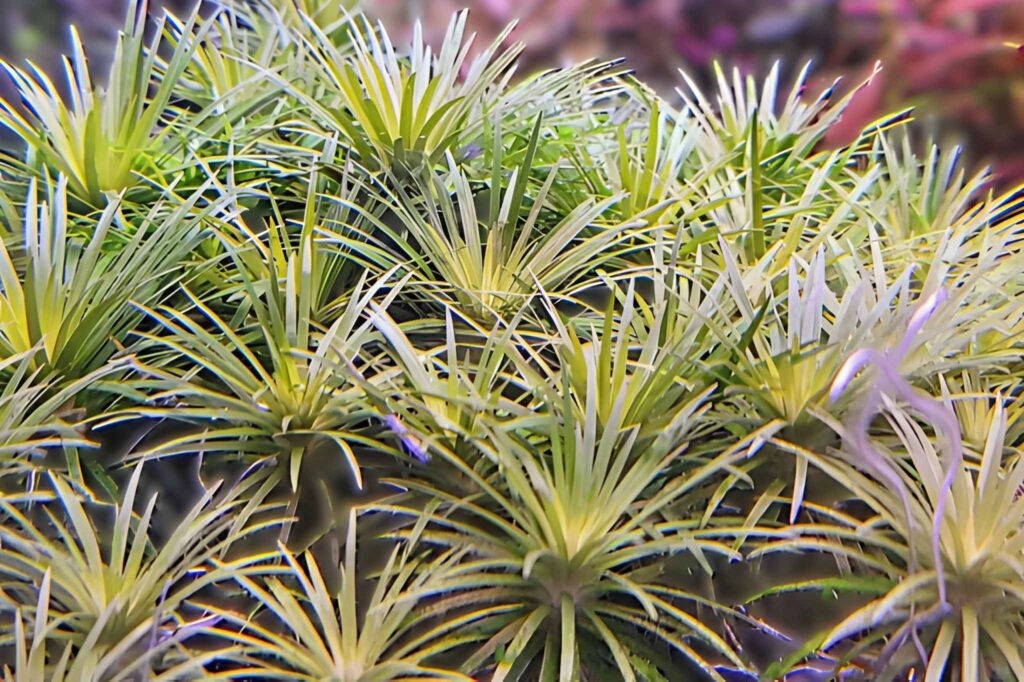
Visually, this variety displays a highly distinctive structure. Its stem is notably rigid, providing mechanical strength that supports adaptation to fluctuating seasonal currents in its native habitat. The leaves are short, bright green, and arranged densely in a radial pattern, forming a compact rosette with a strong geometric appearance. This structure is often compared to a miniature palm or pineapple crown emerging from the substrate, making it highly effective as a contrasting element against fine-leaved plants.
Its natural habitat is located in eastern Colombia, specifically within the Vichada Department, part of the Orinoquia region. The waters here are predominantly blackwater systems characterized by extremely low mineral content, acidic conditions, and high concentrations of tannins that give the water a dark coloration while remaining clear. Adaptation to these conditions has resulted in a strict softwater dependency and a high sensitivity to carbonate presence.
In aquascape layouts, this plant is typically positioned in the foreground to midground. Its slow growth and compact structure make it suitable for group planting to create the impression of dense miniature vegetation. Due to its sensitivity to parameter fluctuations, it is often regarded by experienced aquascapers as an indicator of system stability.
Requirements and Care
Maintaining Syngonanthus sp. ‘Vichada’ requires a highly consistent approach across all system parameters. Lighting, carbon supplementation, and water chemistry must remain stable. Even minor fluctuations, particularly in hardness, can lead to physiological stress that directly affects plant tissue integrity.
Growth Characteristics
The growth pattern is vertical with a slow development rate. The rigid stem provides strong structural integrity, allowing the plant to remain upright even under moderate water flow. Leaves emerge tightly from the central growth point, forming a dense and compact crown.
Environmental conditions strongly influence crown structure. Under optimal conditions, the plant develops a tightly packed rosette with minimal spacing between leaves. In cases of nutrient deficiency or insufficient light, the structure becomes elongated, reducing its visual density. The plant also develops an extensive white root system that functions as the primary nutrient absorption organ in nutrient-poor environments.
Lighting
The lighting requirement falls within the high category, with a PAR range of approximately 90 to 160 µmol m⁻² s⁻¹ at the substrate level. This intensity is necessary to support efficient photosynthesis in a plant with inherently slow metabolism.
Under insufficient lighting, growth will cease and the plant loses its compact structure. Adequate lighting maintains bright green coloration and preserves the tight rosette form. A photoperiod of 8 to 10 hours per day with a stable spectrum is generally applied. High light intensity also increases the risk of algae development, requiring precise nutrient balance.
CO₂ and Carbon
This species has a high carbon demand and cannot be sustained without CO₂ injection. A stable dissolved CO₂ concentration, typically at or above 30 mg/L, is essential for maintaining growth.
Fluctuations in CO₂ levels, particularly at the onset of the photoperiod, can induce physiological stress that leads to damage at the growth point. In non-CO₂ systems, the plant is unable to survive long term and will gradually deteriorate.
Nutrients
Nutrient availability must be maintained consistently through both the water column and substrate. Micronutrients, especially iron, play a critical role in maintaining leaf coloration and tissue health.
Macronutrients such as nitrate and potassium are also required in balanced amounts to support metabolic functions. The plant’s developed root system allows efficient nutrient uptake from the substrate, making a combined nutrient strategy the most stable approach.
Water Parameters
Water parameters are the most critical factor for successful cultivation. This species thrives only in softwater conditions with extremely low carbonate levels. The ideal KH range is 0 to 2 dKH, where significant increases can lead to tissue damage.
General hardness should be maintained at low to moderate levels, around 0 to 5 dGH, to ensure the availability of essential ions without disrupting osmotic balance. The ideal pH range is acidic, between 4.5 and 6.0, supporting micronutrient availability. Temperature should remain stable between 22 and 26 °C to maintain equilibrium between respiration and photosynthesis.
Substrate
An active substrate with pH-lowering properties is essential. Clay-based substrates provide a stable acidic environment for root development and support nutrient availability.
The cation exchange capacity of active substrates helps retain micronutrients in a form accessible to the plant. Adequate substrate depth is necessary to support the developing root system. Inert materials such as sand or gravel do not provide sufficient nutritional support for this species.
Propagation
Propagation is achieved through the separation of lateral shoots that develop from the parent plant. Due to the rigid stem structure, a sharp tool is required to prevent tissue damage during separation.
Once separated, the shoots can be directly replanted into active substrate. The adaptation phase is relatively slow, requiring strict environmental stability until new growth is established.
Conclusion
Syngonanthus sp. ‘Vichada’ is an aquascape plant with a strong visual identity, characterized by a compact rosette resembling a miniature palm. Its placement in the foreground to midground provides significant textural contrast within a layout.
This species is best suited for high tech systems with high-intensity lighting, stable CO₂ injection, and consistently maintained softwater parameters. Its aesthetic value is considerable, but successful cultivation depends entirely on maintaining low KH levels, adequate light intensity, and stable carbon availability over time.