Daftar Isi Show
| Characteristic | Detail |
| Genus | Syngonanthus |
| Species | Syngonanthus macrocaulon |
| Family | Eriocaulaceae |
| Origin | South America (Amazon Basin, Brazil) |
| Common Name | White Stripes Hatpin, Variegated Belem |
| Light Requirement | High to very high (±120–300 µmol m⁻² s⁻¹ / PAR) |
| Optimal Temperature | 22–28 °C |
| Growth Rate | Slow to moderate |
| Placement | Midground / Background |
| Plant Height | 10–30 cm |
| Ideal pH | 4.5–6.5 |
| Water Hardness | GH 1–5 dGH; KH 0–2 dKH |
| CO₂ Requirement | High |
| Propagation | Stem cuttings |
Additional Information
Syngonanthus macrocaulon ‘White Stripes’ is a variegated cultivar of Syngonanthus macrocaulon, belonging to the Eriocaulaceae family, a group of aquatic plants recognized for their pin-like inflorescences with rounded tips. In modern aquascaping, this plant occupies a highly specialized niche as a premium specimen requiring tightly controlled environmental parameters.
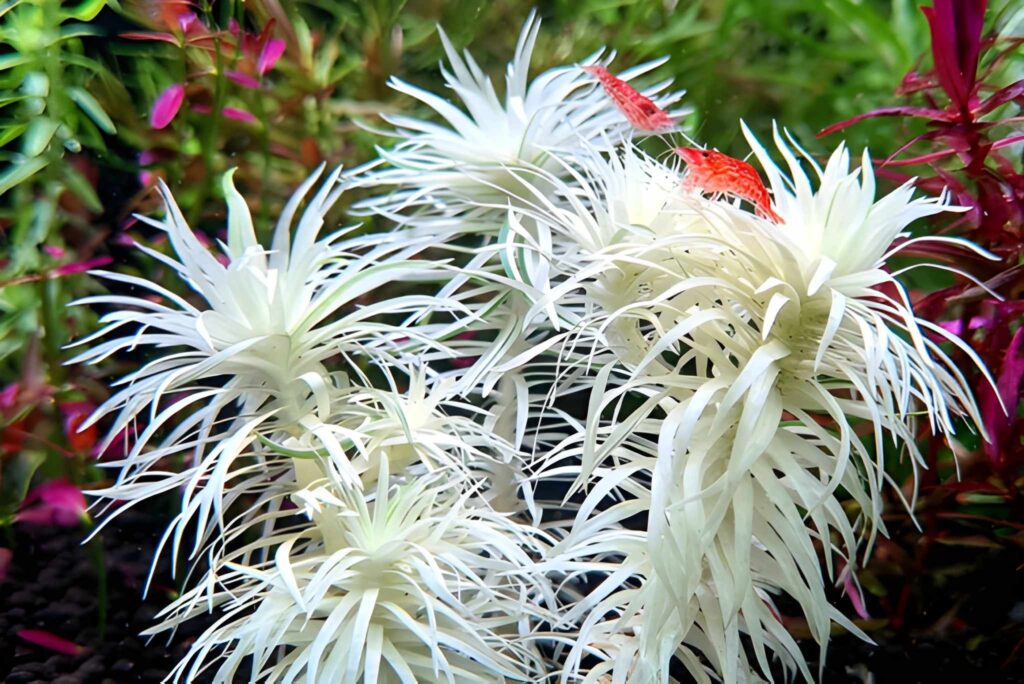
Morphologically, it exhibits a vertical growth pattern with whorled leaf arrangements along the stem. The leaves are linear, fine-textured, and characteristically curved downward at the tips, forming a crown-like structure reminiscent of miniature palm canopies. Its defining feature is the presence of longitudinal white striping contrasted against bright green tissue. This variegation is chimeric in nature, resulting from partial loss of functional chlorophyll in specific cellular layers.
Within aquascape layouts, this species is typically positioned in the midground to background as a focal element. Its crown-like architecture introduces strong textural contrast when combined with broadleaf plants or carpeting species. When planted in small groups, it creates a cohesive visual effect resembling dense clusters of miniature palms.
Its natural habitat consists of Amazonian blackwater systems characterized by extremely soft, acidic water with low carbonate content. These environments are rich in dissolved organic compounds such as humic substances, yet exhibit very low mineral conductivity. This ecological background explains its pronounced sensitivity to water chemistry in aquarium conditions, particularly to carbonate hardness.
Care and Requirements
Growth Characteristics
This plant demonstrates a consistent vertical growth habit with the ability to produce lateral shoots from stem nodes. Growth rate is relatively slow, largely due to the reduced photosynthetic capacity of variegated tissues.
Its response to light intensity and carbon availability is directly reflected in internode spacing. Under optimal conditions, nodes remain compact, producing a dense and well-formed crown. In insufficient lighting, the plant exhibits elongation, resulting in sparse leaf distribution and loss of structural compactness.
A notable physiological challenge is its tendency toward reversion to solid green form. Non-variegated shoots grow more vigorously and may dominate if not controlled through selective pruning.
Lighting
Lighting requirements fall within the high to very high category, ranging approximately from 120 to 300 µmol m⁻² s⁻¹. Elevated light intensity is necessary to compensate for the reduced photosynthetic efficiency of white tissues.
At the lower threshold, growth remains viable but less compact, with diminished variegation contrast. Under stable high-intensity lighting, the crown becomes denser, white striping appears more pronounced, and lateral shoot production increases.
Insufficient light leads to etiolation, while excessive intensity without system stability may induce photoinhibition and tissue damage.
CO₂ and Carbon
This species has a high demand for CO₂ and relies heavily on dissolved CO₂ injection. Its ability to utilize bicarbonate is extremely limited, making free CO₂ the primary carbon source.
A stable concentration in the range of 25–40 mg/L is required to sustain metabolic processes. Fluctuations in CO₂ levels are a primary cause of growth disruption, particularly affecting apical meristems.
In non-CO₂ systems, long-term viability is generally not achievable.
Nutrients
Nutrient management should focus on a balanced supply of macro and micronutrients. Nitrogen, phosphorus, and potassium support vegetative growth, while trace elements such as iron and magnesium are critical for maintaining photosynthetic efficiency in green tissues.
Iron plays a key role in preserving color contrast. Deficiency results in chlorosis of green areas, reducing visual distinction between variegated zones.
A stable and consistent dosing strategy is preferable over irregular or excessive nutrient input.
Water Parameters
Parameter stability is critical. The plant requires acidic conditions with a pH range of 4.5–6.5 and extremely low carbonate hardness, ideally within 0–2 dKH.
General hardness should remain low but sufficient to provide essential calcium and magnesium. Imbalances may result in stunted growth or leaf deformation.
Optimal temperature ranges between 22–28 °C. Elevated temperatures increase physiological stress and may accelerate tissue degradation.
Substrate
An active substrate such as aquasoil is strongly recommended. This type of substrate helps maintain acidic conditions while supplying nutrients to the root system.
The substrate structure should allow adequate water and oxygen circulation within the root zone. Inert media such as sand or gravel do not provide the chemical support required for optimal development.
Propagation
Propagation is performed through stem cuttings. Healthy apical sections are trimmed and replanted into the substrate to establish new individuals.
Remaining stem bases typically produce lateral shoots over time. Consistent selection for variegation is necessary to prevent dominance of reverted green growth.
Conclusion
Syngonanthus macrocaulon ‘White Stripes’ is a highly demanding aquascape plant that requires precise environmental control. Its distinctive crown structure and striking white variegation make it a powerful focal element in midground to background compositions.
This species is best suited for high-tech systems where lighting, CO₂, and soft water parameters can be tightly regulated. Under optimal conditions, it delivers a level of texture and visual refinement rarely matched by other aquatic plants, reflecting a high degree of technical proficiency in aquascaping practice.