
Daftar Isi Show
| Characteristic | Detail |
| Genus | Rotala |
| Species | Rotala sp. (not formally identified) |
| Family | Lythraceae |
| Origin | Southeast Asia (cultivated selection variety) |
| Common Name | Rotala BSD |
| Light Requirement | Medium – High (±70–150 µmol m⁻² s⁻¹ / PAR) |
| Optimal Temperature | 22–28 °C |
| Growth Rate | Fast |
| Placement | Midground – Background |
| Plant Height | 20–45 cm |
| Ideal pH | 5.5–7.0 |
| Water Hardness | GH 2–8 dGH; KH 0–4 dKH |
| CO₂ Requirement | Medium – High |
| Propagation | Stem cutting |
Additional Information
Rotala sp. ‘BSD’ is a selected cultivated variety of Rotala popular among aquascapers. Its exact species identity has not been formally published in botanical taxonomy, which is why it retains the placeholder designation Rotala sp.
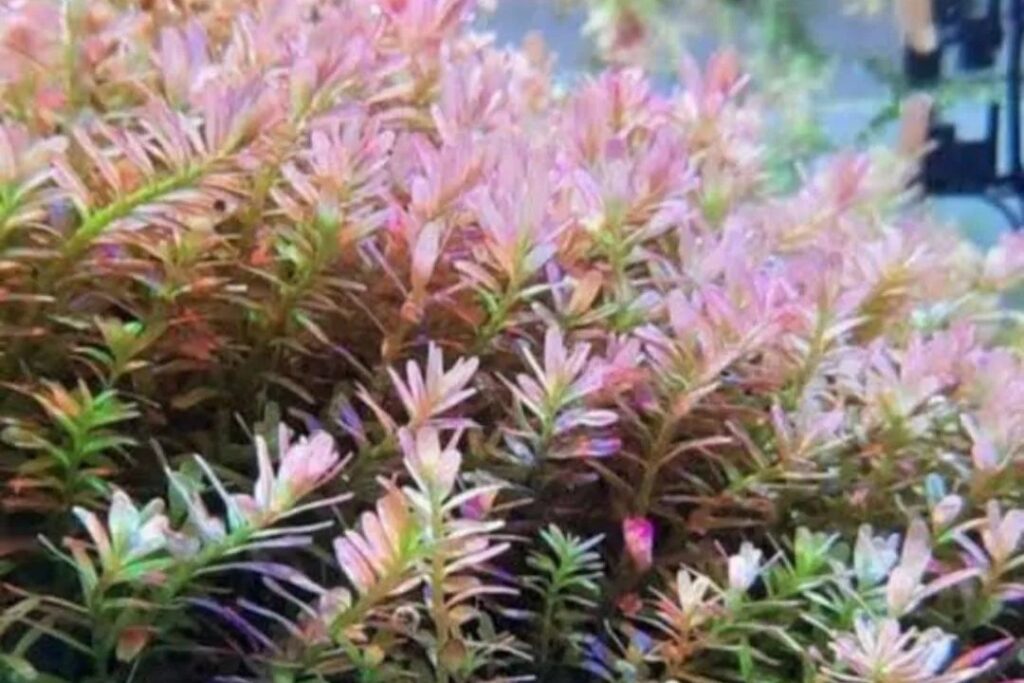
Morphologically, the plant features slender stems lined with small, narrow lanceolate to oval leaves. Under optimal conditions, the top shoots develop reddish-orange to bright red hues, while the lower stem sections maintain a yellowish-green tone. Internodes stay relatively tight under strong lighting, producing a dense, high-contrast plant mass.
In aquascape layouts, Rotala sp. ‘BSD’ is commonly used as a color accent in midground to background areas. Its flexible stems and excellent response to trimming make it ideal for shaping compact bushes or creating smooth color transitions behind hardscape structures.
The natural habitats of the genus Rotala generally consist of wetlands, marshes, and riverbanks across tropical Asia, characterized by soft, slightly acidic water and relatively high sunlight exposure.
Care and Requirements
Growth Characteristics
Rotala sp. ‘BSD’ is a fast-growing aquatic stem plant with an upright growth habit. Lateral shoots emerge from stem nodes after pruning, making routine trimming necessary to maintain cluster density and overall shape. Under low light, stems stretch with wider internodal spacing and pale coloration. Under medium to high light with steady CO₂ injection, growth stays compact and foliage coloration becomes noticeably richer.
Lighting
Lighting requirements fall into the medium to high category, with an ideal PAR range of 70 to 150 µmol m⁻² s⁻¹ at leaf level. Below 60 µmol m⁻² s⁻¹ PAR, red pigmentation fails to express and foliage stays predominantly green. Above 100 µmol m⁻² s⁻¹ PAR with balanced nutrients and CO₂, the top shoots display distinct reddish-orange coloration and tighter branching. Very high light intensity above 150 µmol m⁻² s⁻¹ PAR produces even sharper red tones, though it requires precise carbon and nutrient management to maintain ecosystem stability.
CO₂ and Carbon
Carbon requirements are classified as medium to high. While the plant can survive without injected CO₂, its growth rate slows down, internodes stretch, and leaf color remains dull. In high-tech aquariums with stable CO₂ injection at 20 to 30 ppm, it demonstrates rapid growth, prolific branching, and vibrant color expression. Fluctuations in carbon levels often lead to stunted top shoots or minor leaf deformities.
Nutrition
As a fast-growing stem plant, Rotala sp. ‘BSD’ requires a consistent supply of macronutrients including nitrate, phosphate, and potassium, along with micronutrients—especially iron—to support pigment development. Nitrogen deficiency results in small, pale foliage, while a lack of micronutrients causes faded shoot coloration. A balanced, steady nutrient supply is far more critical than heavy dosing.
Water Parameters
The ideal pH range is 5.5 to 7.0, with long-term stability serving as the primary success factor. Soft to moderately hard water parameters between 2 and 8 dGH and 0 to 4 dKH support optimal nutrient uptake, whereas overly hard water can delay acclimation and dull foliage colors. Optimal temperatures range between 22 and 28 °C, as prolonged high temperatures accelerate metabolic rates while reducing overall system stability margins.
Substrate
This plant thrives in both inert substrate and active nutrient soil. A nutrient-rich substrate assists early establishment and fosters stronger root anchorage. As a stem plant, its primary nutrient uptake occurs through the water column, with roots serving mainly to anchor the stems in the substrate bed.
Propagation
Propagation is easily carried out using standard stem cuttings. Healthy terminal shoots measuring 5 to 10 cm in length can be trimmed and replanted with adequate spacing so light penetrates to the lower stem sections. Regular pruning stimulates lateral branching to form a denser plant mass over time.
Conclusion
Rotala sp. ‘BSD’ is a colorful aquatic stem plant valued for its rapid growth rate and positive response to trimming. Requiring medium to high light and CO₂, it reaches peak performance in high-tech aquariums while remaining adaptable to bright low-tech setups. Its reddish-orange foliage and fine stem architecture make it an effective visual element for midground to background placement, particularly in aquascape layouts designed around dynamic color contrast.


