Daftar Isi Show
| Characteristic | Detail |
| Genus | Rotala |
| Species | Rotala rotundifolia |
| Family | Lythraceae |
| Origin | Southeast Asia (Vietnam) |
| Common Name | Rotala H’ra |
| Light Requirement | Medium – High (±80–150 µmol m⁻² s⁻¹ / PAR) |
| Optimal Temperature | 22–28 °C |
| Growth Rate | Fast |
| Placement | Midground – Background |
| Plant Height | 20–50 cm |
| Ideal pH | 5.5–7.0 |
| Water Hardness | GH 2–10 dGH; KH 0–6 dKH |
| CO₂ Requirement | Medium – High |
| Propagation | Stem cutting |
Additional Information
Rotala rotundifolia ‘H’ra’ is a selected geographic color variant of Rotala rotundifolia, highly prized for displaying far more intense orange-red foliage than the standard green form of the species. The name ‘H’ra’ refers to a district in Vietnam where this particular variant was first collected and popularized within the aquascaping community.
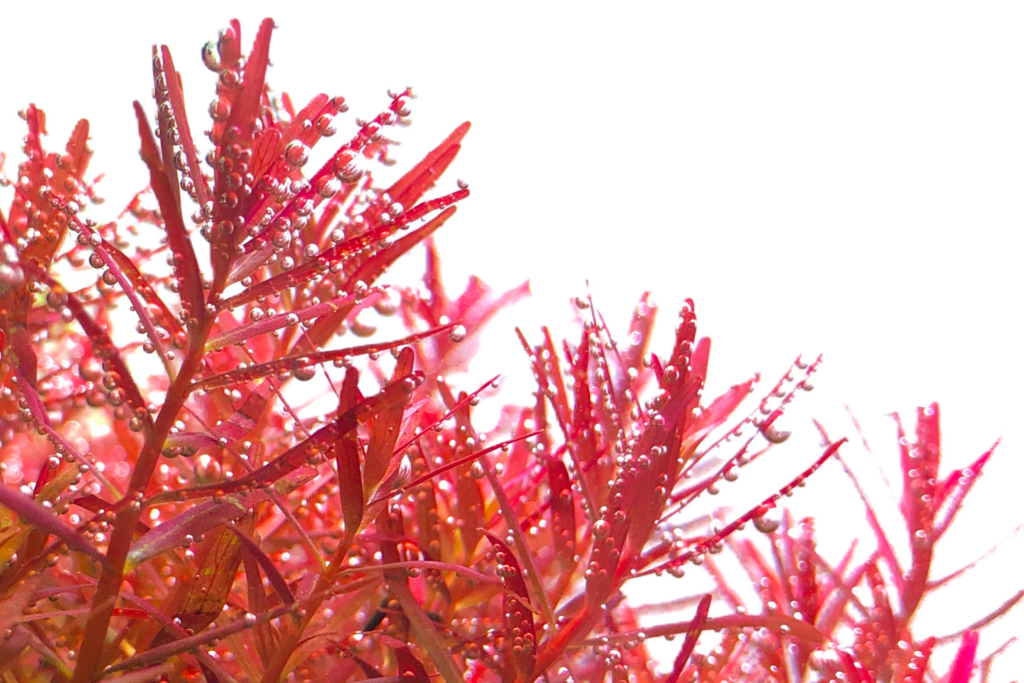
Morphologically, the plant features slender stems lined with small, oval to narrow lanceolate leaves. Under strong lighting conditions and consistent carbon availability, the upper shoot tips develop a vivid bright red to intense fiery orange coloration. Internodes stay noticeably tighter compared to regular Rotala rotundifolia when provided with sufficient light energy.
In aquascaping compositions, Rotala rotundifolia ‘H’ra’ serves as a high-impact color accent across midground and background zones. It is exceptionally effective for creating sharp visual contrast against green foliage and building smooth color gradients in both Nature Style and Dutch Style layouts.
The natural habitat of the parent species Rotala rotundifolia includes riverbanks, flooded rice paddies, and shallow seasonal marshes characterized by fluctuating water levels and soft, slightly acidic water parameters.
Care and Requirements
Growth Characteristics
As a stem plant, Rotala rotundifolia ‘H’ra’ grows vertically at a rapid pace. Following a trim, lateral shoots emerge generously from lower stem nodes to build dense, bushy clusters. Without regular pruning, stems grow tall and lower sections begin shedding leaves due to shading from upper foliage. Routine trimming preserves cluster density and maintains proper proportions within the layout.
Lighting
Lighting requirements fall into the medium to high range, with an optimal PAR level of 80 to 150 µmol m⁻² s⁻¹ at leaf level. Within the 80 to 100 µmol m⁻² s⁻¹ PAR range, foliage begins transitioning from green to a warm reddish-orange. Pushing intensity above 110 to 120 µmol m⁻² s⁻¹ PAR alongside steady nutrients and CO₂ yields vivid red coloration and shorter internodal spacing. Lighting levels below 70 µmol m⁻² s⁻¹ PAR cause the plant to remain predominantly green and grow leggy.
CO₂ and Carbon
Carbon demand falls into the medium to high category. While Rotala rotundifolia ‘H’ra’ can survive in non-CO₂ injected aquariums, red color saturation remains muted and growth forms become noticeably loose. In high-tech aquariums equipped with stable CO₂ injection at 20 to 30 ppm, growth speeds up, branching becomes prolific, and coloration stays consistent. Fluctuating carbon levels often cause shoot tips to stunt or shrink.
Nutrition
As a fast-growing stem plant, macronutrient consumption is relatively high. Maintaining adequate nitrate levels supports leaf size and growth stability. Micronutrients, especially iron, play an essential role in synthesizing red pigments across new growth. Nutrient imbalances usually present as pale shoot tips or stunted metabolic rates.
Water Parameters
The ideal pH range is 5.5 to 7.0, where long-term parameter stability is far more critical than targeting a rigid number. Soft to moderately hard water conditions between 2 and 10 dGH and 0 to 6 dKH are well tolerated, though excessively hard water can reduce color brilliance. Optimal temperatures range between 22 and 28 °C, as temperatures nearing 30 °C accelerate metabolic rates while reducing system stability margins.
Substrate
This plant thrives in both inert gravel and active nutrient soil. A nutrient-rich substrate aids early establishment and speeds up root development following planting. However, because it absorbs a large portion of its nutrients directly through its foliage from the water column, consistent liquid fertilization remains important for top performance.
Propagation
Propagation is easily accomplished using standard stem cuttings. Healthy terminal shoots measuring 5 to 10 cm in length can be trimmed and replanted directly into the substrate. Regular pruning stimulates abundant lateral branching, allowing aquascapers to shape dense, well-proportioned plant groups that fit specific layout designs.
Conclusion
Rotala rotundifolia ‘H’ra’ is a fast-growing, colorful aquatic stem plant that responds exceptionally well to routine trimming. Ideally suited for midground to background placement, it provides a vivid orange-red contrast in any layout. Requiring medium to high light and CO₂, it reaches peak color and density in high-tech aquariums while remaining remarkably adaptable to bright low-tech setups. Its main appeal lies in its intense pigmentation, fine texture, and effortless ability to form neat, dense plant masses.