Daftar Isi Show
| Characteristics | Detail |
|---|---|
| Genus | Ludwigia |
| Species | Ludwigia inclinata |
| Family | Onagraceae |
| Origin | South America |
| Common Name | Ludwigia Twister, Ludwigia Tornado |
| Light Requirement | High (±90–150+ µmol m⁻² s⁻¹ / PAR) |
| Optimal Temperature | 22–28 °C |
| Growth Rate | Moderate |
| Placement | Midground – Background |
| Plant Height | 20–50 cm |
| Ideal pH | 5.5–7.0 |
| Water Hardness | GH 2–8 dGH; KH 0–4 dKH |
| CO₂ Requirement | High |
| Propagation Method | Stem cuttings |
Additional Information
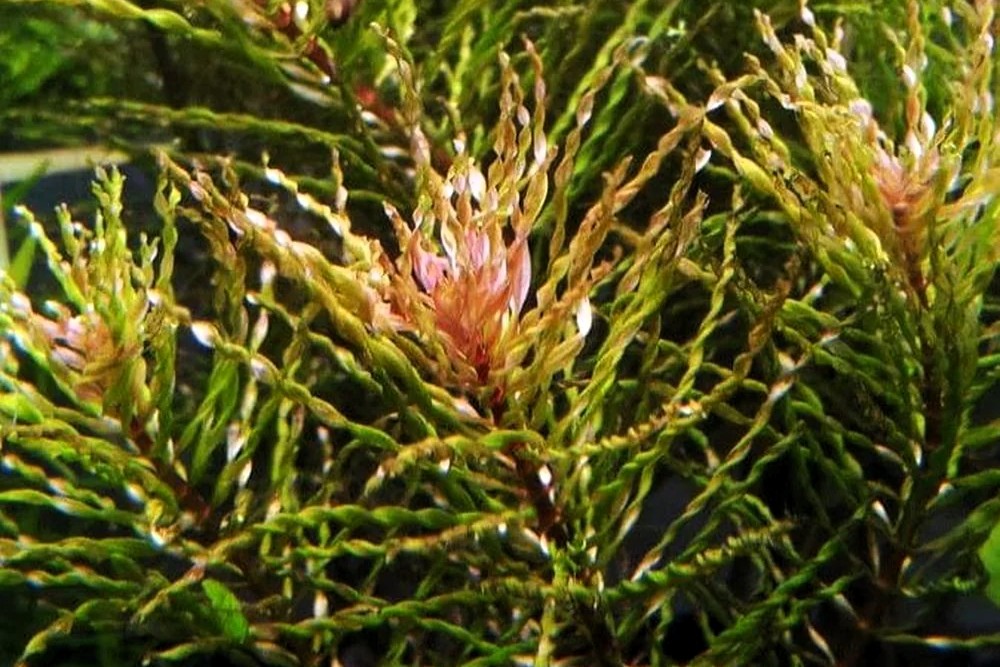
Ludwigia inclinata var. verticillata ‘Twister’, commonly known as Ludwigia Tornado, is one of the most morphologically unique Ludwigia variants used in aquascaping. Its defining characteristic is the twisted and spiraling leaves along the stem, creating a visual effect resembling a vortex or “tornado.”
This distorted leaf structure is not caused by stress but is a genetic trait of the variant. Leaf coloration ranges from yellowish green to red-orange depending on light intensity and nutrient availability, particularly iron.
In aquascape layouts, this plant is often used as a focal point in the midground to background area. Its asymmetrical and dynamic form contrasts strongly with conventional straight-growing stem plants, providing a bold and artistic visual dimension.
Its natural habitat is in tropical South American waters with slow to moderate flow, typically in areas with strong lighting and sufficient nutrient availability.
Requirements and Care
Growth Characteristics
Ludwigia inclinata var. verticillata ‘Twister’ (Tornado) grows vertically with a main stem that continues extending upward. Branching occurs when the top is trimmed, resulting in a bushier structure.
Growth is relatively stable but highly influenced by environmental conditions. Under optimal conditions, leaves display a consistent spiral pattern. In suboptimal conditions, leaf shape may become straighter or inconsistent.
Its response to light and carbon is highly significant. Deficiency in either factor will quickly manifest as deformation in leaf structure and reduced coloration.
Light
The light requirement falls under the high category, with a range of approximately ±90–150+ µmol m⁻² s⁻¹.
Under high light intensity:
Leaves become denser and the spiral pattern becomes more pronounced
Coloration becomes brighter and shifts toward reddish tones
Internodes become shorter, resulting in a more compact appearance
Under low light:
The spiral structure weakens or disappears
Stems elongate (etiolation)
Color shifts back to pale green
Consistent light distribution is also important to prevent directional growth bias.
CO₂ and Carbon
Ludwigia inclinata var. verticillata ‘Twister’ (Tornado) has a high CO₂ requirement and strongly depends on CO₂ injection to maintain its characteristic form.
Without CO₂:
The plant may survive under limited adaptive conditions
However, the spiral form will not develop optimally
Growth tends to be slow and unstable
In high-tech systems:
Stable CO₂ levels (around 20–30 ppm) significantly improve morphological quality
Helps maintain leaf density and coloration
Nutrients
As a high-demand stem plant, a balanced supply of macronutrients (nitrate, phosphate, potassium) and micronutrients (especially iron) is essential.
Nutrient deficiencies may result in:
Pale or translucent leaves
Incomplete spiral formation
Stagnant growth
Excess nutrients without proper balance of light and CO₂ may trigger algae growth, making balance the key factor.
Water Parameters
The ideal parameters for Ludwigia inclinata var. verticillata ‘Twister’ (Tornado) are:
pH: 5.5–7.0
Temperature: 22–28 °C
GH: 2–8 dGH
KH: 0–4 dKH
Soft to moderately soft water supports optimal growth. Stability of parameters is far more important than exact numerical values, especially in intensive systems.
Sudden fluctuations may cause deformation and plant stress.
Substrate
Active, nutrient-rich substrates are highly recommended as they support root systems and long-term nutrient supply.
Although Ludwigia absorbs nutrients from the water column, substrate still plays a role in:
Stabilizing early growth
Supporting root development
Maintaining micro-ecosystem balance
Inert substrates can still be used but require stricter nutrient management.
Propagation
Propagation is performed through stem cuttings.
General steps:
Cut a healthy top portion
Replant it into the substrate
Under optimal conditions, roots will develop within a few days
Regular trimming also helps maintain a compact shape and encourages branching.
Conclusion
Ludwigia inclinata var. verticillata ‘Twister’ (Tornado) is an aquascape plant with a highly distinctive visual character, featuring spiral leaves not found in other stem plants. With high light and CO₂ requirements, it is more suitable for high-tech systems rather than low-tech setups.
Aesthetically, this plant is highly effective as a focal point in the midground to background area, delivering strong visual dynamics within a layout. However, maintaining its characteristic form requires precise control of lighting, carbon, and nutrients.
For experienced aquascapers, this plant offers high artistic value. For beginners, a solid understanding of ecosystem stability is necessary to achieve consistent and optimal growth.