Daftar Isi Show
| Characteristics | Detail |
|---|---|
| Genus | Ludwigia |
| Species | Ludwigia repens ‘Rubin’ |
| Family | Onagraceae |
| Origin | Cultivar (based on a North American species) |
| Common Name | Ludwigia Red Rubin |
| Light Requirement | Medium–high (±60–140 µmol m⁻² s⁻¹ / PAR) |
| Optimal Temperature | 22–28 °C |
| Growth Rate | Moderate |
| Placement | Midground – background |
| Plant Height | 20–50 cm |
| Ideal pH | 5.0–7.5 |
| Water Hardness | GH 2–15 dGH; KH 1–8 dKH |
| CO₂ Requirement | Adaptive – medium |
| Propagation Method | Stem cuttings |
Additional Information
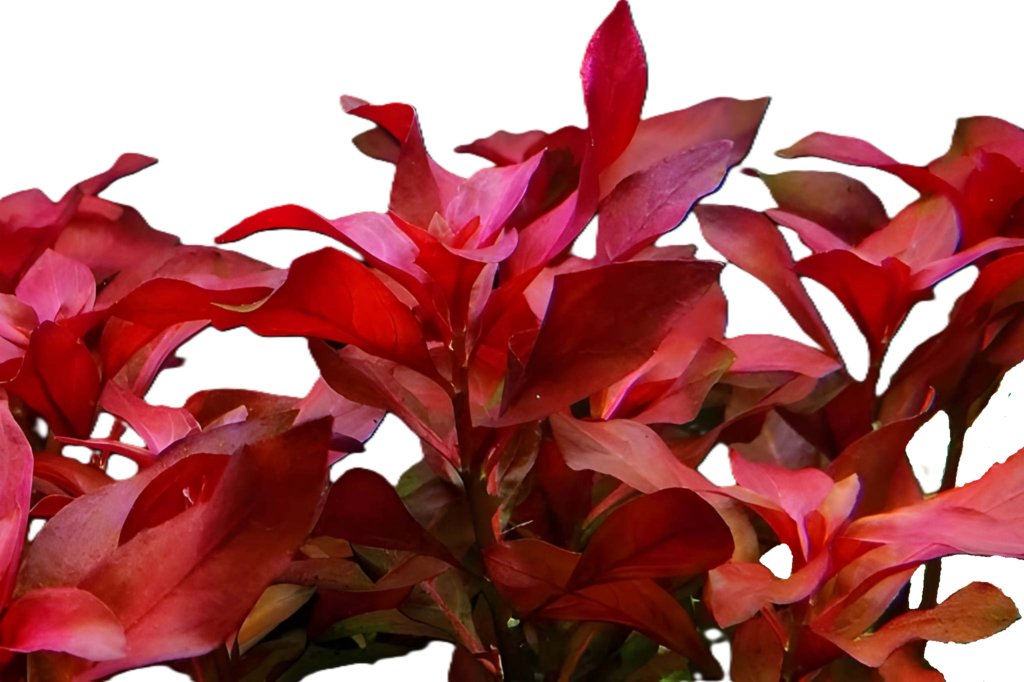
Ludwigia repens ‘Rubin’ is a red-leaved cultivar of Ludwigia repens, developed to produce deeper coloration compared to its natural form. This plant features elongated oval leaves arranged in opposite pairs along upright stems, with coloration ranging from brownish red to deep intense red.
In aquascaping, this plant is well known as an effective color contrast element, especially when placed among green plants. When planted in groups, ‘Rubin’ is capable of forming a strong visual mass and adding depth to the layout.
The original species originates from shallow waters in North America with relatively stable conditions, which explains its high adaptability across various aquarium environments.
Requirements and Care
Growth Characteristics
This plant grows vertically with a main stem that branches easily after trimming. Internodes tend to elongate under low light conditions, while under high light they become shorter and more compact.
With regular trimming, the plant can develop a dense and bushy structure, especially in systems with sufficient carbon supply and lighting.
Light
The light category ranges from medium to high.
At approximately ±60–90 µmol m⁻² s⁻¹, the plant can grow stably, but red coloration is not yet optimal and tends to appear dull. At higher intensities (±100–140 µmol m⁻² s⁻¹), red coloration becomes deeper, and internode spacing shortens, resulting in a more compact appearance.
Insufficient light often leads to the loss of lower leaves due to shading.
CO₂ and Carbon
The CO₂ requirement is adaptive, but optimal performance is achieved at a medium level.
This plant can survive without CO₂ injection (low-tech systems), but growth tends to be slower with less intense coloration. In systems with stable dissolved CO₂ (around 15–30 mg/L), the plant shows significant improvements in growth rate, leaf density, and color intensity.
Therefore, while not strictly required, CO₂ supply becomes an important factor for achieving the best visual quality.
Nutrients
As a stem plant, Ludwigia repens ‘Rubin’ primarily absorbs nutrients from the water column. A balanced supply of macronutrients supports stable growth, while micronutrients—especially iron—play a key role in developing red coloration.
Nutrient deficiencies may result in pale leaves and stunted growth, while excess nutrients without proper balance may trigger algae growth.
Water Parameters
This plant is relatively tolerant of varying water parameters, from soft to moderately hard conditions.
The ideal pH range is 5.0–7.5, with GH 2–15 dGH and KH 1–8 dKH. An optimal temperature of 22–28 °C supports stable metabolic processes.
Parameter stability remains the primary factor in maintaining plant health and consistent coloration.
Substrate
Although not fully dependent on substrate, having a stable substrate helps support root development and keeps the plant firmly anchored.
Nutrient-rich substrates can provide additional support, especially during the initial growth phase, but are not a limiting factor in systems with well-managed water column fertilization.
Propagation
Propagation is carried out through stem cuttings, either from the top shoots or lateral branches.
Regular trimming not only serves as a propagation method but also encourages lateral branching, resulting in a denser and more aesthetically pleasing plant structure.
Conclusion
Ludwigia repens ‘Rubin’ is a well-balanced aquascape stem plant in terms of ease of care and aesthetic value. With its adaptability to CO₂ and broad tolerance to water parameters, it is suitable for a wide range of systems, from low-tech to high-tech setups.
However, to achieve intense red coloration and a compact plant structure, medium to high lighting and stable CO₂ supply are required.
As a midground to background plant, ‘Rubin’ is highly effective in creating color contrast and enhancing visual composition, especially when planted in groups and maintained with regular trimming.