Daftar Isi Show
| Characteristics | Details |
|---|---|
| Genus | Ludwigia |
| Species | Ludwigia inclinata |
| Family | Onagraceae |
| Origin | South America (Brazil region, particularly the Araguaia Basin) |
| Common Name | Ludwigia Araguaia |
| Light Requirement | High (±100–180 µmol m⁻² s⁻¹ / PAR) |
| Optimal Temperature | 22–28°C |
| Growth Rate | Moderate |
| Placement | Midground – background |
| Plant Height | 20–50 cm |
| Ideal pH | 5.5–7.0 |
| Water Hardness | GH 2–8 dGH; KH 0–4 dKH |
| CO₂ Requirement | High |
| Propagation | Stem cuttings |
Additional Information
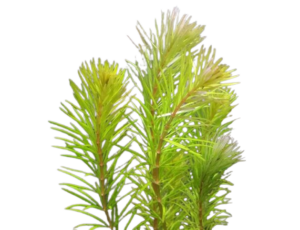
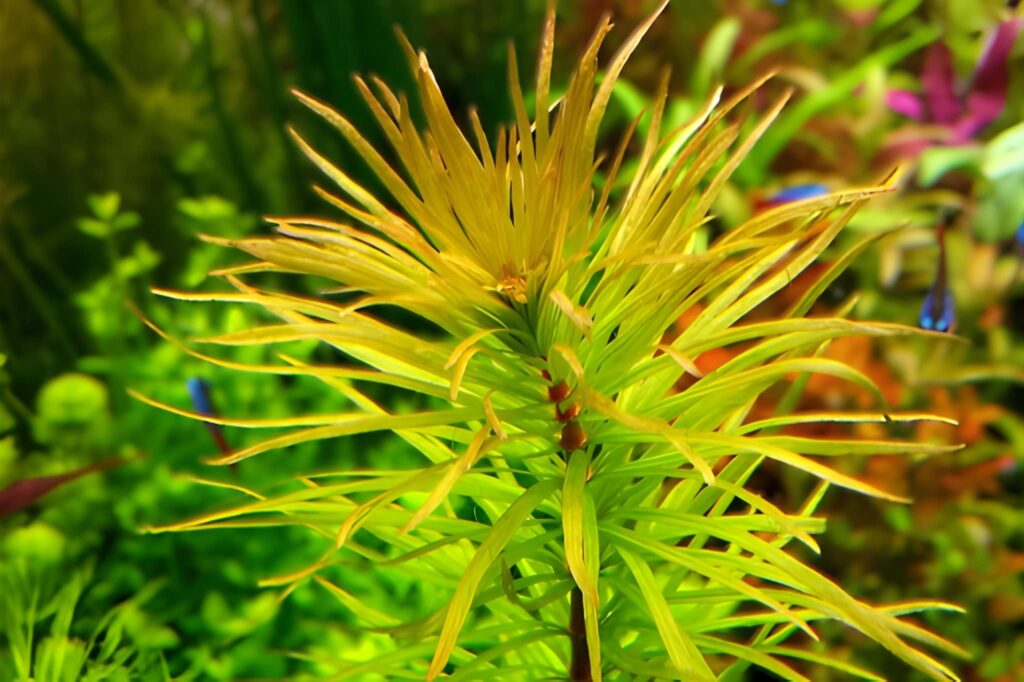
Ludwigia inclinata var. verticillata ‘Araguaia’ is a Ludwigia variant recognized for its highly distinctive leaf morphology, clearly different from most aquascape stem plants. The leaves grow in a verticillate pattern (whorled around a single point on the stem), with a narrow, elongated form that gently curves outward, creating a light yet complex silhouette.
Under optimal conditions, the coloration ranges from yellowish green to orange-red, with intensity strongly influenced by lighting and nutrient stability. Compared to other Ludwigia species, the ‘Araguaia’ variant exhibits a finer and less dense visual texture, making it suitable for creating contrast against broad-leaved plants.
Its natural habitat consists of shallow waters with slow to moderate flow in tropical regions of South America. These environments typically feature relatively soft, slightly acidic water rich in organic matter, which explains its preference in aquascape systems.
In aquascape layouts, this plant is generally placed in the midground to background. Its upright yet flexible stem structure allows aquascapers to create natural layering, particularly in nature-style or Dutch-style layouts that emphasize variation in leaf shapes.
Requirements and Care
Growth Characteristics
This plant grows vertically as a typical stem plant. Internodes tend to elongate under insufficient light, while under high light intensity, growth becomes more compact and dense.
It responds well to trimming. Regular pruning stimulates lateral branching, although not as aggressively as some other stem plants. With consistent trimming techniques, the plant can develop a denser and more structured mass.
Light
The light category for Ludwigia inclinata var. verticillata ‘Araguaia’ is high, with a PAR requirement of approximately 100–180 µmol m⁻² s⁻¹.
Under low to medium light intensity, the plant tends to lose its visual characteristics. Leaves become longer, internode spacing increases, and coloration shifts toward pale green. In contrast, under high light, the leaves exhibit stronger curvature, more compact growth, and consistent orange to reddish coloration.
Even light distribution is also important, as the lower parts of the stem are prone to shading when covered by other plants.
CO₂ and Carbon
Ludwigia inclinata var. verticillata ‘Araguaia’ is classified as a high CO₂-demanding plant. In practice, maintaining optimal form without stable CO₂ injection is difficult.
In high-tech systems with consistent dissolved CO₂, growth becomes more stable, leaves appear healthier, and coloration intensifies. CO₂ fluctuations often result in stunted growth or leaf deformation, making stability a critical factor.
In non-CO₂ systems, the plant may survive, but its visual performance and structural quality will be significantly suboptimal.
Nutrients
As a relatively demanding stem plant, it requires a balanced supply of macronutrients (nitrogen, phosphate, potassium) and micronutrients (iron and trace elements).
Deficiencies, particularly in nitrogen and iron, can lead to pale coloration and inhibited growth. However, excessive nutrients without proper control may trigger algae, especially under high light conditions.
The balance between light, CO₂, and nutrients is the primary factor in maintaining stable growth.
Water Parameters
Ludwigia inclinata var. verticillata ‘Araguaia’ performs best in soft to slightly acidic water, with a pH range of 5.5 to 7.0.
Low to moderate hardness (GH 2–8 dGH with low KH) supports metabolic flexibility. Stability of parameters is more important than targeting specific values, as fluctuations can induce plant stress.
The optimal temperature range is 22–28°C, consistent with its tropical nature.
Substrate
A nutrient-rich active substrate generally produces the best results, particularly during the initial growth phase. The root system of Ludwigia develops relatively well, although a significant portion of nutrient uptake also occurs through the water column.
A stable substrate helps maintain long-term nutrient availability and supports proper anchoring of the stems.
Propagation
Propagation is performed through stem cuttings. Healthy top shoots are cut and replanted into the substrate.
Over time, the lower portions of older stems may decline in quality, making replanting from the tops a common practice to maintain a fresh and proportional appearance.
Conclusion
Ludwigia inclinata var. verticillata ‘Araguaia’ is an aquascape plant with a unique visual character, highlighted by its whorled leaf structure and fine texture. It is best suited for high-tech systems due to its requirement for high light and stable CO₂ supply to achieve optimal performance.
In layout composition, it functions in the midground to background as a contrasting element against broad-leaved plants. With proper care and stable water parameters, this plant can provide high aesthetic value without appearing excessive, making it an excellent choice for aquascapers who prioritize detail and structural composition.