Daftar Isi Show
| Characteristics | Details |
|---|---|
| Genus | Ludwigia |
| Species | Ludwigia inclinata var. verticillata ‘Cuba’ |
| Family | Onagraceae |
| Origin | South America (aquascape cultivated variety) |
| Common Name | Ludwigia Cuba, Ludwigia Meta Cuba |
| Light Requirement | High (±100–200 µmol m⁻² s⁻¹ / PAR) |
| Optimal Temperature | 22–28°C |
| Growth Rate | Moderate |
| Placement | Background |
| Plant Height | 30–60 cm |
| Ideal pH | 5.5–7.0 |
| Water Hardness | GH 2–8 dGH; KH 0–4 dKH |
| CO₂ Requirement | High |
| Propagation | Stem cuttings |
Additional Information
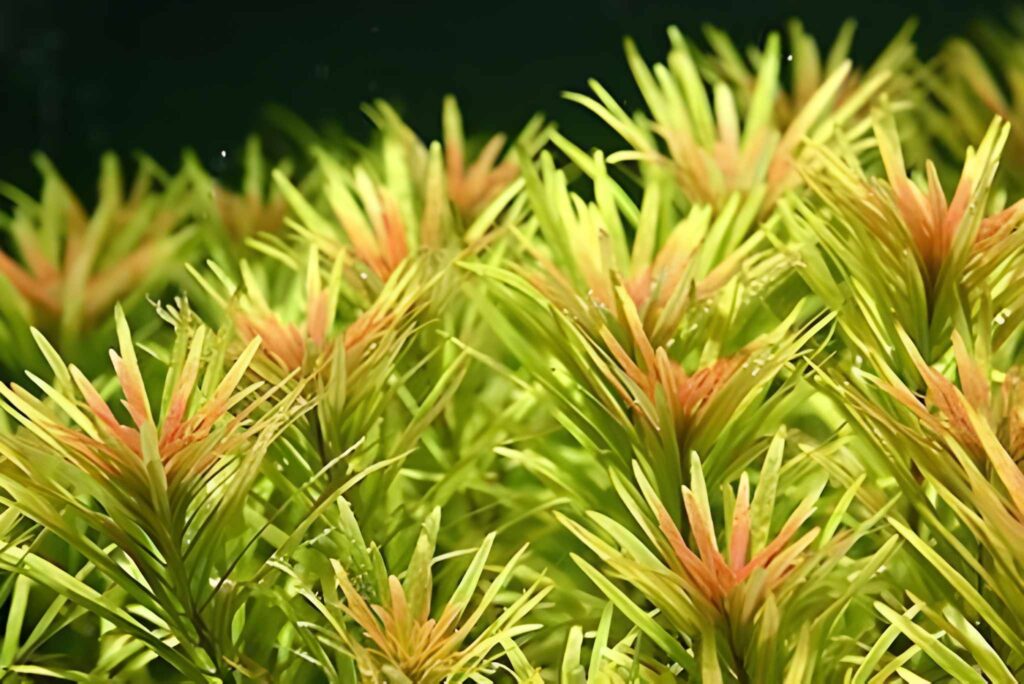
Ludwigia inclinata var. verticillata ‘Cuba’ is a stem plant variety with a highly distinctive visual character in high-end aquascapes. Its leaves are arranged in a whorled pattern, forming a dense and symmetrical radial structure along the stem. Leaf coloration ranges from yellowish green to intense orange-red, depending on light intensity and nutrient stability.
Under optimal conditions, this plant exhibits strong color contrast and a dense crown structure, making it an effective focal background plant in both Dutch-style and nature-style aquascapes. Internodes tend to remain short under high light, resulting in a compact and aesthetically refined appearance.
The original species originates from shallow, slow-flowing waters in South America, typically characterized by soft, nutrient-rich conditions. However, the ‘Cuba’ variety found in aquascaping is generally a cultivated selection with enhanced coloration.
Requirements and Care
Growth Characteristics
This plant exhibits a vertical growth pattern typical of stem plants, with lateral branching occurring after trimming. Its response to light is highly significant: under high intensity, leaves become denser and coloration more vivid, while under low light, internodes elongate and colors fade.
Growth is considered moderate but is strongly influenced by CO₂ and nutrient stability. Without proper parameter control, the plant is prone to stagnation or leaf deformation.
Light
The light category is high, with a realistic PAR requirement of approximately ±100–200 µmol m⁻² s⁻¹.
At low intensity (<80 µmol), the plant tends to:
Elongate (etiolation)
Exhibit pale green coloration
Develop a less dense structure
In contrast, under high intensity:
Red-orange coloration becomes more pronounced
Internodes remain short
Leaf formation becomes more symmetrical and compact
Even light distribution is essential to prevent shading between stems.
CO₂ and Carbon
CO₂ demand is high and critically important.
This plant is not stable in systems without CO₂ injection. In high-tech systems with stable dissolved CO₂ levels (±20–30 ppm), growth becomes significantly more consistent and coloration more optimal.
CO₂ fluctuations often result in:
Leaf deformation
Growth stagnation
Increased risk of algae
Nutrients
As a colored stem plant, nutrient demand is relatively high and must remain balanced between macronutrients (nitrate, phosphate, potassium) and micronutrients (iron and trace elements).
Deficiency in specific nutrients, particularly iron (Fe), is immediately visible through reduced red/orange coloration intensity. However, excess nutrients without proper balance with light and CO₂ can trigger algae.
Stability and consistency are more important than high dosing.
Water Parameters
Ideal conditions are soft to moderately soft water:
pH: 5.5–7.0
GH: 2–8 dGH
KH: 0–4 dKH
Temperature: 22–28°C
This plant is sensitive to sudden parameter changes, especially fluctuations in KH and CO₂. System stability is the key factor for long-term success.
Substrate
Active substrate (aquasoil) is strongly recommended because it:
Supports a healthy root system
Provides initial nutrient reserves
Helps maintain a slightly acidic and stable pH
Although most nutrients are absorbed through the water column, the root system still plays an important role in overall growth stability.
Propagation
Propagation is performed through stem cuttings.
Standard procedure:
Cut the healthy top portion of the stem
Replant it into the substrate
The lower portion will produce side shoots
Regular trimming is not only used for propagation but also to maintain plant shape and density within the layout.
Conclusion
Ludwigia inclinata var. verticillata ‘Cuba’ is a high-difficulty background aquascape plant that requires precise system control. Its demand for high light, stable CO₂, and balanced nutrients makes it more suitable for high-tech setups.
From an aesthetic perspective, this plant offers a unique structure and intense coloration that are difficult to match by other stem plants. In aquascape layouts, it plays a strong role as both a visual accent and focal point, particularly in compositions that emphasize contrast in color and texture.
It is not recommended for low-tech systems; however, under optimal conditions, it becomes one of the most visually impressive species in aquascaping.