| Characteristics | Details |
|---|---|
| Genus | Hygrophila |
| Species | Hygrophila odora |
| Family | Acanthaceae |
| Origin | West Africa (Guinea, Guinea-Bissau, Liberia, Senegal, Sierra Leone) |
| Common Name | Hygrophila sp. “Guinea”, Hygrophila sp. “Africa” |
| Lighting Requirements | Medium to high (±80–150 µmol m⁻² s⁻¹ PAR) |
| Optimal Temperature | 24–28°C |
| Growth Rate | Slow to moderate |
| Placement | Midground to background |
| Plant Height | 10–20+ cm (submerged), >50 cm (emersed) |
| Ideal pH | 4.5–7.0 |
| Water Hardness | GH 3–10 dGH; KH 0–7 dKH |
| CO₂ Requirement | Medium to high |
| Propagation | Stem cuttings (top and lateral cuttings) |
Additional Information
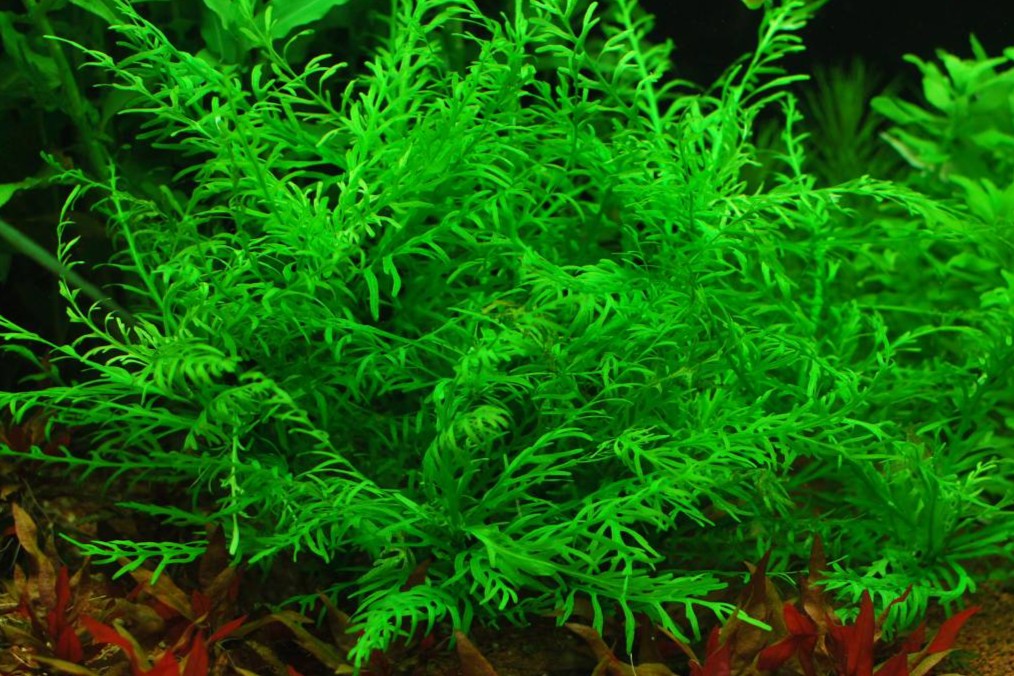
Hygrophila odora is the only known Hygrophila species from Africa commonly used in aquascaping. In its submerged form, it displays bright green, pinnatisect leaves with narrow lobes, resembling Hygrophila difformis but with a slimmer profile and thicker, more rigid stems. Internodes remain relatively short under optimal lighting and CO₂ conditions, resulting in a dense, bushy structure suitable for midground to background placement.
Visually, this plant contributes a fine-textured appearance with a branched silhouette, creating strong contrast against broad-leaved or red plant species. In nature-style and jungle aquascapes, H. odora is particularly effective in adding depth and structural layering.
Requirements and Care
Growth Characteristics
Growth is classified as slow to moderate and is highly responsive to environmental parameters. The plant exhibits vertical growth with increased lateral branching when CO₂ and nutrient levels are sufficient. Under ideal conditions, submerged leaves become more segmented and compact, while unstable conditions tend to produce simpler leaf forms and elongated growth.
Lighting
The optimal lighting category is medium to high, with an ideal PAR range of approximately ±80–150 µmol m⁻² s⁻¹.
Under low light conditions, leaves become simpler, internodes elongate, density decreases, and coloration becomes paler. Under higher light intensity, leaf segmentation becomes more complex, the plant develops a bushier form, and lateral shoot formation increases. However, excessively high light without balanced macro and micronutrients may lead to apical necrosis.
CO₂ and Carbon
Although capable of surviving without CO₂ injection, optimal performance is achieved under medium to high CO₂ levels. A recommended range is approximately 25–40 mg/L.
Carbon enrichment enhances leaf density, branching, and stability of the submerged form. Compared to most Hygrophila species, H. odora is more sensitive, making CO₂ stability critical to avoid growth issues.
Nutrients
Consistent nutrient supply is essential, with particular sensitivity to phosphate availability. Observations indicate that PO₄ levels below 0.3 mg/L can impair apical growth. Recommended nutrient ranges include NO₃ at 10–50 mg/L, PO₄ at 0.3–3 mg/L, potassium at 5–30 mg/L, and iron at 0.01–0.5 mg/L.
A nutrient-rich substrate supports early stability and promotes stronger root development, although the plant primarily relies on water column nutrients.
Water Parameters
The ideal pH range is 4.5–7.0, with a preference for soft to moderately hard water. Suitable ranges include GH 3–10 dGH and KH 0–7 dKH, with optimal temperatures between 24–28°C. Higher temperatures, particularly above 26°C, tend to enhance submerged growth dynamics. Stability is more important than absolute values, as fluctuations can directly affect plant condition.
Substrate
The root system develops well in both active and inert substrates supplemented with nutrients. While not strictly a heavy root feeder, the plant benefits from nutrient availability in the root zone. Poor substrates may result in slower growth and less defined leaf segmentation.
Propagation
Propagation is straightforward through top cuttings and lateral stem cuttings. An additional method involves allowing cut stems to float for several weeks to stimulate lateral shoot formation before replanting.
Conclusion
Hygrophila odora is a distinctive aquascape species with high aesthetic value due to its slender pinnatisect leaves and characteristic branching structure. Although less adaptable than more common Hygrophila species, it can grow reliably in medium to high-tech systems with stable CO₂ and nutrient management. It is best suited for experienced aquascapers seeking unique texture in midground or background zones, particularly in nature or jungle-style layouts. With consistent care, H. odora can serve as a strong and character-rich visual element within an aquascape composition.