Daftar Isi Show
| Characteristic | Details |
|---|---|
| Genus | Syngonanthus |
| Species | Syngonanthus macrocaulon |
| Family | Eriocaulaceae |
| Origin | Brazil (Amazon region) |
| Common Name | Syngonanthus sp. Belem, Tonina sp. Belem |
| Light Requirement | High (±90–150 µmol m⁻² s⁻¹ / PAR) |
| Optimal Temperature | 22–26 °C |
| Growth Rate | Moderate |
| Placement | Midground |
| Plant Height | 10–25 cm |
| Ideal pH | 4.5–6.0 |
| Water Hardness | GH 1–5 dGH; KH 0–2 dKH |
| CO₂ Requirement | High |
| Propagation | Stem cuttings (top shoots) |
Additional Information
Syngonanthus macrocaulon is widely regarded as one of the more distinctive members of the Eriocaulaceae family in the aquascaping context, both in terms of morphology and its environmental sensitivity. In earlier stages of its introduction into the aquarium hobby, this plant was commonly traded under the name Tonina sp. Belem, referencing its origin near Belém in Brazil. However, subsequent taxonomic evaluation clarified that this species does not belong to the genus Tonina. Instead, its floral and vegetative structures align with the genus Syngonanthus, while Tonina itself is taxonomically restricted to a single species, Tonina fluviatilis.
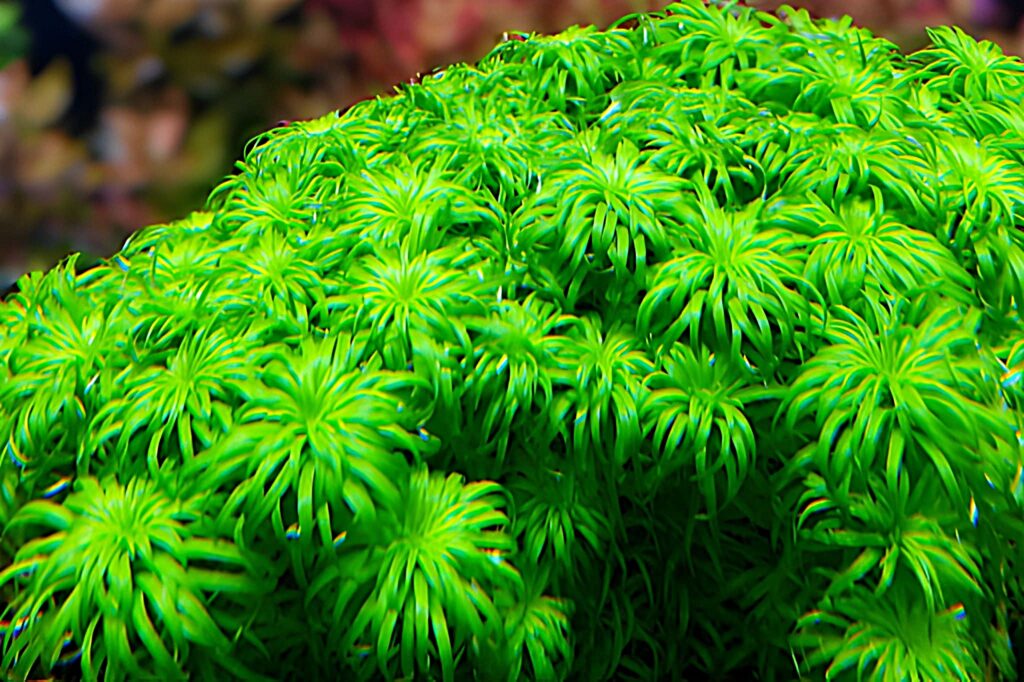
Morphologically, this species exhibits an upright stem growth pattern with a dense rosette formation at the apical tip. The leaves are narrow, linear, and gently arch downward, forming a crown-like structure. This apical arrangement is the defining visual feature of the plant, creating a compact and refined appearance when grown under optimal conditions.
The coloration is typically a bright, clean green, lacking the darker or duller tones seen in many stem plants. This clarity of color makes it particularly effective when used in contrast with red or bronze-toned species. In aquascape compositions, Syngonanthus macrocaulon is most often positioned in the midground, where it functions as a visual transition element without adding excessive mass to the layout.
Its natural habitat consists of Amazonian blackwater systems, characterized by extremely soft, acidic, and chemically stable water. This ecological background directly explains its narrow tolerance range in aquarium conditions. The plant does not adapt well to fluctuating parameters and requires a consistently controlled environment.
Requirements and Care
Growth Characteristics
The growth pattern of Syngonanthus macrocaulon is primarily vertical, with a tendency to produce lateral shoots from the main stem. Its growth rate is moderate and predictable, making it manageable in long-term aquascape layouts.
Under sufficient lighting, the plant develops short internodes, resulting in a dense and compact crown. In contrast, insufficient light leads to stem elongation and increased spacing between leaves, reducing its visual quality. The plant may also develop adventitious roots along the stem, particularly when allowed to grow excessively tall or when replanted using long cuttings.
Lighting
This species falls into the high light category, requiring approximately ±90–150 µmol m⁻² s⁻¹ PAR. Adequate light intensity is essential to ensure penetration into the dense crown structure, allowing lower sections of the plant to remain photosynthetically active.
Under low light conditions, the plant typically exhibits etiolation, characterized by elongated stems and a less compact crown. Leaf coloration may also become paler. In contrast, strong lighting promotes tighter growth, improved coloration, and a more defined structure. However, increased light intensity must be balanced with sufficient CO₂ and nutrient availability to maintain system stability.
CO₂ and Carbon
The carbon requirement of Syngonanthus macrocaulon is high and non-negotiable. The plant relies almost entirely on dissolved CO₂ and does not effectively utilize bicarbonate as an alternative carbon source in harder water conditions.
Without CO₂ injection, growth is typically poor and often stagnant. In a high-tech setup with stable CO₂ levels, the plant responds with improved density, stronger apical development, and active photosynthesis. Proper water circulation is equally important to ensure that CO₂ reaches all parts of the plant, particularly within the dense crown.
Nutrients
Nutrient management plays a critical role, especially regarding micronutrients. Iron is particularly important for maintaining healthy apical growth. Deficiency is usually evident in new leaves, which may appear pale or nearly translucent.
Macronutrients such as nitrogen, phosphorus, and potassium should be provided in balanced proportions. While the plant responds positively to nutrient-rich conditions, excessive dosing should be avoided, as it originates from mineral-poor environments. Stability and consistency are more important than high nutrient concentration.
Water Parameters
Water chemistry is the most critical factor in maintaining this species successfully. Syngonanthus macrocaulon requires very soft water, with KH ideally between 0–2 dKH and GH maintained around 1–5 dGH.
The preferred pH range is acidic, typically between 4.5 and 6.0. Such conditions enhance nutrient availability and align with its natural habitat. Fluctuations in KH and pH are among the most common causes of failure when keeping this plant.
Substrate
An active substrate is strongly recommended. Its role is not limited to nutrient supply but also includes stabilizing pH and helping maintain low carbonate hardness.
The plant has relatively fine root structures, making substrates with small to medium grain sizes more suitable. Inert substrates are generally less effective unless supported by highly controlled water column fertilization and precise CO₂ management.
Propagation
Propagation is typically carried out through apical cuttings or by separating lateral shoots. This method is straightforward but requires attention to detail.
Short cuttings are preferred. Longer stem sections tend to develop roots along the stem when replanted, which can negatively affect the visual cleanliness of the aquascape. Shorter cuttings encourage the formation of a new, compact crown.
Conclusion
Syngonanthus macrocaulon is a highly specialized aquascape plant with distinct visual characteristics and strict environmental requirements. Its crown-like growth form and bright green coloration make it an effective midground element, contributing both structure and contrast to a layout.
This species is best suited for high-tech aquariums where water parameters, CO₂ levels, and nutrient balance can be precisely controlled. When maintained under optimal conditions, it develops into dense, well-defined clusters that significantly enhance the overall composition of an aquascape.