Daftar Isi Show
| Characteristic | Detail |
| Genus | Rotala |
| Species | Rotala sp. ‘Myanmar’ (undescribed species) |
| Family | Lythraceae |
| Origin | Southeast Asia (Myanmar; hobby trade introduction) |
| Common Name | Rotala Myanmar |
| Light Requirement | High to Very High (±120–300 µmol m⁻² s⁻¹ / PAR) |
| Optimal Temperature | 22–28 °C |
| Growth Rate | Moderate to Fast |
| Placement | Midground – Background |
| Plant Height | ±20–40 cm (in aquarium) |
| Ideal pH | 5.0–7.0 |
| Water Hardness | GH 1–8 dGH; KH 0–4 dKH |
| CO₂ Requirement | High |
| Propagation | Stem cutting and top replanting |
Additional Information
Rotala sp. ‘Myanmar’ is an intensely red aquatic stem plant celebrated in the aquascaping community for its powerful color response to light and carbon availability. This species lacks a formal taxonomic description, so it is designated in hobby literature as a Rotala species with a geographic trade name indicating its origin.
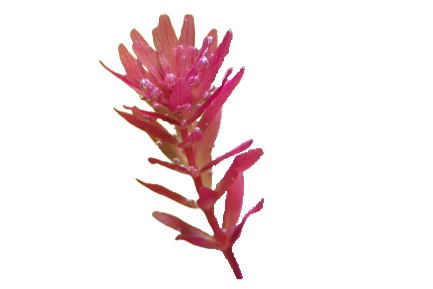
Morphologically, the plant features slender stems lined with opposite, narrow to lanceolate leaves. Under high light intensity, the foliage develops a rich red to purplish-red hue with short internodes and tight branching, creating a dense, bushy appearance.
In aquascape design, Rotala sp. ‘Myanmar’ serves as a striking midground to background element, introducing bold red accents and fine texture. Its highly responsive growth habit makes it an excellent indicator plant for high-tech system stability, as environmental changes immediately reflect in the plant’s coloration and growth form.
Explanation of the Term ‘sp.’
In botanical nomenclature, the abbreviation “sp.” (species) is used to denote an organism known to belong to a specific genus, but which has not yet been formally identified or published as a valid scientific species.
Regarding Rotala sp. ‘Myanmar’, the term “sp.” signifies that:
- The plant is identified as a member of the genus Rotala.
- Its species identity remains unconfirmed in formal taxonomy.
- The designation ‘Myanmar’ functions as a geographic collection marker or trade name within the aquascaping community.
Thus, Rotala sp. ‘Myanmar’ is not a scientifically valid name under the International Code of Nomenclature (ICN), but rather a practical label used in the plant trade and hobby community.
For comparison, a formally published scientific description exists for Rotala myanmarensis sp. nov., described as a new species from Myanmar in international botanical journals. However, it cannot be assumed that Rotala sp. ‘Myanmar’ in the aquascaping trade is identical to Rotala myanmarensis without further taxonomic analysis.
Care and Requirements
Growth Characteristics
Rotala sp. ‘Myanmar’ grows vertically as a stem plant, producing active lateral branches following shoot pruning. Trimming the top shoots stimulates side branches, allowing the plant to form a thick, high-density bush. Its response to light and carbon is exceptionally strong; optimal conditions produce short internodes, tightly packed leaves, and deep red pigmentation, whereas suboptimal conditions lead to stretched stems, sparse foliage, and color fading toward pale orange or reddish-green.
Lighting
Lighting demand falls into the high to very high category, with an estimated optimal PAR range of 120 to 300 µmol m⁻² s⁻¹ at leaf level. High light levels produce vivid red tones and compact growth. Under very high light, canopy density increases further, internodes become extremely tight, and foliage shifts toward a darker red shade. Under medium light, the plant will continue to grow, but red intensity is compromised, often shifting toward pinkish or reddish-green with longer internodes.
CO₂ and Carbon
Pressurized CO₂ injection is required to unlock maximum visual quality. In systems without CO₂ injection, the plant may survive, but achieving dense bush structures and deep red coloration is virtually impossible. In high-tech systems with consistent CO₂ management, Rotala sp. ‘Myanmar’ exhibits rapid growth and stable coloration, making it a reliable indicator of carbon stability and ecosystem health.
Nutrition
This plant requires a balanced regime of both macro and micronutrients. Excessively high nitrate concentrations can dull the intensity of the red coloration, while micronutrient deficiencies quickly cause stunted growth and leaf deformation. Sustaining nutritional stability is vital due to the plant’s elevated metabolic rate under strong illumination.
Water Parameters
The ideal pH range sits between 5.0 and 7.0, paired with soft to moderate water hardness (1–8 dGH and 0–4 dKH). An optimal temperature range of 22 to 28 °C supports healthy growth. Water parameter stability is essential for maintaining vibrant foliage color and structural integrity.
Substrate
A fine granular substrate with moderate nutrient content supports adventitious root development along the stem nodes. A stable substrate bed holds stems upright and facilitates dense cluster formation, while sufficient depth simplifies the replanting of top cuttings following routine maintenance.
Propagation
Propagation is easily accomplished through standard stem cuttings. Healthy terminal shoots are trimmed and replanted directly into the substrate. This method is regularly used in aquascaping to maintain canopy density and replace aging lower stem sections.
Conclusion
Rotala sp. ‘Myanmar’ is an intensely red stem plant valued for its high responsiveness to lighting and carbon delivery. It reaches peak visual performance in high-tech aquariums equipped with strong illumination, stable CO₂ injection, and soft water chemistry. Positioned across midground and background zones, it provides powerful red color contrast, enhances visual depth, and adds vibrant dynamic energy to green-dominated aquascape layouts.