Daftar Isi Show
| Characteristic | Detail |
| Genus | Rotala |
| Species | Rotala rotundifolia ‘Blood Red Singapore’ (cultivar) |
| Family | Lythraceae |
| Origin | Southeast Asia (aquascape hobby selection variant) |
| Common Name | Rotala Blood Red Singapore |
| Light Requirement | High to Very High (±120–300 µmol m⁻² s⁻¹ / PAR) |
| Optimal Temperature | 22–28 °C |
| Growth Rate | Moderate to Fast |
| Placement | Midground – Background |
| Plant Height | ±20–40 cm (in aquarium) |
| Ideal pH | 5.5–7.0 |
| Water Hardness | GH 1–8 dGH; KH 0–4 dKH |
| CO₂ Requirement | High |
| Propagation | Stem cutting and top replanting |
Additional Information
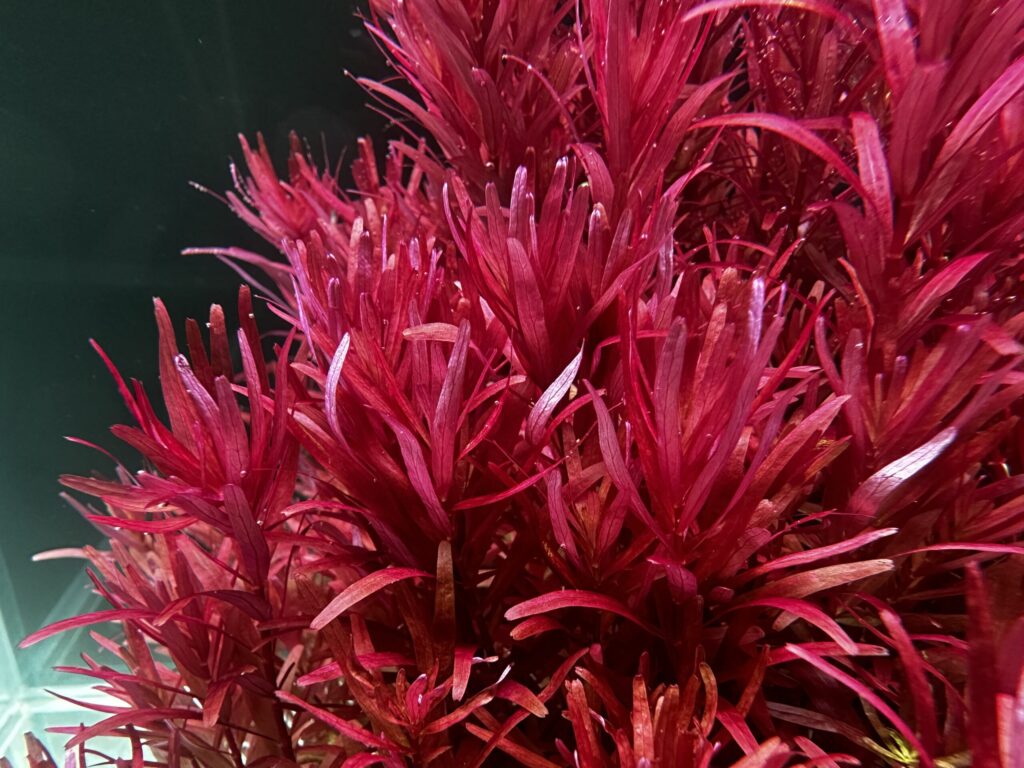
Rotala rotundifolia ‘Blood Red Singapore’ is an intensely red cultivar of Rotala rotundifolia developed through selective propagation within the aquascaping hobby. The plant features slender stems lined with opposite, oval to lanceolate leaves that display a deep crimson to dark maroon hue under optimal light and carbon conditions.
Visually, this cultivar is famous for achieving a much deeper, richer red than standard Rotala rotundifolia, while maintaining short internodal spacing under intense illumination. In aquascape compositions, it is frequently used as a midground or background accent to establish striking color contrast against green aquatic plants.
In its natural habitat, Rotala rotundifolia inhabits shallow waters and river margins with seasonal parameter changes. The ‘Blood Red Singapore’ selection retains the adaptive nature of its parent species, though its intense red pigmentation makes it far more responsive to precise light and carbon management in aquariums.
Care and Requirements
Growth Characteristics
Rotala rotundifolia ‘Blood Red Singapore’ exhibits an upright vertical stem habit with an active branching pattern. Pruning terminal shoot tops stimulates lateral side shoots, producing a thick, bushy canopy across midground or background zones. Its growth habit responds dramatically to light and carbon availability; optimal conditions produce short internodes, tightly packed foliage, and intense red coloration, whereas insufficient light or carbon stretches the stems and dulls the foliage to a pale orange or green.
Lighting
Lighting demand falls into the high to very high category, with an estimated optimal PAR range of 120 to 300 µmol m⁻² s⁻¹ at leaf level. High lighting produces strong red tones and dense bushy growth. Under very high lighting, stem density reaches its maximum with extremely tight internodes and foliage shifting toward a deep maroon tone. At medium light levels, the plant will still grow, but red coloration remains muted, often shifting toward pinkish-red or reddish-green.
CO₂ and Carbon
Pressurized CO₂ injection is required to unlock the plant’s full visual potential. In systems without CO₂ injection, growth continues at a slower pace, but intense red colors fail to develop and the bush structure remains loose. High-tech systems with consistent carbon delivery support rapid growth rates, tighter foliage density, and stable color saturation.
Nutrition
This cultivar requires a balanced regime of both macro and micronutrients. Excessively high nitrogen levels can suppress red color intensity, whereas micronutrient deficiencies quickly lead to leaf deformation and stunted shoot growth. Maintaining long-term nutritional stability is far more important than fluctuating dosing spikes, especially under high light levels that drive rapid metabolic rates.
Water Parameters
The ideal pH range sits between 5.5 and 7.0, paired with soft to moderate hardness (1–8 dGH and 0–4 dKH). An optimal temperature range of 22 to 28 °C supports healthy growth. Water chemistry stability is crucial for preventing leaf loss and uneven growth patterns under high-tech conditions.
Substrate
A fine granular substrate with moderate nutrient content supports adventitious root anchoring and overall stem stability. Adequate substrate depth holds stems securely in dense group plantings and simplifies the replanting of top cuttings following routine maintenance.
Propagation
Propagation is easily accomplished using standard stem cuttings. Healthy shoot tips are trimmed and replanted directly into the substrate bed. This technique is routinely used in aquascaping to maintain thick bush structures and refresh aging lower stem sections.
Conclusion
Rotala rotundifolia ‘Blood Red Singapore’ is an intensely red stem plant valued for its vibrant coloration and rapid growth response. It reaches peak performance in high-tech aquariums equipped with high to very high lighting, stable CO₂ injection, and soft water parameters. Positioned across midground to background zones, it delivers dramatic visual depth and bold color contrast within green-dominated aquascapes.