Daftar Isi Show
| Characteristic | Detail |
| Genus | Rotala |
| Species | Rotala mexicana |
| Family | Lythraceae |
| Origin | South Asia (hobby populations known from Bangladesh) |
| Common Name | Rotala mexicana ‘Bangladesh’ |
| Light Requirement | Medium – High (±70–150 µmol m⁻² s⁻¹ / PAR) |
| Optimal Temperature | 22–28 °C |
| Growth Rate | Moderate to Fast |
| Placement | Background to Midground (tall stems can be trimmed) |
| Plant Height | ±20–50 cm (depending on light intensity and trimming) |
| Ideal pH | 5.5–7.5 |
| Water Hardness | GH 2–8 dGH; KH 1–4 dKH |
| CO₂ Requirement | Medium – High |
| Propagation | Stem cutting |
Additional Information
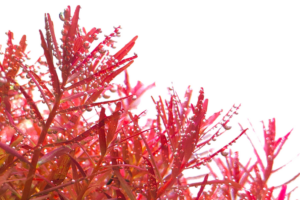
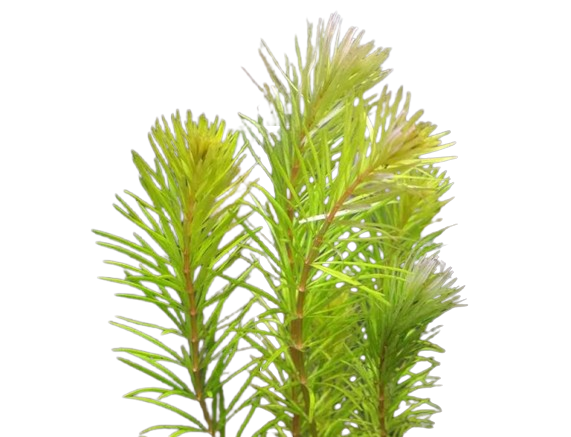
Rotala mexicana ‘Bangladesh’ is a variety of Rotala mexicana that has gained popularity among aquascapers due to its relatively small leaves displaying bright green to yellowish-green hues. Under high light intensity and optimal nutrient and carbon levels, the top shoot tips can develop a warm golden-yellow or subtle reddish tint.
Morphologically, the plant features slender stems lined with opposite, narrow to elongated oval leaves. Under bright lighting conditions, internodal spacing remains short, producing a dense, bushy appearance ideal for fine-textured background details or midground focal points.
In aquascape design, Rotala mexicana ‘Bangladesh’ is frequently used to establish smooth visual transitions between bright green foliage and intensely red stem plants, introducing depth and dynamic contrast behind hardscape arrangements.
Care and Requirements
Growth Characteristics
Rotala mexicana ‘Bangladesh’ exhibits an upright stem growth habit with a strong tendency to develop side branches following shoot pruning. Its growth pattern reacts dynamically to light and carbon availability; strong illumination and steady carbon injection shorten internodal spacing while increasing canopy branching.
Lighting
Lighting requirements fall into the medium to high category, with an effective PAR range between 70 and 150 µmol m⁻² s⁻¹ at leaf level. Under low to medium lighting, stems stretch out with wider internodes and retain a solid green coloration. Under high light intensity, growth becomes compact, leaf size stays small, and foliage colors shift toward yellowish-green with subtle reddish tips on top shoots.
CO₂ and Carbon
Carbon demand is classified as medium to high. While the plant can survive without CO₂ injection in low-tech aquariums, growth rates slow down and structural density remains loose. In high-tech systems with stable CO₂ injection, both morphological form and visual quality improve significantly.
Nutrition
This plant requires a balanced supply of macronutrients and micronutrients to sustain healthy growth and prevent chlorosis on young foliage. Deficiencies in nitrogen or micronutrients like iron often cause shoot tips to pale and growth rates to stagnate.
Water Parameters
The ideal pH range spans from 5.5 to 7.5, paired with soft to moderate general hardness (2–8 dGH) and low carbonate hardness (1–4 dKH). Overall parameter stability is far more critical than targeting exact values, as sharp shifts in water chemistry cause physiological stress and growth disruptions.
Substrate
A nutrient-rich substrate with fine to medium grain size supports adventitious root development and stem stability. Although its root system is not overly aggressive, nutrient-dense soil enhances growth vigor, particularly during the initial post-planting acclimation phase.
Propagation
Propagation is easily accomplished using standard stem cuttings. Terminal shoots can be trimmed and replanted directly into the substrate bed. Regular pruning further stimulates lateral branching, creating thicker, bushier stands over time.
Conclusion
Rotala mexicana ‘Bangladesh’ is a versatile aquatic stem plant featuring bright green to golden-yellow foliage that introduces soft contrast into aquascape layouts. It performs best in medium to high-tech environments, though it remains adaptively viable in low-tech setups. Given medium to high light, steady CO₂ injection, and balanced fertilization, it forms dense, functional bushes that bring exceptional aesthetic value to both background and midground zones in professional aquascapes.