Daftar Isi Show
| Characteristic | Detail |
| Genus | Rotala |
| Species | Rotala sp. (trade variety, not formally identified) |
| Family | Lythraceae |
| Origin | South Asia (Sri Lanka) |
| Common Name | Rotala Ceylon |
| Light Requirement | Medium – High (±70–140 µmol m⁻² s⁻¹ / PAR) |
| Optimal Temperature | 22–28 °C |
| Growth Rate | Moderate to Fast |
| Placement | Midground – Background |
| Plant Height | 20–40 cm |
| Ideal pH | 5.5–7.0 |
| Water Hardness | GH 2–8 dGH; KH 0–4 dKH |
| CO₂ Requirement | Medium |
| Propagation | Stem cutting |
Additional Information
Rotala sp. ‘Ceylon’ is a trade variety associated with the region of Sri Lanka (formerly Ceylon). Its precise species identity has not been formally published in botanical literature, which is why it retains the placeholder designation Rotala sp.
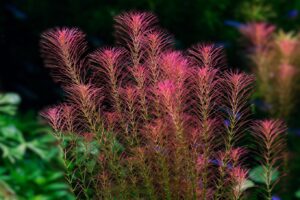
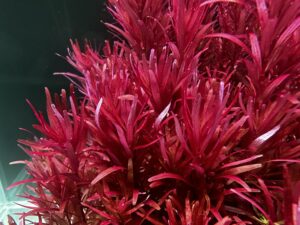
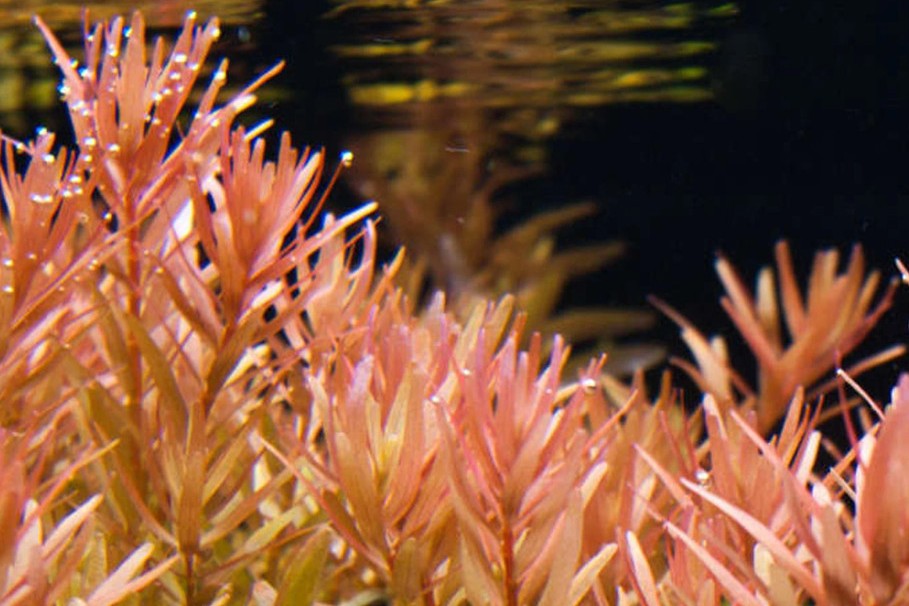
Morphologically, the plant features slender stems with narrow, lanceolate to linear leaves. Foliage color ranges from bright green to reddish-orange at the upper shoot tips, depending on light intensity and carbon stability. Compared to several intensely red Rotala species, its color profile presents a softer, more natural appearance.
In aquascaping layouts, Rotala sp. ‘Ceylon’ is frequently used as a fine-textured plant mass to create smooth color transitions from green to red in midground or background zones. Its dense lateral branching following a trim makes it highly effective for building compact, bushy stands.
The natural habitat of the genus Rotala typically includes riverbanks, seasonal marshes, and shallow waters subject to fluctuating water levels, soft water parameters, and moderate to high sunlight.
Care and Requirements
Growth Characteristics
This species grows as a vertical stem plant with a moderate to fast growth rate under stable light and nutrient conditions. Unpruned stems grow upward with increasingly wide internodal spacing, particularly under low light. Regular trimming stimulates side shoot development, increasing overall bush density.
Lighting
Lighting requirements fall into the medium to high category, with an optimal PAR range between 70 and 140 µmol m⁻² s⁻¹ at leaf level. Within the medium range of 70 to 90 µmol m⁻² s⁻¹ PAR, the plant maintains steady growth with yellowish-green to subtle orange hues. At higher light levels above 100 µmol m⁻² s⁻¹ PAR, red pigmentation becomes more pronounced and internodes shorten. Lighting levels below 60 µmol m⁻² s⁻¹ PAR result in leggy stems and pale green foliage.
CO₂ and Carbon
Carbon requirements are classified as medium. Rotala sp. ‘Ceylon’ can grow without injected CO₂, though its growth rate slows down and stem structure becomes less compact. With a stable CO₂ supply of 20 to 30 ppm, growth accelerates, branching becomes active, and coloration remains consistent. It is noticeably more forgiving than demanding red Rotala varieties.
Nutrition
As an actively growing stem plant, Rotala sp. ‘Ceylon’ requires a balanced supply of macronutrients and micronutrients. Adequate nitrate maintains leaf size and stable growth, while iron availability supports orange and red pigmentation on top shoots. Nutrient imbalances typically manifest as stunted shoot tips or dull foliage.
Water Parameters
The ideal pH range is 5.5 to 7.0, where overall parameter stability is far more critical than targeting a specific number. Low to moderate water hardness between 2 and 8 dGH and 0 to 4 dKH supports optimal nutrient absorption, whereas excessively hard water can slow color expression. Optimal temperature ranges between 22 and 28 °C, as temperatures approaching 30 °C accelerate metabolism while narrowing the system’s margin for error.
Substrate
This variety can be cultivated in both inert and active nutrient substrates. A nutrient-rich substrate assists early establishment and speeds up root development. However, because it is a stem plant, a significant portion of its nutrient uptake occurs directly through the water column.
Propagation
Propagation is accomplished via standard stem cuttings. Healthy terminal shoots measuring 5 to 10 cm in length can be trimmed and replanted with sufficient spacing so light reaches the lower stem sections. Periodic pruning is necessary to maintain a compact form and prevent lower leaves from deteriorating due to self-shading.
Conclusion
Rotala sp. ‘Ceylon’ is a reliable aquatic stem plant featuring green to reddish-orange foliage that remains stable without requiring extreme care. It is well-suited for midground and background placement, offering a natural color transition in aquascape designs. Requiring medium to high light and moderate CO₂, it thrives in both bright low-tech systems and stable high-tech aquariums. Its primary aesthetic value lies in its delicate texture, positive response to trimming, and ability to form dense, well-proportioned plant groups.