Daftar Isi Show
| Characteristic | Detail |
| Genus | Rotala |
| Species | Rotala rotundifolia ‘Orange Juice’ (cultivar) |
| Family | Lythraceae |
| Origin | Southeast Asia (cultivated variant of native tropical Asian species) |
| Common Name | Rotala Orange Juice |
| Light Requirement | High (±90–160 µmol m⁻² s⁻¹ / PAR) |
| Optimal Temperature | 22–28 °C |
| Growth Rate | Fast |
| Placement | Midground – Background |
| Plant Height | 25–50 cm |
| Ideal pH | 5.5–7.0 |
| Water Hardness | GH 2–8 dGH; KH 1–5 dKH |
| CO₂ Requirement | High |
| Propagation | Stem cutting |
Additional Information
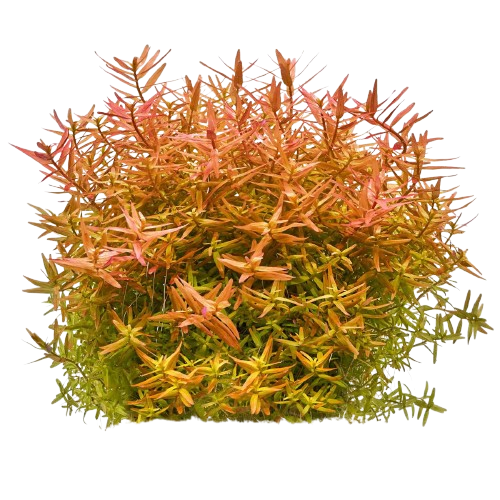
Rotala rotundifolia ‘Orange Juice’ is a selectively developed cultivar of Rotala rotundifolia engineered to express a vivid orange-copper color gradient under strong lighting and balanced nutritional conditions. Morphologically, it features slender stems lined with opposite, narrow lanceolate leaves that form a light yet dense plant mass when planted in clusters.
Unlike the standard green form of the species, this cultivar exhibits heightened synthesis of carotenoid and anthocyanin pigments under intense light, delivering a bright, stable orange coloration in high-tech aquarium setups.
In aquascaping compositions, this plant is generally positioned in tall midground or background zones to create warm color accents alongside green foliage. Its flexible stem architecture and positive response to trimming make it equally suitable for both Dutch and Nature Style layouts.
The natural habitat of the baseline species consists of shallow marshes, riverbanks, and seasonal wetlands characterized by variable nutrient levels and open sunlight exposure.
Care and Requirements
Growth Characteristics
This plant exhibits an upright growth habit with active lateral branching following top pruning. Internodal spacing shortens significantly under high light intensity and stable CO₂ delivery. Under insufficient light or unstable carbon levels, stems stretch upward, leaves decrease in size, and the vivid orange hue fades into a yellowish-green. Its rapid growth rate necessitates routine trimming to preserve cluster density and prevent self-shading at lower stem levels.
Lighting
Lighting demand falls into the high category, with an effective PAR range between 90 and 160 µmol m⁻² s⁻¹ at leaf level. To achieve optimal orange pigmentation, light intensity should remain above 100 µmol m⁻² s⁻¹ with uniform distribution reaching the lower sections of the plant group. Below 80 µmol m⁻² s⁻¹ PAR, foliage tends to remain yellowish-green with looser internodes. At intensities exceeding 150 µmol m⁻² s⁻¹ PAR, growth becomes extremely fast and color saturation deepens, though precise CO₂ and nutrient control is required to prevent algae outbreaks.
CO₂ and Carbon
Carbon requirements are high. While it can adaptively survive in non-CO₂ injected systems, structural density and color saturation diminish drastically. In aquascaping practice, this cultivar delivers its best performance in high-tech aquariums with consistent CO₂ injection maintained at 20 to 30 ppm. Carbon fluctuations frequently trigger lower leaf shedding or unstable growth; long-term distribution consistency is far more critical than temporary concentration spikes.
Nutrition
As a fast-growing stem plant with intense pigment demands, it requires a steady supply of macronutrients, particularly nitrogen and potassium. Nitrogen deficiency leads to pale growth and slowed development, whereas phosphate imbalances can disrupt color stability. Micronutrients like iron play an essential role in synthesizing rich orange tones, though oversupplying trace minerals without macronutrient balance invites algae growth. Maintaining a steady, balanced dosing regime yields the best results.
Water Parameters
The ideal pH range sits between 5.5 and 7.0, leaning slightly acidic to support optimal pigment expression. Recommended water hardness spans 2 to 8 dGH and 1 to 5 dKH, as excessively hard water can dull color intensity and slow down initial post-planting acclimation. An optimal temperature range of 22 to 28 °C supports stable metabolism and pigment synthesis.
Substrate
A nutrient-dense active substrate supports early growth phases and fosters strong root system establishment. Although primary nutrient uptake occurs through the water column, a stable substrate bed with medium grain size keeps stems anchored upright and minimizes basal stem rot. In high-light systems, a buffering active soil helps maintain overall water chemistry consistency.
Propagation
Propagation is easily carried out using standard stem cuttings. Terminal shoots measuring 5 to 10 cm in length are trimmed and replanted with sufficient spacing to allow light to penetrate down to the substrate. The traditional top-and-replant technique is widely used to maintain intense top coloration and prevent lower stems from becoming bare due to shading.
Conclusion
Rotala rotundifolia ‘Orange Juice’ is a striking orange stem plant valued for its rapid growth rate and dynamic responsiveness to light and CO₂. It is best suited for high-tech aquariums backed by strong lighting and steady carbon distribution. Positioned across midground to background zones, this cultivar provides a warm, powerful contrast to green aquatic flora, enhancing the overall visual depth of the layout. With consistent trimming and balanced fertilization, it maintains its dense form and rich orange coloration over long periods.