Daftar Isi Show
| Characteristic | Detail |
|---|---|
| Genus | Echinodorus |
| Species | Echinodorus amazonicus |
| Family | Alismataceae |
| Origin | South America, particularly the Amazon Basin and surrounding regions |
| Common Name | Amazon Sword, Amazon Sword Plant |
| Light Requirement | Medium (±50–100 µmol m⁻² s⁻¹ / PAR) |
| Optimal Temperature | 22–28 °C |
| Growth Rate | Moderate to fast |
| Placement | Background |
| Plant Height | 30–60 cm in aquariums |
| Ideal pH | 6.0–7.5 |
| Water Hardness | GH ±3–12 dGH; KH ±1–6 dKH |
| CO₂ Requirement | Adaptable |
| Propagation | Adventitious runners and plantlets produced on flower stalks |
Additional Information
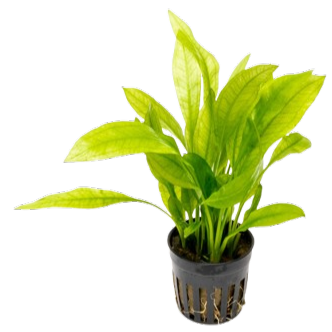
Echinodorus amazonicus is a robust rosette-forming aquatic plant characterized by elongated lanceolate to narrowly elliptic leaves with pointed tips and a clearly defined central midrib. The leaves emerge directly from a basal crown on relatively long petioles, giving the plant a strong vertical presence within the aquarium.
Foliage generally ranges from bright green to deep green, with coloration and leaf development influenced by light intensity, nutrient availability, carbon supply, and overall environmental stability.
In aquascaping, Echinodorus amazonicus is primarily used as a background plant because of its substantial size and strong architectural structure. Its upright foliage creates a natural vertical backdrop and can provide visual depth behind smaller foreground and midground species.
Ecologically, Echinodorus species are associated with tropical freshwater environments that may include relatively calm waters, shallow margins, and nutrient-rich muddy or sandy substrates. Their extensive root systems reflect an adaptation toward efficient nutrient acquisition from the substrate, making root-zone nutrition particularly important in aquarium cultivation.
Care and Requirements
Growth Characteristics
Echinodorus amazonicus develops as a vertical rosette with an extensive root system. New leaves emerge continuously from the center of the basal crown, while older leaves gradually age and may naturally deteriorate.
The plant can produce adventitious runners or elongated flower stalks capable of developing plantlets. Once these plantlets develop sufficiently strong roots, they can be separated and replanted as independent specimens.
Light and carbon availability have a noticeable influence on leaf architecture. Under lower light, petioles tend to elongate as the plant positions its foliage closer to the available light source. Under stronger and more stable lighting, the plant generally maintains a more compact and substantial leaf canopy.
Because of its extensive root system and relatively high nutrient demand, sufficient substrate volume is important for maintaining long-term growth.
Lighting
The lighting requirement of Echinodorus amazonicus falls within the medium range, approximately 50–100 µmol m⁻² s⁻¹ PAR.
Under lower light intensity, leaves may become longer and more widely spaced, while coloration can appear somewhat paler. Moderate lighting generally supports stronger leaf development and a more substantial rosette structure.
Higher light intensity can encourage denser and more compact foliage, but the plant is not considered exceptionally demanding in terms of illumination.
The response to light is particularly evident in canopy density, petiole length, and overall plant architecture. However, increasing light without providing adequate carbon and nutrients can create an imbalance that promotes algae rather than proportionally improving plant growth.
CO₂ and Carbon
Echinodorus amazonicus has an adaptable carbon requirement and can be successfully cultivated without injected CO₂ in low-tech aquariums.
In CO₂-enriched systems, however, the plant generally exhibits faster growth, larger foliage, and more consistent metabolic activity. Stable carbon availability is particularly beneficial during the establishment phase following transplantation.
Sudden environmental changes, including major fluctuations in CO₂ concentration, can contribute to leaf deterioration or temporary melting during adaptation. Once the plant becomes established and stable conditions are restored, new leaves typically develop from the central crown.
CO₂ supplementation should therefore be viewed as a means of improving growth performance rather than an absolute requirement for survival.
Nutrients
Echinodorus amazonicus is a strong root feeder and benefits substantially from a nutrient-rich substrate.
Macronutrients such as nitrogen, phosphorus, and potassium are required for sustained vegetative growth, while micronutrients including iron and manganese contribute to chlorophyll production, enzyme activity, and overall tissue development.
Although water-column fertilization can provide supplementary nutrition, root-zone availability is particularly important for this species. Nutrient-rich aquasoil, nutrient-containing substrate layers, or appropriately positioned root fertilizers can significantly support long-term development.
Nutritional deficiencies may manifest as chlorosis, reduced leaf size, slow growth, or premature deterioration of older foliage. Maintaining balanced nutrition is therefore more important than relying on high concentrations of any individual nutrient.
Water Parameters
Suitable conditions generally fall within a pH range of 6.0–7.5, with temperatures between 22–28 °C.
Low to moderate water hardness, approximately GH 3–12 dGH and KH 1–6 dKH, is generally appropriate for cultivation.
Although Echinodorus amazonicus is relatively tolerant of a broad range of aquarium conditions, parameter stability remains important. Abrupt changes in pH, hardness, temperature, or nutrient availability can cause physiological stress and may contribute to temporary leaf deterioration.
Consistent environmental conditions are particularly valuable during transplantation and early establishment, when the plant is redirecting energy toward root development and new leaf production.
Substrate
A fine to medium-textured substrate with adequate nutrient availability is strongly recommended because of the plant’s extensive root system.
Fine sand can be used when supplemented with an appropriate root nutrient source, while nutrient-rich aquasoil provides both physical support and direct access to essential nutrients.
The substrate should have sufficient depth to accommodate the expanding root system and provide adequate mechanical stability for a large rosette plant.
Nutrient-poor substrates can result in slower growth, smaller leaves, and reduced overall vigor. For long-term cultivation, maintaining a productive root zone is therefore one of the most important aspects of Echinodorus amazonicus care.
Propagation
Vegetative propagation commonly occurs through adventitious plantlets produced on elongated flower stalks.
As the plantlet develops, it gradually forms its own leaves and root system. Once the roots are sufficiently established, the young plant can be carefully separated from the flower stalk and planted directly into the substrate.
This method is relatively reliable and allows new specimens to be produced without dividing or damaging the parent crown.
Under favorable conditions, a mature specimen can produce multiple plantlets, making vegetative propagation an efficient method for gradually expanding a planted aquarium.
Conclusion
Echinodorus amazonicus is a robust background aquascape plant characterized by elongated foliage, a strong basal root system, and broad tolerance of aquarium conditions. Its moderate lighting requirement and adaptable carbon demand make it suitable for both low-tech and high-tech systems.
The species performs particularly well when provided with a nutrient-rich substrate, stable water parameters, and consistent carbon availability. As a heavy root feeder, it benefits more from a productive root zone than from excessive water-column fertilization.
As a background specimen, Echinodorus amazonicus introduces substantial vertical structure and a natural sense of scale. Its large rosette and upright foliage make it particularly effective in medium to large aquariums, where it can function as a dominant structural plant while providing a visually natural transition between the background and smaller midground species.