Daftar Isi Show
| Characteristic | Detail |
|---|---|
| Genus | Microsorum |
| Species | Microsorum pteropus |
| Family | Polypodiaceae |
| Origin | Southeast Asia, particularly tropical rivers and streams |
| Common Name | Java Fern |
| Light Requirement | Low to medium (±20–70 µmol m⁻² s⁻¹ / PAR) |
| Optimal Temperature | 22–28 °C |
| Growth Rate | Slow to moderate |
| Placement | Midground / Background |
| Plant Height | 15–35 cm |
| Ideal pH | 5.5–7.5 |
| Water Hardness | GH ±2–12 dGH; KH ±1–6 dKH |
| CO₂ Requirement | Adaptable |
| Propagation | Plantlets on leaves and rhizome division |
Additional Information
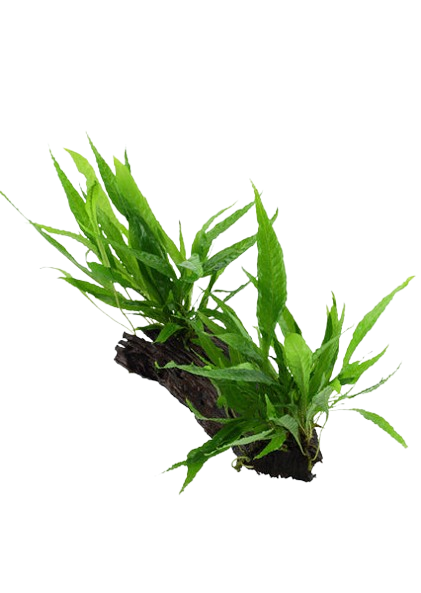
Microsorum pteropus is an aquatic fern characterized by a thick, creeping rhizome from which individual leaves emerge. The foliage is typically elongated and lanceolate, with a relatively firm texture that allows mature leaves to maintain their structure under flowing water.
Leaf coloration generally ranges from medium green to deep green, although morphology and growth characteristics can vary among cultivated forms and according to environmental conditions.
In aquascaping, Microsorum pteropus is widely valued as a stable structural plant with a high tolerance for fluctuating aquarium conditions. It is commonly attached directly to driftwood, rocks, and other hardscape materials, creating a natural transition between the structural elements of the layout and surrounding vegetation.
The species is associated with shallow freshwater habitats and slow to moderately flowing streams, where it can grow attached to submerged rocks, wood, and other solid surfaces. This epiphytic growth strategy explains why it should not be planted directly into aquarium substrate.
Care and Requirements
Growth Characteristics
Microsorum pteropus develops through horizontal rhizome growth. New leaves emerge individually from the rhizome and develop progressively, resulting in a naturally slow growth pattern compared with many stem plants.
Its relatively slow metabolism allows established specimens to remain stable for long periods with minimal maintenance. Under suitable conditions, the rhizome gradually expands across the hardscape while producing new foliage.
Light and carbon availability influence leaf size, density, and overall development. Stable environmental conditions generally produce stronger foliage and reduce the likelihood of premature leaf deterioration.
Because the rhizome serves as the primary structural and storage organ, maintaining its health is considerably more important than maximizing growth speed.
Lighting
The lighting requirement of Microsorum pteropus falls within the low to medium range, approximately 20–70 µmol m⁻² s⁻¹ PAR.
Under low light, the plant remains viable and typically develops slowly while maintaining relatively dark green foliage. Moderate lighting can increase growth activity and support more consistent production of new leaves.
Very high light intensity is generally unnecessary. Excessive illumination can increase algae pressure on the leaf surfaces, particularly because mature Microsorum leaves have a relatively slow turnover rate and textured surfaces that can provide attachment points for algae.
Moderate lighting is therefore generally preferable for long-term cultivation.
CO₂ and Carbon
Microsorum pteropus has an adaptable carbon requirement and can grow successfully without injected CO₂. This makes it one of the most practical epiphytic plants for low-tech aquarium systems.
In high-tech aquariums with stable CO₂ supplementation, growth can become more consistent and new foliage may develop more rapidly. However, the improvement is generally moderate rather than dramatic because the species naturally has a slow to moderate growth rate.
CO₂ supplementation should therefore be considered an enhancement rather than a strict requirement. Consistent carbon availability is more important than maintaining excessively high concentrations.
Nutrients
Microsorum pteropus primarily obtains nutrients from the water column rather than through a buried root system. Its overall nutrient requirement is relatively low to moderate.
Nitrogen, phosphorus, potassium, and essential micronutrients should remain available at balanced concentrations. Trace elements, including iron, contribute to maintaining healthy pigmentation and tissue development.
Nutritional imbalance may become visible through deterioration of older leaves, abnormal dark spots, or reduced production of new foliage. However, excessive fertilization is unnecessary and may increase algae pressure.
Because the rhizome and leaves are directly exposed to the surrounding water, maintaining clean circulation around the plant can improve nutrient exchange and reduce the accumulation of organic debris.
Water Parameters
Suitable water conditions generally fall within a pH range of 5.5–7.5, with an optimal temperature range of 22–28 °C.
Low to moderate water hardness, approximately GH 2–12 dGH and KH 1–6 dKH, is generally well tolerated.
The species is notably adaptable, but stability remains important. Extreme or repeated fluctuations in temperature, pH, hardness, or nutrient concentration can slow rhizome development and contribute to leaf deterioration.
Stable conditions allow established plants to maintain foliage for extended periods and gradually produce new leaves.
Substrate
Microsorum pteropus should not be planted directly into the substrate.
The rhizome should remain completely exposed and be attached to driftwood, rocks, roots, or other suitable hardscape surfaces. Thread, aquarium-safe cyanoacrylate gel, or appropriate mesh can be used to secure the plant during establishment.
Submerging the rhizome beneath substrate can restrict water circulation around the tissue and significantly increase the risk of rhizome rot.
Once attached, the plant gradually develops attachment structures that allow the rhizome to anchor itself naturally to the hardscape. The substrate therefore functions primarily as a supporting visual component of the overall aquascape rather than as the plant’s primary growing medium.
Propagation
Propagation occurs primarily through vegetative reproduction.
Mature leaves can produce small plantlets along their surface or margins. These plantlets gradually develop their own roots and leaves and can be separated once sufficiently established before being attached to new hardscape.
Another method involves dividing the rhizome into healthy sections, with each section retaining sufficient foliage and rhizome tissue to continue growing.
Both techniques are relatively reliable and allow propagation without significantly compromising the parent plant when performed correctly.
Conclusion
Microsorum pteropus is a highly resilient and adaptable aquascape plant that is particularly valuable for low-maintenance aquarium systems. Its thick rhizome, durable foliage, and tolerance of relatively broad water parameters make it one of the most dependable epiphytic plants used in aquascaping.
The species performs well in both low-tech and high-tech systems, although stable CO₂ availability can improve growth consistency. Its relatively low lighting and nutrient requirements also make it useful in aquariums where more demanding species would be difficult to maintain.
As a midground to background hardscape plant, Microsorum pteropus provides long-term structural stability and natural texture. When attached to driftwood or rock, its elongated foliage creates a seamless transition between hardscape and vegetation, making it a highly functional component of professionally designed natural-style aquascapes.