Daftar Isi Show
| Characteristic | Detail |
| Genus | Bacopa |
| Species | Bacopa salzmannii |
| Family | Plantaginaceae |
| Origin | South America |
| Common Name | Bacopa Salzmannii |
| Light Requirement | Medium – High (±70–150 µmol m⁻² s⁻¹ / PAR) |
| Optimal Temperature | 22–28 °C |
| Growth Rate | Moderate |
| Placement | Midground – Background |
| Plant Height | 15–35 cm |
| Ideal pH | 5.5–7.5 |
| Water Hardness | GH 2–8 dGH; KH 0–4 dKH |
| CO₂ Requirement | Medium – High |
| Propagation | Stem cutting |
Additional Information
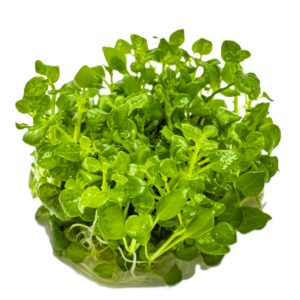
Bacopa salzmannii is an aquatic stem plant belonging to the family Plantaginaceae, naturally distributed across South America. In its wild habitat, this species inhabits marshes, riverbanks, and shallow water bodies characterized by slow currents.
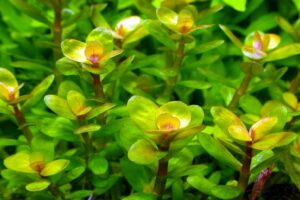
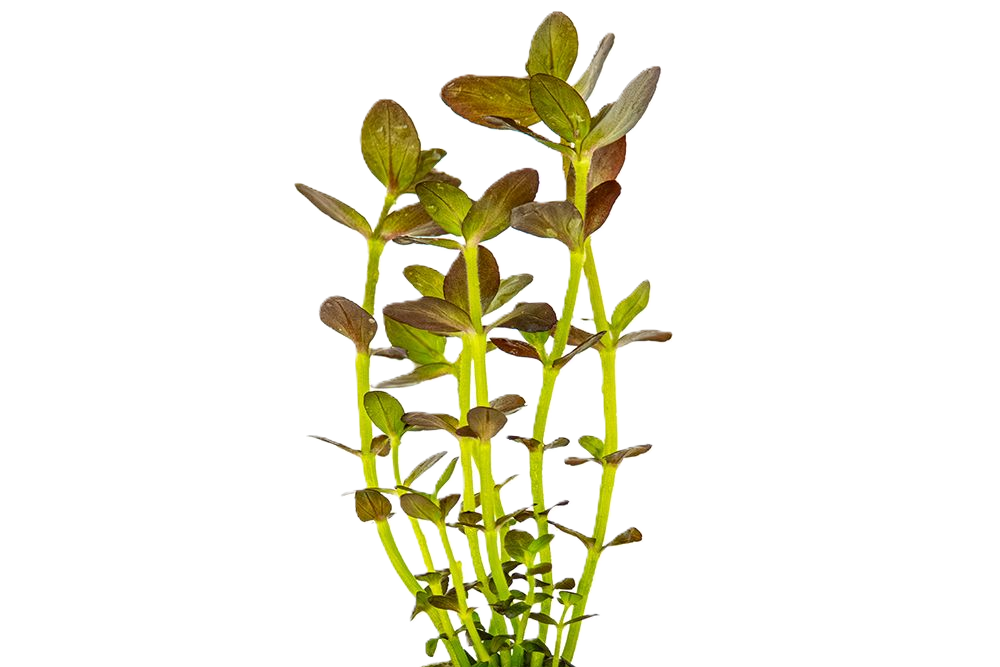
Morphologically, the plant features upright stems with opposite, oval to rounded leaves with blunt tips. Under suitable aquascaping conditions with adequate illumination, the foliage exhibits shades ranging from soft pink to reddish-violet, particularly on the leading shoots and upper stem sections.
In aquascape compositions, Bacopa salzmannii is positioned within the midground to background zones. Its relatively sturdy stem habit and short internodal spacing under intense lighting make it highly effective as a contrasting color accent among predominantly green flora.
Clarification: Distinct from the “Purple Singapore” Variant
Bacopa salzmannii is frequently confused with the variant known as “Purple Singapore”. Taxonomically and geographically, the two are distinct. The variant circulating under the trade name “Singapore” typically refers to a cultivated form featuring smaller leaves and a more compact growth habit. From a botanical standpoint, “Singapore” is not an official taxonomic entity, but rather a commercial or collector designation.
Key differences observed in cultivation involve several distinct morphological and behavioral traits. Regarding leaf structure, Bacopa salzmannii produces slightly broader and thicker leaves, whereas the “Singapore” variant generally displays smaller, narrower foliage. Under high light conditions, Bacopa salzmannii displays a soft pink-purple gradient, while the “Singapore” variant often exhibits a deeper, solid purple saturation under very high PAR levels coupled with high CO₂ concentration. At elevated PAR levels of 120 µmol m⁻² s⁻¹ or greater, Bacopa salzmannii forms closely spaced internodes while maintaining a natural appearance, whereas the “Singapore” variant grows even tighter with significantly shorter internodes. Furthermore, color stability in Bacopa salzmannii is more sensitive to nutrient and carbon fluctuations, reverting to a pale green state under unstable conditions, whereas the “Singapore” variant retains its deep pigmentation more consistently in stable high-tech systems. It is worth noting that the name “Singapore” reflects commercial trade labeling rather than a native geographical origin.
Care and Requirements
Growth Characteristics
This plant exhibits vertical growth, branching laterally when top shoots are trimmed. Its response to light intensity is pronounced; under low light, stems stretch with wide internodes and dominant green coloration, whereas high light induces compact growth and vivid pink-purple tones. Routine trimming is necessary to maintain bush density and prevent the lower foliage from deteriorating due to shading.
Lighting
Lighting requirements fall into the medium to high category, with an effective range for optimal performance between 70 and 150 µmol m⁻² s⁻¹ PAR. Below approximately 60 µmol m⁻² s⁻¹ PAR, the plant remains viable, though purple pigmentation will be difficult to achieve. Within the 100 to 150 µmol m⁻² s⁻¹ PAR range—supported by balanced nutrients and stable CO₂—coloration becomes intense and stem structures grow sturdy.
CO₂ and Carbon
Carbon requirements are classified as medium to high. Without CO₂ injection, Bacopa salzmannii can survive in low-tech systems under medium light, though growth remains slow and foliage leans toward green. In high-tech systems with stable CO₂ injection around 20 to 30 ppm, growth accelerates, internodal distance shortens, and anthocyanin pigmentation develops optimally.
Nutrition
As a stem plant, Bacopa salzmannii responds actively to balanced nitrogen, phosphate, and potassium availability. Nitrogen deficiency causes pale terminal shoots, while a lack of micronutrients—particularly iron—can hinder vivid color development. Maintaining consistent nutrient stability is far more critical than applying heavy doses intermittently.
Water Parameters
This species performs best in soft to moderately hard water conditions. Recommended guidelines include a pH range of 5.5 to 7.5, a general hardness of 2 to 8 dGH, a carbonate hardness of 0 to 4 dKH, and a temperature range of 22 to 28 °C. Excessively hard water can impair the uptake of specific nutrients and negatively impact color expression.
Substrate
An active substrate with good cation exchange capacity supports healthy root system establishment. While the plant can grow in inert sand provided water column fertilization is consistent, peak performance is typically achieved using an active aquasoil that keeps the root zone slightly acidic while providing essential base nutrients.
Propagation
Propagation is accomplished through stem cuttings. Healthy terminal shoots measuring 5 to 8 cm in length can be trimmed and replanted directly into the substrate, leaving sufficient space between stems so light reaches the base. Adventitious roots readily establish from buried nodes within a few days under stable aquarium conditions.
Conclusion
Bacopa salzmannii is a pink-purple aquatic stem plant suitable for midground and background placement in medium-to-high light aquariums. It represents a distinct species rather than the “Purple Singapore” trade variant, possessing its own unique morphological features and color responses. It is an excellent choice for aquascapers seeking a soft color accent in high-tech environments with stable CO₂, while remaining adaptable to medium-light setups where green hues are acceptable. Aesthetically, its rounded leaf texture contrasts nicely against fine-leafed stem plants, making it a valuable visual element in both natural and modern layout designs.