Daftar Isi Show
| Characteristic | Detail |
|---|---|
| Genus | Blyxa |
| Species | Blyxa japonica |
| Family | Hydrocharitaceae |
| Origin | East and Southeast Asia, particularly shallow freshwater habitats |
| Common Name | Japanese Blyxa |
| Light Requirement | Medium to high (±70–150 µmol m⁻² s⁻¹ / PAR) |
| Optimal Temperature | 22–28 °C |
| Growth Rate | Moderate to fast |
| Placement | Midground |
| Plant Height | 10–30 cm |
| Ideal pH | 5.5–7.0 |
| Water Hardness | GH ±2–10 dGH; KH ±0–4 dKH |
| CO₂ Requirement | Medium to high |
| Propagation | Basal offsets and division of established clumps |
Additional Information
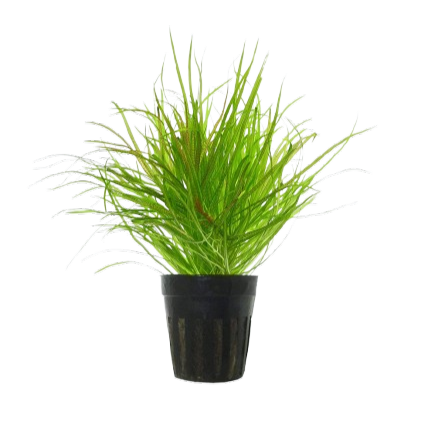
Blyxa japonica is a narrow-leaved aquatic plant that develops as a compact, tufted rosette. Its elongated, flexible leaves emerge from a short basal stem and radiate outward, creating a distinctive grass-like appearance without forming a conventional creeping carpet.
Leaf coloration typically ranges from bright green to deeper green, although plants exposed to stronger illumination and specific nutrient conditions may develop warmer yellowish or reddish tones. The intensity of these color changes depends on the interaction between light, carbon availability, nutrient status, and overall plant health.
In aquascaping, Blyxa japonica is primarily used as a midground plant because of its compact rosette architecture and dynamic foliage. Its fine leaves create a soft, textured transition between low-growing foreground plants and larger background vegetation.
The species is associated with shallow freshwater habitats in East and Southeast Asia, where it can grow in soft substrates with access to light and dissolved nutrients. Its active root system supports vegetative growth and contributes to the development of dense, established clumps.
Care and Requirements
Growth Characteristics
Blyxa japonica develops as a tufted rosette and produces lateral basal offsets around the parent plant. Individual leaves grow predominantly upward and outward, often developing a gentle curvature toward their tips.
The species responds strongly to both light intensity and carbon availability. Under favorable conditions, it can develop compact, dense clumps with shorter and more robust foliage.
When light or carbon availability is insufficient, growth tends to become more elongated and open. The resulting plant may lose some of its characteristic compact appearance and become visually less effective as a midground specimen.
Because the plant reproduces through basal offsets, established specimens can gradually expand into larger groups when provided with sufficient substrate space and stable environmental conditions.
Lighting
The lighting requirement of Blyxa japonica falls within the medium to high range, approximately 70–150 µmol m⁻² s⁻¹ PAR.
Under lower light intensity, the leaves tend to become longer, thinner, and more widely spaced. Moderate to high light encourages shorter, denser foliage and helps maintain the compact rosette structure that makes the species valuable in aquascaping.
Strong illumination may also promote warmer pigmentation, including yellowish or reddish tones, although coloration should not be treated as a direct response to light alone. Nutrient availability, carbon stability, and overall plant health also influence pigmentation.
High light increases the demand for carbon and nutrients. If these factors are not balanced, algae can develop rapidly on the surrounding substrate and foliage.
CO₂ and Carbon
Blyxa japonica has a medium to high CO₂ requirement for optimal growth. Although it can survive in low-tech aquariums without injected CO₂, growth is generally slower and the resulting clumps may be less compact.
In CO₂-enriched systems, stable carbon availability supports faster leaf production, stronger basal development, and denser overall growth.
CO₂ stability is particularly important under high lighting. Increasing light intensity without providing sufficient carbon can create a physiological imbalance in which the plant is unable to utilize the available light efficiently.
For high-tech systems, consistent CO₂ availability is therefore one of the key factors in maintaining compact and vigorous growth.
Nutrients
Blyxa japonica obtains nutrients through both its root system and the water column. A balanced supply of macronutrients such as nitrogen, phosphorus, and potassium is important for sustained vegetative development.
Micronutrients, particularly iron and other trace elements, also contribute to healthy pigmentation and tissue formation. Nutritional deficiencies may appear as chlorosis, translucent foliage, reduced leaf production, or gradual deterioration of older leaves.
Because the species can grow relatively quickly under favorable conditions, nutrient availability should remain consistent rather than fluctuate significantly.
A nutrient-rich substrate combined with balanced water-column fertilization provides a reliable nutritional foundation for maintaining dense and healthy clumps.
Water Parameters
Suitable water conditions generally fall within a pH range of approximately 5.5–7.0, with temperatures between 22–28 °C.
Low to moderate water hardness, around GH 2–10 dGH and KH 0–4 dKH, is generally suitable for stable cultivation.
Although Blyxa japonica can tolerate some variation, sudden changes in pH, hardness, temperature, or carbon availability can cause physiological stress and contribute to leaf deterioration.
Parameter stability is therefore more important than targeting an exact numerical value. Consistent environmental conditions allow the plant to maintain steady vegetative growth and produce new basal offsets.
Substrate
A fine to medium-grained substrate with adequate nutrient availability is recommended for supporting the plant’s active root system.
Both nutrient-rich aquasoil and appropriately supplemented inert substrates can be used. Sufficient substrate depth provides mechanical stability for the rosette and allows roots to develop without becoming excessively restricted.
A nutrient-poor substrate can result in slower growth, thinner foliage, and reduced production of basal offsets.
Because the plant gradually expands through lateral offsets, sufficient space around the parent clump is also useful for allowing new growth to establish naturally.
Propagation
Propagation occurs primarily through basal offsets that develop around the parent plant.
Once an offset has developed sufficient roots and several healthy leaves, it can be carefully separated from the parent clump and replanted into the substrate.
The new plant should be positioned securely enough to prevent displacement while its root system establishes. Over time, the offset develops into an independent rosette and can produce additional offsets of its own.
This vegetative propagation method is relatively straightforward and allows aquascapers to gradually increase the number of Blyxa japonica specimens without significantly disturbing established plants.
Conclusion
Blyxa japonica is a distinctive midground aquascape plant valued for its tufted rosette structure, fine foliage, and dynamic growth architecture. Its compact form provides an effective visual transition between low foreground vegetation and taller background plants.
The species performs particularly well in medium to high-tech systems with strong but controlled lighting, stable CO₂ availability, and balanced nutrition. It can survive in low-tech aquariums, but growth is generally slower and the resulting foliage may be less compact.
As a midground specimen, Blyxa japonica introduces fine texture and natural movement to an aquascape while maintaining a distinct architectural form. Its ability to develop dense clumps and produce warmer foliage tones under favorable conditions makes it a versatile choice for professionally structured natural-style layouts.