Daftar Isi Show
| Characteristic | Detail |
| Genus | Ludwigia |
| Species | Ludwigia sp. ‘White’ (not formally identified) |
| Family | Onagraceae |
| Origin | Not clearly documented (likely a horticultural selection) |
| Common Name | Ludwigia White, Ludwigia White Stem |
| Light Requirement | High (±100–180 µmol m⁻² s⁻¹ / PAR) |
| Optimal Temperature | 22–28 °C |
| Growth Rate | Slow – Moderate (tends to slow down after trimming) |
| Placement | Midground – Background |
| Plant Height | 20–50 cm |
| Ideal pH | 5.5–7.0 |
| Water Hardness | GH 2–8 dGH; KH 0–4 dKH |
| CO₂ Requirement | High |
| Propagation | Stem cutting |
Additional Information
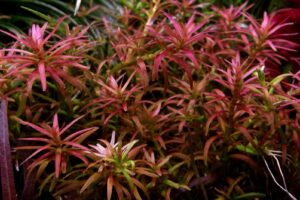
Ludwigia sp. ‘White’ is a rare stem plant variant known for its unique coloration, featuring white to pale cream leaves with faint pink undertones under optimal conditions. Morphologically, it grows with upright stems and opposite, oval-to-oblong leaves that are relatively thin compared to other Ludwigia species.
In aquascaping layouts, this plant functions as a strong visual focal point, providing extreme contrast against green and red plants. It is typically positioned in the midground to background as an accent plant rather than a background mass plant due to its sensitivity and unpredictable growth patterns.
Physiologically, the white leaf coloration indicates extremely low chlorophyll content, which restricts photosynthetic capacity. This inherent limitation makes Ludwigia sp. ‘White’ a highly demanding species with low tolerance for environmental fluctuations.
Care and Requirements
Growth Characteristics
Growth is strictly vertical with a single-stem structure that may branch out following a trim. During the initial setup after planting, the species displays relatively stable growth with longer internodes.
However, post-trimming response is often inconsistent. New side shoots usually emerge smaller, shorter, and frequently experience growth stagnation.
This species relies heavily on environmental stability. Minor fluctuations in light intensity, CO₂ levels, or nutrient delivery can easily trigger growth arrest.
Lighting
- Category: High (±100–180 µmol m⁻² s⁻¹ / PAR)
High-intensity lighting is crucial to maintaining its distinct white coloration. At PAR levels below ±90 µmol m⁻² s⁻¹, the plant tends to:
- Revert to green due to increased chlorophyll production
- Stretch vertically (etiolation)
- Lose its visual aesthetic value
At optimal high PAR levels (±120–180 µmol m⁻² s⁻¹):
- The white color remains stable
- Internodes stay short
- Plant structure becomes compact
High lighting without balanced nutrients and stable CO₂ will accelerate physiological stress and tissue damage.
CO₂ and Carbon
- Category: High
This species cannot perform reliably without dedicated CO₂ injection. In low-tech or non-CO₂ setups, growth remains extremely slow and white coloration is virtually impossible to maintain.
In high-tech systems with stable CO₂ concentrations (±20–30 mg/L):
- Growth becomes more consistent
- Colors appear brighter
- The risk of leaf melting decreases
Fluctuations in CO₂ delivery are a primary trigger for post-trimming stagnation.
Nutrition
Nutrient requirements are highly sensitive and require a precise balance between macronutrients and micronutrients.
Important factors include:
- Nitrate Control: Excessive nitrate levels can stimulate chlorophyll production, causing the leaves to green up.
- Iron (Fe): Essential for maintaining the pale, porcelain-like leaf hue.
- Micronutrient Balance: Deficiencies quickly show as miniature, hyper-pale leaves.
Ludwigia sp. ‘White’ is particularly vulnerable to nutrient imbalances, not just severe deficiencies.
Water Parameters
This plant thrives within narrow water parameter ranges:
- pH: 5.5–7.0
- Temperature: 22–28 °C
- GH: 2–8 dGH
- KH: 0–4 dKH
Elevated water hardness (GH/KH) inhibits growth and worsens post-trimming recovery. Parameter stability is far more critical than achieving precise target values.
Substrate
An active aquasoil substrate is strongly recommended to:
- Deliver essential nutrients directly to the roots
- Maintain a stable, slightly acidic pH environment
- Support fine root development
Because the root system of Ludwigia sp. ‘White’ is non-aggressive, substrate quality directly impacts overall plant health.
Propagation
Propagation is executed via stem cuttings. However, replanting cuttings does not always yield long-term stability.
Standard procedure:
- Cut healthy stem tops using sharp aquascaping scissors.
- Replant directly into the active substrate.
- Maintain strict environmental stability before and after trimming.
Success rates depend heavily on water stability and nutrient availability at the time of propagation.
Why It Frequently Stagnates After Trimming
The growth stagnation commonly observed in Ludwigia sp. ‘White’ post-trimming is a physiological response rather than a simple maintenance issue:
- Low Chlorophyll Content: The white coloration reflects minimal chlorophyll concentration. When the main top section is removed, the plant loses its main photosynthetic engine. New shoots struggle to grow with limited energy reserves.
- Apical Dominance Dependency: The plant relies strongly on its growing tip (apical meristem). Trimming disrupts growth hormone distribution (auxins), making it difficult for lateral buds to develop normally.
- High Physiological Stress: Pruning causes severe tissue stress. Unlike hardy stem plants, Ludwigia sp. ‘White’ has low stress resilience, often resulting in stunted growth, leaf miniaturization, or dull color.
- Energy Deficit: Post-trimming regeneration demands significant energy. Without absolute optimal light, CO₂, and nutrient levels, recovery fails.
- Weak Root System: The delicate root network provides insufficient energy reserves to support rapid recovery after top tissue removal.
Due to these factors, many aquascapers view it as a “single-cycle” or accent plant that looks its best primarily during the initial growth phase before the first trim.
Conclusion
Ludwigia sp. ‘White’ is an exceptional aquascape plant offering high visual value, but it remains one of the most sensitive species in the hobby. Its striking white foliage creates unmatched contrast, yet reflects underlying physiological vulnerabilities.
This plant is best suited for high-tech aquariums with precise environmental control over lighting, CO₂, and nutrient dosing. In aquascaping practice, it functions most effectively as a temporary accent plant rather than a long-term, heavily pruned stem species.