Daftar Isi Show
| Karakteristik | Detail |
|---|---|
| Genus | Ludwigia |
| Spesies | Ludwigia glandulosa |
| Keluarga | Onagraceae |
| Asal | North America (primarily the southeastern United States) |
| Nama Umum | Red Star Ludwigia |
| Kebutuhan Cahaya | Medium–high (±80–150 µmol m⁻² s⁻¹ / PAR) |
| Suhu Optimal | 20–28 °C |
| Laju Pertumbuhan | Moderate |
| Area Penanaman | Midground – background |
| Tinggi Tanaman | 20–50 cm |
| pH Ideal | 5.5–7.0 |
| Kesadahan Air | GH 2–8 dGH; KH 0–4 dKH |
| Kebutuhan CO₂ | Medium–high |
| Cara Perbanyakan | Stem cuttings |
Additional Information
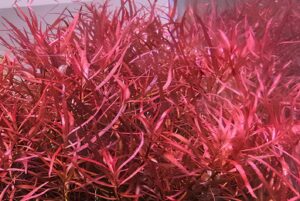
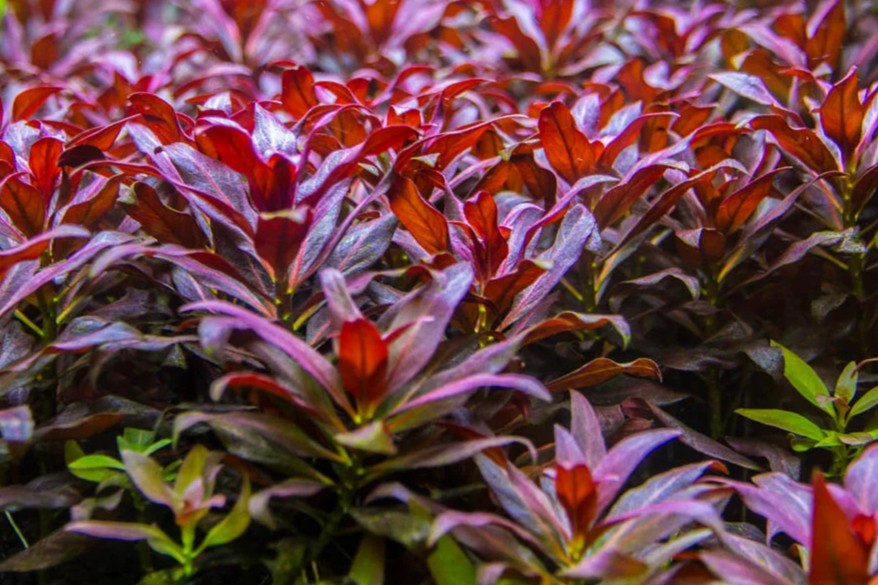
Ludwigia glandulosa is a stem plant with a highly distinctive visual character, particularly due to its leaf coloration, which can develop into deep red to dark purple under optimal conditions. The leaves are arranged oppositely, narrow lanceolate in shape, and relatively rigid compared to other Ludwigia species.
In aquascaping, this plant is commonly used as a contrasting color accent in the midground to background. Its upright stem structure and vertical growth provide strong visual dimension, especially when planted in dense groups. The intensity of its coloration is strongly influenced by lighting and nutrient stability.
Its natural habitat consists of shallow waters such as swamps, slow-moving rivers, and riverbanks. These environments typically feature soft substrates rich in organic matter, along with seasonal water fluctuations.
Functionally within an aquascape layout, Ludwigia glandulosa serves as a focal point plant. It is not intended for covering large areas, but rather as a contrasting element to enhance visual composition.
Requirements and Care
Growth Characteristics
This plant grows vertically with a predominantly upright stem structure. Branching occurs after trimming, although it naturally tends to form a single dominant stem.
Its response to light is highly significant. Under low light, growth continues but coloration becomes dull green and internodes elongate. Under high light, the plant becomes more compact with shorter internodes and develops deep red coloration.
Lighting
Category: medium–high
The optimal PAR range is approximately 80–150 µmol m⁻² s⁻¹. At the lower end of the medium range, the plant can survive but will not display optimal coloration.
Increasing light intensity enhances anthocyanin pigmentation, producing deeper red to purple tones. However, high light must be balanced with stable CO₂ and nutrient levels to prevent ecosystem imbalance.
CO₂ and Carbon
Ludwigia glandulosa is not recommended for systems without CO₂ injection. While it may survive in low-tech setups, growth becomes slow, coloration fades, and structural stability declines.
In high-tech systems with stable CO₂ injection, the plant achieves optimal performance in terms of color intensity, leaf density, and growth rate.
Nutrients
As a vividly colored stem plant, its nutrient demand is relatively high, particularly for macronutrients such as nitrogen (N), phosphorus (P), and potassium (K), as well as micronutrients like iron (Fe).
Iron availability plays a crucial role in maintaining red coloration. However, overall nutrient balance is more critical than focusing on a single element.
Nutrient imbalance is often indicated by pale leaves or inhibited growth.
Water Parameters
Ideal parameters include a pH range of 5.5–7.0 with low to moderate hardness (GH 2–8 dGH; KH 0–4 dKH). The plant tends to perform more consistently in soft water.
Parameter stability is far more important than achieving exact numerical values. Sudden fluctuations in pH, GH, or CO₂ can induce stress and reduce leaf quality.
The optimal temperature range is 20–28 °C, with moderate tolerance to gradual temperature variation.
Substrate
A nutrient-rich active substrate strongly supports root system development. Ludwigia glandulosa develops a relatively established root structure, making substrate quality relevant for both stability and nutrient uptake.
In inert substrates, growth remains possible but requires consistent nutrient supplementation via the water column.
Substrate stability is important to prevent uprooting, particularly due to the plant’s relatively rigid stems.
Propagation
Propagation is carried out through stem cuttings. Healthy top sections are trimmed and replanted into the substrate.
The remaining stem typically produces lateral shoots, increasing plant density. Routine trimming is necessary to maintain shape and prevent excessive vertical growth.
Conclusion
Ludwigia glandulosa is an aquascape plant with high aesthetic value, defined by its intense red coloration and firm stem structure. It is best suited for medium to high-tech systems with strong lighting and stable CO₂ supply.
Within an aquascape layout, it is ideally positioned in the midground to background as a contrasting accent plant. With proper care and stable water parameters, it can function as a dominant visual element that significantly enhances overall composition.