Daftar Isi Show
| Characteristics | Detail |
|---|---|
| Genus | Ludwigia |
| Species | Ludwigia senegalensis |
| Family | Onagraceae |
| Origin | Africa (tropical regions) |
| Common Name | Ludwigia Senegalensis |
| Light Requirement | Medium–high (±70–150 µmol m⁻² s⁻¹ / PAR) |
| Optimal Temperature | 20–26 °C |
| Growth Rate | Moderate |
| Placement | Midground |
| Plant Height | ±10–30 cm |
| Ideal pH | 5.5–7.2 |
| Water Hardness | GH 2–8 dGH; KH 0–4 dKH |
| CO₂ Requirement | Adaptive–medium |
| Propagation Method | Stem cuttings |
Additional Information
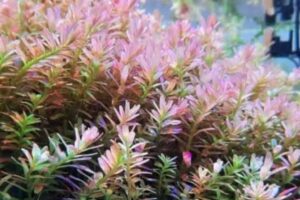
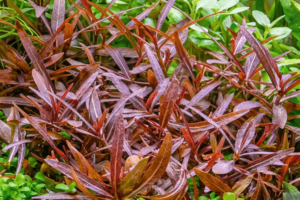
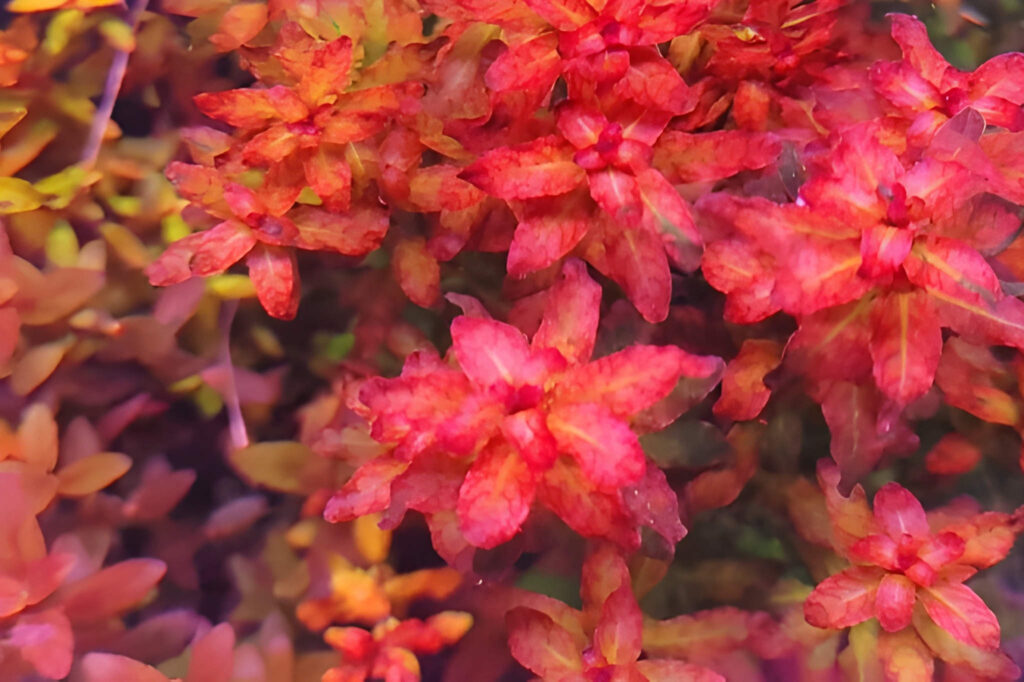
Ludwigia senegalensis is a small to medium-sized stem plant used in aquascaping, originating from tropical regions of Africa. This species is known for its distinctive red coloration, often accompanied by fine vein patterns (reticulation) on the leaf surface when grown under optimal conditions.
The leaves are oval to elongated in shape, relatively small in size, and arranged in opposite pairs along the stem. Leaf coloration can vary from brownish green to bright red, depending on light intensity, nutrient availability, and overall system stability.
In aquascape layouts, Ludwigia senegalensis is most effectively used as a midground plant. Its moderate height and relatively open stem structure make it ideal as a visual transition element between foreground and background. It is also frequently used to provide a red accent that contrasts with darker hardscape or surrounding green plants.
Requirements and Care
Growth Characteristics
Ludwigia senegalensis grows vertically as a stem plant, with lateral branching emerging from the nodes. Under optimal conditions, the plant develops side shoots, though not as densely as some other stem species, maintaining a relatively open structure.
Its response to environmental conditions is fairly flexible. Under low nutrient or limited light conditions, the plant tends to produce smaller leaves with thicker-looking stems. In contrast, under nutrient-rich and well-lit conditions, leaves grow broader with more balanced proportions.
Light
This plant falls within the medium to high light category, with a requirement of approximately ±70–150 µmol m⁻² s⁻¹ PAR.
Under low light intensity, leaf coloration tends to shift toward olive green with minimal red pigmentation. Internodes also become longer, resulting in a less compact appearance.
Conversely, under high lighting with a supportive spectrum, red coloration becomes more dominant and evenly distributed, often forming distinctive vein patterns. Leaves also become denser and more proportionate, enhancing the plant’s aesthetic value in aquascapes.
CO₂ and Carbon
Ludwigia senegalensis is considered adaptable to CO₂ availability. It can survive in low-tech systems without CO₂ injection, particularly at lower temperatures and moderate lighting.
However, in high-tech systems, stable CO₂ injection significantly improves growth, leaf size, and color intensity. Stability is the key factor; CO₂ fluctuations may inhibit growth, especially at the tips, where symptoms such as smaller and darker leaves may appear.
Nutrients
The nutrient requirement of Ludwigia senegalensis is moderate, but maintaining a balance of macro and micronutrients is critical for stable growth.
This plant responds well to nutrients absorbed through the roots, particularly nitrogen in reduced forms available in the substrate zone. Adequate nutrient availability results in larger leaves and a healthier plant structure.
Nutrient imbalance, whether deficiency or excess, can cause issues at the growing tips, such as stunted growth or discoloration.
Water Parameters
Stable water parameters are essential for maintaining plant performance.
The ideal pH range is 5.5–7.2, with an optimal temperature of 20–26 °C. This plant performs best in low to moderate water hardness, around GH 2–8 dGH and KH 0–4 dKH.
Nevertheless, Ludwigia senegalensis remains adaptable to a range of conditions as long as there are no drastic parameter fluctuations.
Substrate
Substrate plays an important role in the growth of this plant, particularly due to its active root system in nutrient absorption.
The use of nutrient-rich or active substrates helps provide a stable reserve of nutrients in the root zone. This directly influences leaf size, color intensity, and long-term growth stability.
In inert substrates, growth is still possible but requires more precise nutrient management to achieve optimal results.
Propagation
Propagation of Ludwigia senegalensis is carried out through stem cuttings, which is a standard method for stem plants.
The top portion is cut and replanted into the substrate. Meanwhile, the remaining stem can produce lateral shoots under healthy conditions, gradually increasing plant density.
Regular trimming practices also help maintain a proportional plant shape and stimulate new branch growth.
Conclusion
Ludwigia senegalensis is a midground aquascape plant characterized by its distinctive red coloration and unique leaf patterns. It has good adaptability, making it suitable for both low-tech and high-tech systems, although its best performance is achieved under sufficient lighting and stable CO₂ conditions.
From an aesthetic perspective, this plant provides strong color contrast within aquascape layouts. Functionally, it remains manageable with standard stem plant techniques. The combination of flexibility and visual character makes it an excellent choice for aquascapers seeking to introduce red accents without high complexity.