Daftar Isi Show
| Characteristics | Detail |
|---|---|
| Genus | Limnophila |
| Species | Limnophila aromatica |
| Family | Plantaginaceae |
| Origin | Southeast Asia |
| Common Name | Limnophila aromatica Mini, Limnophila cf. hippuridoides ‘Mini’ |
| Light Requirement | Medium–high (±70–150 µmol m⁻² s⁻¹ / PAR) |
| Optimal Temperature | 22–26 °C |
| Growth Rate | Moderate–fast |
| Placement | Midground, foreground (small tanks), group |
| Plant Height | 10–30 cm |
| Ideal pH | 6.0–7.5 |
| Water Hardness | GH 3–10 dGH; KH 1–6 dKH |
| CO₂ Requirement | Medium–high |
| Propagation Method | Stem cuttings |
Additional Information
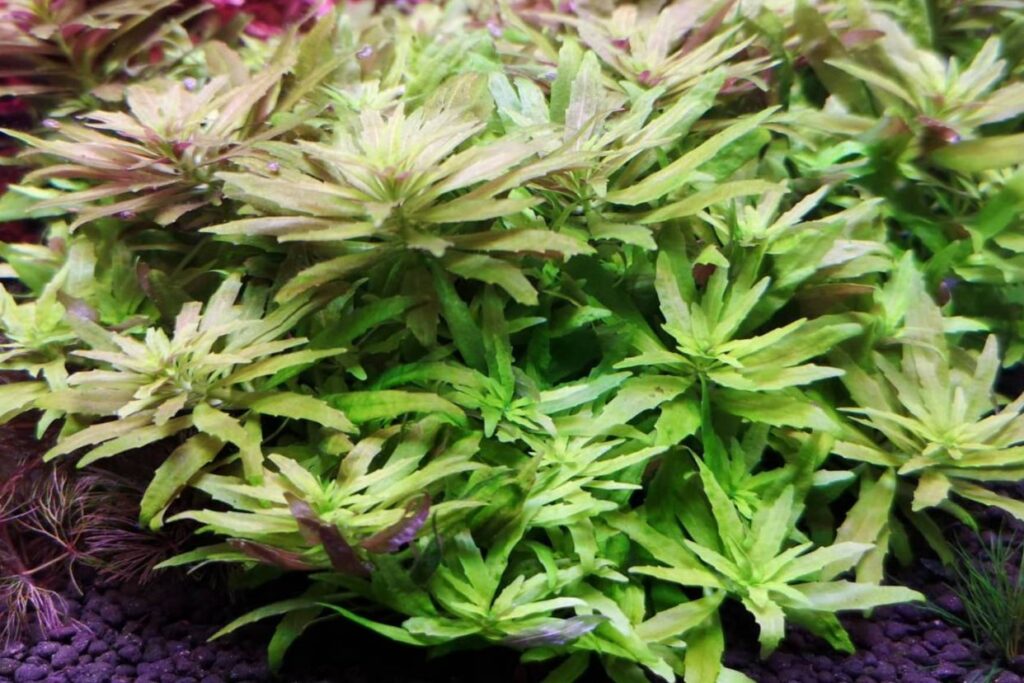
Limnophila aromatica ‘Mini’ is a common trade name used in the aquascaping hobby for the plant Limnophila cf. hippuridoides ‘Mini’. Morphologically, this plant has lance-shaped leaves with finely to distinctly serrated edges, arranged oppositely or in whorls. The leaves are relatively small, yet retain the characteristic features of the aromatica variety.
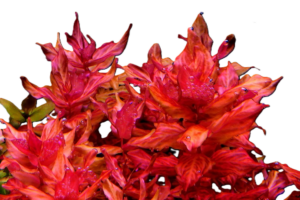
In submerged conditions, leaf coloration is strongly influenced by light intensity. Under high lighting, the leaves develop brownish-red to purple tones with a contrasting midrib that tends to remain green. Under lower light intensity, the leaves appear bright green with slight yellowish hues.
Its natural habitat originates from shallow waters and swamp areas in Southeast Asia with relatively stable water conditions. In aquascaping, this plant is commonly used as a midground accent or as a foreground plant in small tanks due to its manageable size and density through trimming.
Its compact visual character and strong response to shaping make it effective for creating fine textures and layering within layouts, especially in nature aquarium and Dutch-style aquascapes.
Common misidentification in Limnophila aromatica ‘Mini’
In the aquascape hobby, the name Limnophila aromatica ‘Mini’ is widely used, but from a botanical standpoint it is often inaccurate. When evaluated based on morphology, most plants sold under this name do not match the defining characteristics of Limnophila aromatica.
True L. aromatica typically produces only two to three leaves per node in submerged conditions, resulting in a more open and less compact structure. In contrast, the plant commonly referred to as “aromatica mini” shows a much higher leaf count per node, often five or more, forming a dense and compact growth pattern. This trait is a key identifier of Limnophila hippuridoides.
The overall morphology, including the tighter leaf arrangement and naturally dense structure, aligns more closely with L. hippuridoides rather than L. aromatica. Because of this, referring to this plant as Limnophila aromatica ‘Mini’ is misleading if judged by botanical characteristics.
Based on observable morphology, a more accurate identification would be a compact or mini form of Limnophila hippuridoides. In other words, what is commonly sold as Limnophila aromatica ‘Mini’ is, in most cases, better described as Limnophila cf. hippuridoides ‘Mini’.
Understanding this distinction is important not only for correct plant identification but also for setting appropriate expectations in terms of growth pattern and visual outcome in aquascape layouts.
Requirements and Care
Growth Characteristics
This plant grows vertically following a classic stem plant pattern. Internodes tend to remain short under optimal conditions, resulting in a dense and neat appearance. It responds very well to trimming, where pruning stimulates lateral shoot development and increases plant density.
Under limited light and nutrient conditions, the plant tends to elongate, with longer internodes that significantly reduce its aesthetic value.
Light
The light requirement falls within the medium to high category. At approximately ±70–90 µmol m⁻² s⁻¹, the plant can grow stably with predominantly green coloration. However, to develop its characteristic red pigmentation, higher intensity in the range of ±100–150 µmol m⁻² s⁻¹ is required.
High light also helps maintain short internodes and a compact structure. In contrast, low light results in elongated growth and less intense coloration.
CO₂ and Carbon
This plant can survive without CO₂ injection, but its optimal performance depends heavily on the availability of dissolved carbon. In non-CO₂ systems, growth tends to be slower and coloration less developed.
In high-tech systems with stable CO₂, the plant exhibits faster growth, denser structure, and more intense coloration. Therefore, its CO₂ requirement is classified as medium to high in aquascaping practice.
Nutrients
As an active stem plant, Limnophila aromatica ‘Mini’ requires a consistent nutrient supply. Macronutrients such as nitrogen, phosphate, and potassium must be available in stable amounts to support growth and maintain leaf coloration.
Micronutrients, particularly iron, play a role in red color development. Nutrient imbalance may result in pale leaves, stunted growth, or deformation at the shoot tips.
Water Parameters
This plant is relatively tolerant of varying water parameters as long as they remain stable. The ideal pH range is slightly acidic to neutral, with an optimal temperature between 22–26 °C.
Low to moderate water hardness is preferred, particularly to support efficient nutrient uptake. Sudden parameter fluctuations may induce stress and disrupt growth.
Substrate
Nutrient-rich substrates such as aquasoil provide advantages during the initial growth phase, particularly for root development. However, as a stem plant, primary nutrient uptake still occurs through the water column.
A stable substrate structure helps maintain stem positioning and facilitates replanting after trimming.
Propagation
Propagation is carried out through stem cuttings. The top portion can be cut and replanted directly into the substrate, where it will develop new roots within a relatively short period.
Regular trimming serves not only as a propagation method but also as a technique to maintain plant shape and density within the aquascape layout.
Conclusion
Limnophila aromatica ‘Mini’ is a compact stem plant highly adaptable to modern aquascaping systems. It is suitable for use as a midground plant or as a foreground element in small tanks, particularly in layouts requiring fine texture and color contrast.
In low-tech systems, the plant can still grow stably, although with limited visual performance. In high-tech systems with strong lighting and adequate CO₂ supply, it can fully express its potential in both coloration and structure.
Overall, Limnophila aromatica ‘Mini’ offers high aesthetic value and versatile application, making it an excellent choice for aquascapers seeking a balance between compact form and dynamic coloration.