Daftar Isi Show
| Characteristics | Details |
|---|---|
| Genus | Ludwigia |
| Species | Ludwigia inclinata |
| Family | Onagraceae |
| Origin | South America (Brazil, Pantanal region) |
| Common Name | Ludwigia Pantanal |
| Light Requirement | High to very high (±120–300 µmol m⁻² s⁻¹ / PAR) |
| Optimal Temperature | 22–28 °C |
| Growth Rate | Moderate (can become fast under optimal conditions) |
| Placement | Background |
| Plant Height | 30–70 cm |
| Ideal pH | 5.0–6.8 |
| Water Hardness | GH 1–6 dGH; KH 0–3 dKH |
| CO₂ Requirement | High |
| Propagation | Stem cuttings |
Additional Information
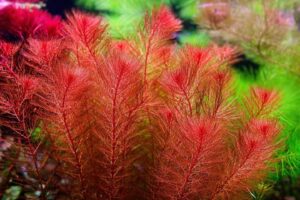
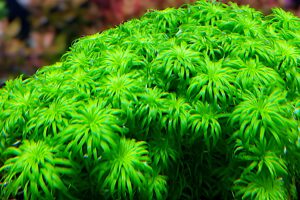
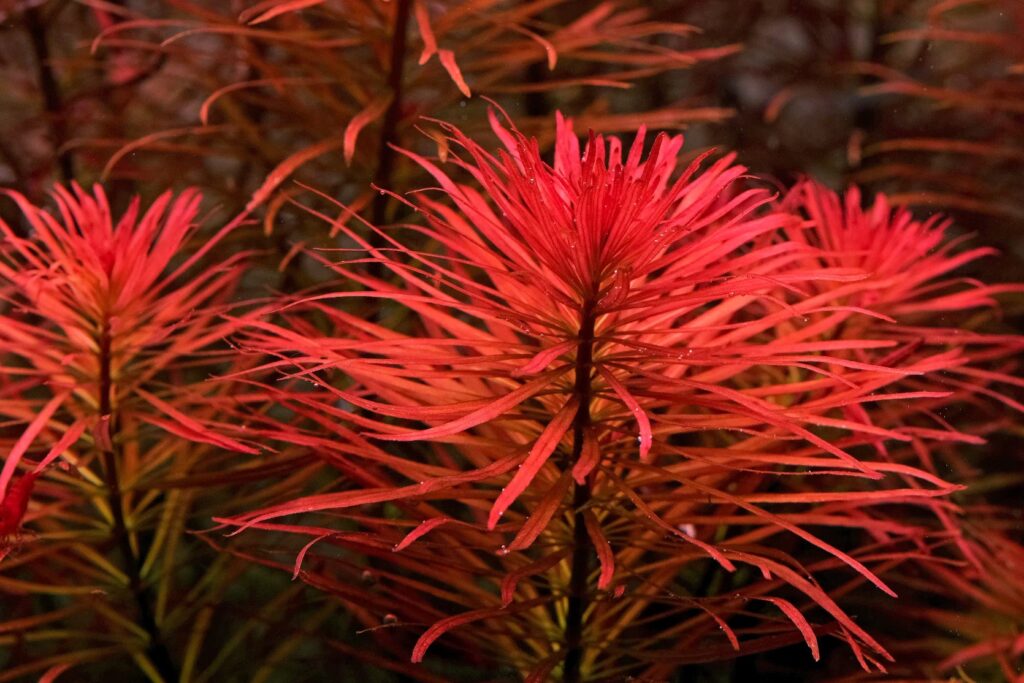
Ludwigia inclinata var. verticillata ‘Pantanal’ is a stem plant characterized by very fine leaves arranged in a whorled pattern along the stem. The narrow and elongated leaf shape creates a light visual texture, providing contrast against broader-leaved plants in aquascape compositions.
Plant coloration is highly influenced by light intensity, nutrient availability, and overall system stability. Under optimal conditions, the leaves can display a color spectrum ranging from bright green to golden yellow and intense orange-red with high saturation. Color shifts may occur relatively quickly in response to environmental parameter changes.
Its natural habitat is located in wetlands and shallow waters of the Pantanal region in South America, typically featuring soft, slightly acidic water. This adaptation explains its preference for low hardness and stable parameters in aquascape systems.
In aquascape layouts, this plant is primarily used as a background or focal accent. Its fine structure and dynamic coloration effectively create visual depth and serve as a strong point of interest within the composition.
Requirements and Care
Growth Characteristics
Growth is vertical, with stems extending toward the surface. Leaves grow densely under optimal conditions, resulting in a compact appearance. The plant responds to trimming by producing lateral shoots, although secondary growth tends to be smaller and not always structurally uniform.
Under stable high light and CO₂ conditions, growth can increase significantly. Conversely, system imbalance is quickly reflected through symptoms such as reduced apical size or halted growth.
Light
Category: high
This plant requires high to very high light intensity to maintain compact leaf structure and optimal coloration. At approximately ±120–150 µmol m⁻² s⁻¹, coloration begins to shift toward yellow and orange tones. Above ±180 µmol m⁻² s⁻¹, coloration becomes more intense and plant structure more compact.
Under low light conditions, leaves tend to remain pale green, internodes elongate, and density decreases. In such conditions, the plant’s characteristic visual traits do not develop optimally.
CO₂ and Carbon
CO₂ requirement is classified as high. This plant does not maintain stable performance without CO₂ injection, especially under high light systems.
In high-tech systems with stable CO₂ levels, growth becomes consistent and leaf morphology improves. CO₂ fluctuations often trigger early symptoms such as tip stunting and leaf deformation.
Nutrients
Nutrient demand is high. Macronutrients such as nitrogen and phosphate are required in sufficient amounts to support growth, while micronutrients such as iron play a key role in color development.
Nutrient balance is critical. The plant responds rapidly to changes in nutrient levels, making both deficiencies and excesses immediately visible in leaf condition and growth behavior.
Water Parameters
This plant performs best in soft water with slightly acidic to neutral pH. Low KH helps maintain pH stability in CO₂-injected systems, while low to moderate GH supports efficient nutrient uptake.
Parameter stability is the primary factor. Sudden changes in pH, CO₂, or hardness can directly affect growth and apical structure.
Substrate
Active substrates are preferred as they provide initial nutrients and help stabilize water conditions. Although stem plants are not entirely dependent on root systems, nutrient-rich substrate supports long-term growth.
Substrate also contributes to nitrogen availability in more accessible forms, influencing both leaf coloration and structure.
Propagation
Propagation is performed through stem cuttings. The apical portion is cut and replanted into the substrate.
In aquascaping practice, replanting tops is more commonly used than maintaining older stems. This is because new shoots from older stems tend to be smaller and less uniform, making it difficult to achieve a clean, dense plant mass.
Conclusion
Ludwigia inclinata var. verticillata ‘Pantanal’ is a high-difficulty background plant designed for high-tech systems. Its combination of intense light requirements, stable CO₂ supply, and balanced nutrition makes it a sensitive indicator of aquarium ecosystem stability.
This plant is not suitable for low-tech systems due to its dependence on dissolved carbon and high light intensity. Under optimal conditions, it provides high aesthetic value through dynamic coloration and fine texture, making it an effective contrast element in aquascape compositions.