Daftar Isi Show
| Characteristics | Details |
|---|---|
| Genus | Limnophila |
| Species | Limnophila barteri Skan |
| Family | Plantaginaceae |
| Origin | Tropical Africa (West, Central, to East Africa) |
| Common Name | Guinea Broad-Leaf Limnophila |
| Light Requirement | Medium–high (±70–140 µmol m⁻² s⁻¹ / PAR) |
| Optimal Temperature | 22–28 °C |
| Growth Rate | Fast |
| Planting Area | Midground |
| Plant Height | 15–40 cm |
| Ideal pH | 5.0–7.0 |
| Water Hardness | GH 2–10 dGH; KH 0–6 dKH |
| CO₂ Requirement | Medium–high |
| Propagation | Stem cuttings |
Additional Information
Limnophila barteri is a species within the Limnophila genus that exhibits morphological characteristics quite distinct from most commonly used aquascape species in the same group. It originates from tropical regions of Africa, with a wide geographical distribution spanning West, Central, and East Africa. Despite its broad natural range, it remains relatively rare in the aquascaping hobby due to limited commercial cultivation.
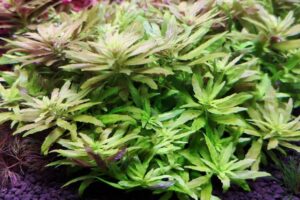
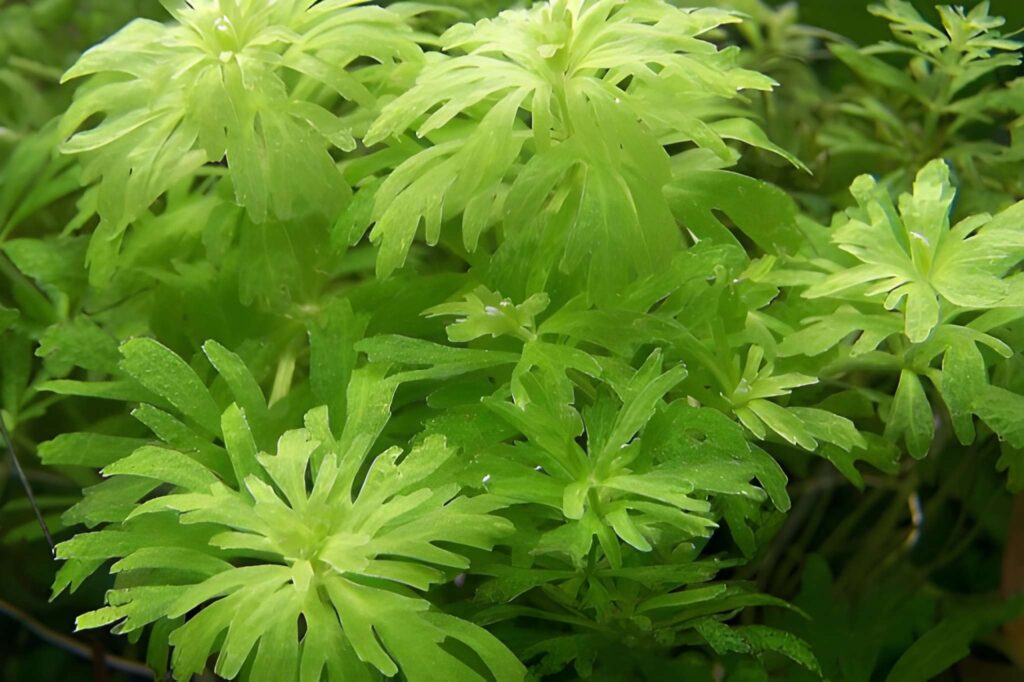
Visually, the main appeal of L. barteri lies in its submersed leaf structure, which is neither as finely divided as Limnophila indica nor as entire as Limnophila aromatica. The leaves are pinnately lobed with clearly defined segments, arranged in a whorled pattern along the stem. The coloration is typically bright green, with a light texture that gives a feathery impression while still maintaining structural integrity. Under high lighting conditions, the leaf lobes become finer and denser, enhancing the plant’s visual complexity.
In aquascaping, this species is not ideal as a background plant like most Limnophila species. Its relatively smaller and finer stem structure makes it more suitable for midground placement. With proper trimming techniques, L. barteri can be shaped into dense plant masses resembling bushes or undulating contours, adding dimension to the layout. This characteristic makes it particularly suitable for natural-style and Dutch-style aquascapes that emphasize layering and texture.
Care and Requirements
Growth Characteristics
Limnophila barteri exhibits a typical vertical growth pattern of stem plants, with a strong tendency to produce numerous lateral shoots under optimal conditions. This results in a dense, bushy, and highly branched structure, allowing aquascapers to form compact plant masses within a relatively short time.
The plant is highly responsive to environmental conditions. In stable systems with sufficient nutrients and CO₂, it grows rapidly with healthy leaves and active branching. Conversely, imbalances, especially in macronutrients or CO₂, often lead to early symptoms such as transparent patches on the leaves, which can progress into tissue degradation.
Due to this sensitivity, L. barteri is often used by experienced aquascapers as an indicator of nutrient and carbon stability within the system.
Lighting
The lighting requirement of Limnophila barteri falls within the medium to high range, with a practical PAR range of approximately 70 to 140 µmol m⁻² s⁻¹. At the lower end, the plant can still grow, but its morphology changes noticeably. Internodes become longer, leaves appear larger but less dense, and the overall structure looks looser.
As light intensity increases, particularly above 100 µmol m⁻² s⁻¹, the plant responds more optimally. Leaves develop finer lobes, internode spacing shortens, and lateral branching increases significantly. The result is a more compact and visually appealing plant structure.
Even light distribution is also critical. Shaded areas often lead to reduced leaf quality, even if overall lighting intensity in the tank is sufficient.
CO₂ and Carbon
From a carbon perspective, L. barteri has a relatively high dependency on dissolved CO₂. It is not suitable for non-CO₂ systems, as its metabolic and growth rates cannot be maintained under limited carbon conditions.
In systems with CO₂ injection around 25–40 mg/L, the plant performs optimally, showing rapid growth, increased lateral shoot production, and healthy leaf development. Stability is crucial, as fluctuations in CO₂ levels can quickly induce physiological stress, visible in leaf tissue.
In aquascaping practice, this species is best categorized as suitable for high-tech systems, although it may survive in well-managed medium-tech setups.
Nutrients
Limnophila barteri has relatively high nutrient demands, particularly for macronutrients such as nitrogen (NO₃⁻), phosphorus (PO₄³⁻), and potassium (K⁺). Consistent availability of these nutrients is essential to maintain leaf integrity and support active growth.
Nutrient deficiencies, especially nitrogen, are often indicated by transparent spots on the leaves, which later develop into tissue damage. This is one of the most common signs of imbalance in this species.
Micronutrients such as iron (Fe) also contribute to maintaining leaf color and vitality. However, as with most stem plants, overall nutrient balance is more important than focusing on a single element.
Water Parameters
In general, L. barteri thrives in soft to moderately hard water, with a slightly acidic to neutral pH range of 5.0–7.0. It tolerates GH levels of 2–10 dGH and KH levels of 0–6 dKH, as long as these parameters remain stable.
The ideal temperature ranges from 22 to 28 °C, aligning with its tropical origin. However, stability in temperature and chemical parameters is more important than exact values.
Water flow also plays a significant role in distributing CO₂ and nutrients. Reduced flow often correlates with decreased plant performance, especially in densely planted systems.
Substrate
As a stem plant, Limnophila barteri does not rely entirely on substrate-based nutrition, as it absorbs a significant portion of nutrients from the water column. However, using a nutrient-rich substrate provides advantages, particularly during the initial planting phase.
A porous and stable substrate supports root development, contributing to overall plant stability. In inert substrate systems, consistent nutrient dosing in the water column becomes essential to prevent deficiencies.
Propagation
Propagation of L. barteri is done vegetatively through stem cuttings. The process is straightforward: a healthy stem section is cut and replanted into the substrate. Under optimal conditions, the cutting quickly develops roots and continues growing.
Additionally, naturally occurring lateral shoots can also be used for propagation, making this plant efficient to multiply in stable aquascape systems.
Conclusion
Limnophila barteri is an aquascape plant with unique morphological characteristics, offering a combination of fine texture and branching structure within a single species. Compared to other members of the Limnophila genus, it has a more specific application as a midground element that forms dense plant masses.
It performs best in high-tech systems with medium to high lighting, stable CO₂ injection, and balanced nutrient supply. Its sensitivity to environmental changes makes it less suitable for low-tech setups, but also adds value as a system stability indicator.
From an aesthetic perspective, L. barteri provides variation in leaf shape and structural dynamics, enhancing aquascape compositions, especially in layouts that emphasize depth and visual layering.