Daftar Isi Show
| Characteristics | Details |
|---|---|
| Genus | Ludwigia |
| Species | Ludwigia inclinata |
| Family | Onagraceae |
| Origin | South America |
| Common Name | Ludwigia Meta |
| Light Requirement | High to very high (±120–250 µmol m⁻² s⁻¹ / PAR) |
| Optimal Temperature | 22–28 °C |
| Growth Rate | Moderate – fast (under optimal conditions) |
| Placement | Background |
| Plant Height | 30–60 cm |
| Ideal pH | 5.5–7.0 |
| Water Hardness | GH 1–6 dGH; KH 0–3 dKH |
| CO₂ Requirement | High |
| Propagation | Stem cuttings |
Additional Information
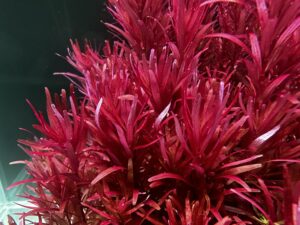
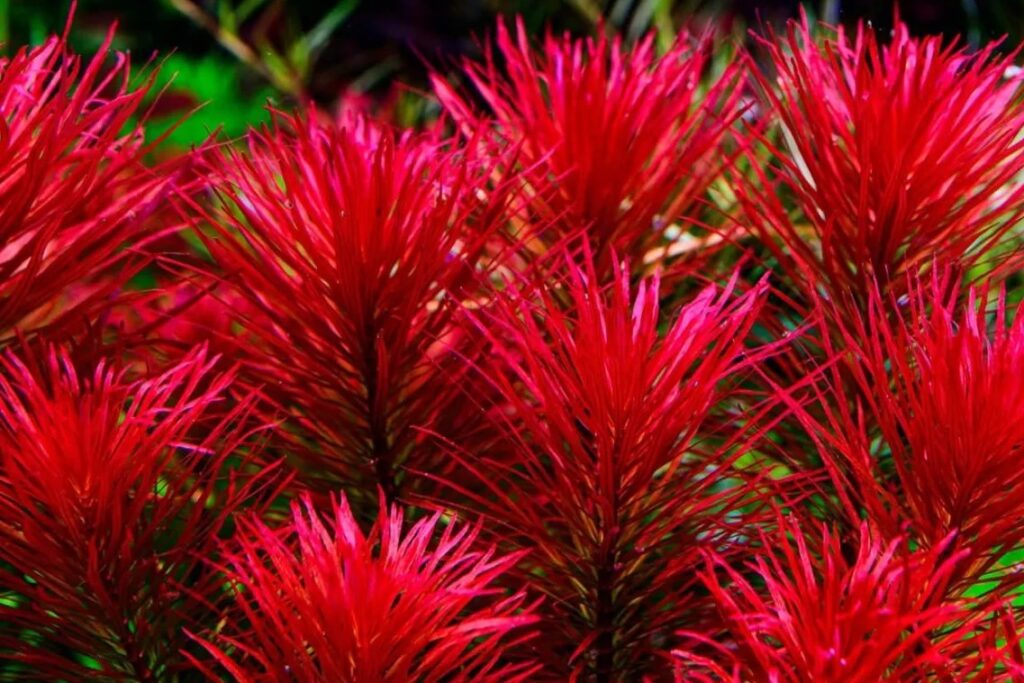
Ludwigia inclinata var. verticillata ‘Meta’ is a specific variant within the Ludwigia inclinata complex, recognized for its highly distinctive radial (whorled) leaf structure. The leaves are arranged in circular whorls along the stem, forming an elongated rosette-like silhouette with considerable structural complexity. Coloration ranges from yellowish green to intense orange-red, depending on light intensity and nutrient conditions.
In aquascaping, this plant holds high aesthetic value as a focal point in the background. Its vertical structure provides strong contrast against fine-leaved plants or carpeting species in the foreground. When planted in dense groups, ‘Meta’ creates a dynamic and complex visual texture, particularly in nature-style or Dutch-style layouts.
Its natural habitat consists of shallow waters with high light intensity and relatively stable nutrient availability. This ecological background explains its demanding technical requirements in aquarium systems.
Requirements and Care
Growth Characteristics
Ludwigia inclinata var. verticillata ‘Meta’ grows vertically with relatively rigid stems. Internodes may elongate significantly under suboptimal lighting. Under high light and high CO₂ conditions, growth becomes more compact with shorter internodal spacing.
The plant responds well to trimming. Regular pruning stimulates lateral branching, increasing density and visual appeal. However, without proper control, the plant can grow excessively tall and lose its compact structure.
Light
Category: high to very high.
This plant performs optimally under high light intensity. At PAR levels below ±100 µmol m⁻² s⁻¹, it tends to exhibit:
Elongated internodes
Pale or predominantly green coloration
Less dense leaf structure
In contrast, within the range of 120–250 µmol m⁻² s⁻¹:
Coloration becomes more intense (orange to red)
Growth becomes more compact
Whorled leaf formation appears clearer and more symmetrical
Light spectrum stability and even distribution are also critical in maintaining consistent leaf morphology.
CO₂ and Carbon
Category: high.
Ludwigia inclinata var. verticillata ‘Meta’ is highly dependent on a stable CO₂ supply. Without CO₂ injection, growth is significantly inhibited and often unstable over time.
In high-tech systems (stable CO₂ at ±20–30 ppm):
Growth is faster and healthier
Coloration is more intense
Risk of leaf deformation is reduced
CO₂ fluctuations are a common cause of issues such as reduced leaf size or growth stagnation.
Nutrients
As a demanding stem plant, nutrient requirements are relatively high, particularly:
Nitrogen (N) for vegetative growth
Phosphate (P) for energy metabolism
Potassium (K) for tissue stability
Micronutrients such as iron (Fe) for color intensity
Nutrient deficiencies, especially iron, often result in dull or yellowish coloration. Nutrient balance is more critical than simply increasing dosage.
Water Parameters
Optimal parameters:
pH: 5.5–7.0
Temperature: 22–28 °C
GH: 1–6 dGH
KH: 0–3 dKH
Soft water conditions generally support the best performance, particularly in maintaining coloration and leaf structure. Parameter stability is far more critical than targeting exact numerical values.
Substrate
Active substrate (aquasoil) is highly recommended because it:
Provides sufficient initial nutrients
Supports healthy root development
Helps maintain stable pH and low KH
Although the plant can grow in inert substrates, performance is typically suboptimal without consistent nutrient supplementation through the water column.
Propagation
Propagation is carried out through stem cuttings:
Cut the top portion of the plant with several nodes
Replant into the substrate
The remaining lower portion will produce new shoots
This method is effective and widely used in aquascaping practice to maintain plant density and layout structure.
Conclusion
Ludwigia inclinata var. verticillata ‘Meta’ is a background plant with a highly pronounced and complex visual character. Its whorled leaf structure and potential for intense coloration make it a prominent focal element in aquascapes.
This plant is best suited for high-tech systems with strong lighting, stable CO₂ supply, and precise nutrient management. Under optimal conditions, ‘Meta’ provides significant aesthetic contribution while enhancing the overall visual dynamics of professional aquascape layouts.