Daftar Isi Show
| Characteristics | Detail |
|---|---|
| Genus | Hygrophila |
| Species | lancea ‘Araguaia’ |
| Family | Acanthaceae |
| Origin | Southeast Asia (Japan – Hong Kong) |
| Common Name | Hygrophila Araguaia |
| Light Requirement | Medium–high (±80–150 µmol m⁻² s⁻¹ / PAR) |
| Optimal Temperature | 22–28°C |
| Growth Rate | Moderate |
| Placement | Midground |
| Plant Height | 10–30 cm |
| Ideal pH | 5–8 |
| Water Hardness | GH 3–12 dGH; KH 1–6 dKH |
| CO₂ Requirement | Medium–high (±20–30 mg/L) |
| Propagation | Top cuttings, side shoots |
Additional Information
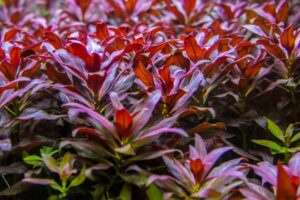
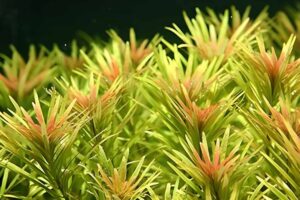
Hygrophila lancea ‘Araguaia’ is a dwarf variant of the Hygrophila genus with narrow, dense leaves and a distinctive coloration ranging from brownish-red to purple under optimal growth conditions. The leaves are closely arranged with short internodes, forming a compact bush that stands out in midground layouts.
In aquascaping, this plant provides a strong warm color accent, especially in Iwagumi and Nature Style compositions. Its natural branching habit makes it easy to form neat plant clusters. In certain conditions—particularly with nutrient-rich substrates and high light intensity—the stems may creep along the substrate surface before transitioning into vertical growth.
Requirements and Care
Growth Characteristics
Hygrophila lancea ‘Araguaia’ exhibits a vertical growth pattern with a natural tendency to produce lateral branches. Under high light and stable CO₂, the plant forms dense bushes with shorter and thicker leaves. In low light conditions, growth becomes elongated, coloration fades, and the structure becomes less compact. The plant shows a strong response to carbon availability: increased CO₂ results in deeper coloration and faster growth.
Lighting
Category: Medium–high (±80–150 µmol m⁻² s⁻¹ / PAR)
Under medium–high PAR, leaves consistently develop red–purple pigmentation. Insufficient light causes leaves to widen, coloration shifts toward greenish-brown, and internodes elongate. High light supports thicker, denser, and more dimensional plant structure, while also stimulating more intensive branching.
CO₂ and Carbon
CO₂ requirement falls into the medium–high category. The plant can survive without CO₂ injection, but its form tends to elongate, coloration becomes pale, and growth rate significantly decreases.
In high-tech systems with stable CO₂ levels around ±20–30 mg/L, the plant displays its best characteristics: compact structure, strong coloration, and optimal branching.
Nutrients
Hygrophila lancea ‘Araguaia’ responds well to a balanced nutrient supply, particularly micronutrients such as iron (Fe) and manganese (Mn), which support pigmentation. Stable availability of macronutrients (NO₃, PO₄, K) maintains a moderate growth rate without deficiencies or stunting. Nutrient imbalance—especially low NO₃—can lead to dull coloration and smaller leaves.
Water Parameters
This plant is tolerant of a wide parameter range, but stability remains crucial. The ideal pH range is 5–8. Optimal water hardness falls within GH 3–12 dGH and KH 1–6 dKH. Large fluctuations in KH or CO₂ can inhibit growth and cause uneven coloration.
Substrate
A nutrient-rich substrate supports early growth and facilitates strong root development. Although it can grow in inert substrates, access to nutrients from the root zone accelerates adaptation and promotes a more compact form. Its root structure is relatively strong, helping maintain stable positioning in midground layouts.
Propagation
Propagation is carried out through top cuttings and side shoots. Regular trimming stimulates the plant to produce new branches, increasing density. Replanting cuttings should be done with proper spacing to prevent excessive shading.
Conclusion
Hygrophila lancea ‘Araguaia’ is a midground plant with unique coloration, compact growth, and high responsiveness to light and carbon. It is best suited for high-tech systems that provide stable CO₂ and medium–high PAR, but it can still be used in low–medium tech setups with simpler coloration performance. Its primary aesthetic value lies in its brown-red to purple tones, enriching the visual character of aquascapes while providing a smooth transition from foreground to background.