Daftar Isi Show
| Characteristics | Details |
|---|---|
| Genus | Ludwigia |
| Species | Ludwigia arcuata |
| Family | Onagraceae |
| Origin | North America (southern United States) |
| Common Name | Needle Leaf Ludwigia |
| Light Requirement | Medium–high (±70–140 µmol m⁻² s⁻¹ / PAR) |
| Optimal Temperature | 22–28°C |
| Growth Rate | Moderate |
| Placement | Midground – background |
| Plant Height | 20–50 cm |
| Ideal pH | 5.5–7.0 |
| Water Hardness | GH 2–8 dGH; KH 0–4 dKH |
| CO₂ Requirement | Medium–high |
| Propagation | Stem cuttings |
Additional Information
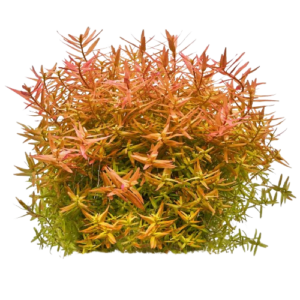
Ludwigia arcuata is a stem plant characterized by very slender, linear, needle-like leaves. This thin leaf structure creates a fine texture and provides strong contrast compared to broader-leaved stem plants in aquascapes.
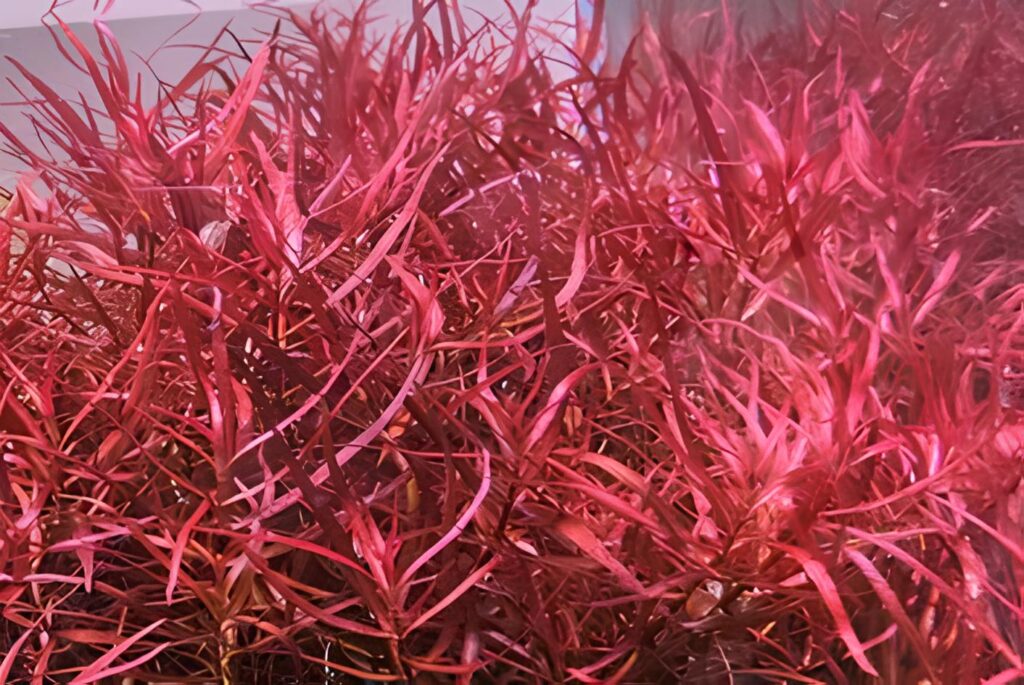
Under optimal conditions, leaf coloration can shift from bright green to orange and copper-red. Color intensity is strongly influenced by light, CO₂ stability, and nutrient balance, particularly micronutrients such as iron.
Its natural habitat consists of shallow waters, swamps, and slow-moving riverbanks. These environments typically feature soft substrates rich in organic matter and relatively stable water parameters.
In aquascape layouts, this plant is commonly used as a midground to background accent. Its fine leaf structure makes it effective for creating smooth visual transitions between foreground and background plants, while also enhancing depth perception within the layout.
Requirements and Care
Growth Characteristics
Ludwigia arcuata grows vertically as a stem plant with active lateral branching when regularly trimmed. Internodes tend to elongate under low light, while under higher light they become shorter, resulting in a more compact structure.
Its response to carbon availability is significant. Without additional CO₂, growth still occurs but is slower, with less dense stem structure.
Light
The light category ranges from medium to high, with an effective range of approximately ±70–140 µmol m⁻² s⁻¹.
At lower intensity:
Coloration tends to remain green
Internodes elongate
Plant structure becomes less compact
At higher intensity:
Red/orange coloration becomes more intense
Growth becomes more compact
Leaf density increases significantly
Even light distribution is essential to prevent lower stem sections from experiencing defoliation.
CO₂ and Carbon
This plant can survive without CO₂ injection (adaptive category), but optimal performance is achieved in systems with stable CO₂ supply (medium–high).
In high-tech systems:
Growth is faster and more consistent
Coloration is more vivid
Algae risk is lower when parameters are stable
CO₂ fluctuations often trigger issues such as stunted growth or algae development on its fine leaves.
Nutrients
As a moderately growing stem plant, nutrient demand is moderate but must remain balanced.
Macronutrients:
Nitrate (NO₃⁻) for vegetative growth
Phosphate (PO₄³⁻) for energy metabolism
Micronutrients:
Iron (Fe) plays a key role in developing red coloration
Nutrient deficiencies are typically visible through pale leaves and slowed growth.
Water Parameters
Optimal parameters:
pH: 5.5–7.0
Temperature: 22–28°C
GH: 2–8 dGH
KH: 0–4 dKH
This plant performs best in soft to moderately hard water. Stability of parameters is far more important than targeting exact values.
Substrate
A highly nutrient-rich substrate is not strictly required, as the plant absorbs a significant portion of nutrients from the water column. However, active or nutrient-rich substrates provide advantages during the initial adaptation phase.
Roots function primarily as anchoring structures rather than the main nutrient uptake system, making inert substrates viable when supported by proper water column fertilization.
Propagation
Propagation is carried out through stem cuttings:
Cut the upper portion of the stem (5–10 cm)
Replant into the substrate
The remaining lower portion will produce lateral shoots
This method is safe and widely used in aquascaping to maintain plant density and structure.
Conclusion
Ludwigia arcuata is a stem plant with very fine leaf texture and high aesthetic value, particularly in creating visual contrast and depth within aquascape layouts.
It is better suited for medium to high-tech systems, as it requires relatively strong lighting and stable CO₂ supply to achieve optimal performance. In low-tech conditions, the plant can survive but with significantly reduced visual quality.
Functionally, it is ideal for midground to background placement, especially in layouts that emphasize fine detail and natural color gradients.