Daftar Isi Show
| Characteristic | Detail |
|---|---|
| Genus | Limnophila |
| Species | Limnophila hippuridoides |
| Family | Plantaginaceae |
| Origin | Southeast Asia (Malay Peninsula) |
| Common Name | Limnophila hippuridoides, Red Limnophila |
| Light Requirement | High (±90–150 µmol m⁻² s⁻¹ / PAR) |
| Optimal Temperature | 22–27 °C |
| Growth Rate | Medium–fast |
| Placement | Midground – background |
| Plant Height | 20–50 cm |
| Ideal pH | 6.0–7.5 |
| Water Hardness | GH 3–12 dGH; KH 2–12 dKH |
| CO₂ Requirement | Medium–high |
| Propagation | Stem cuttings |
Additional Information
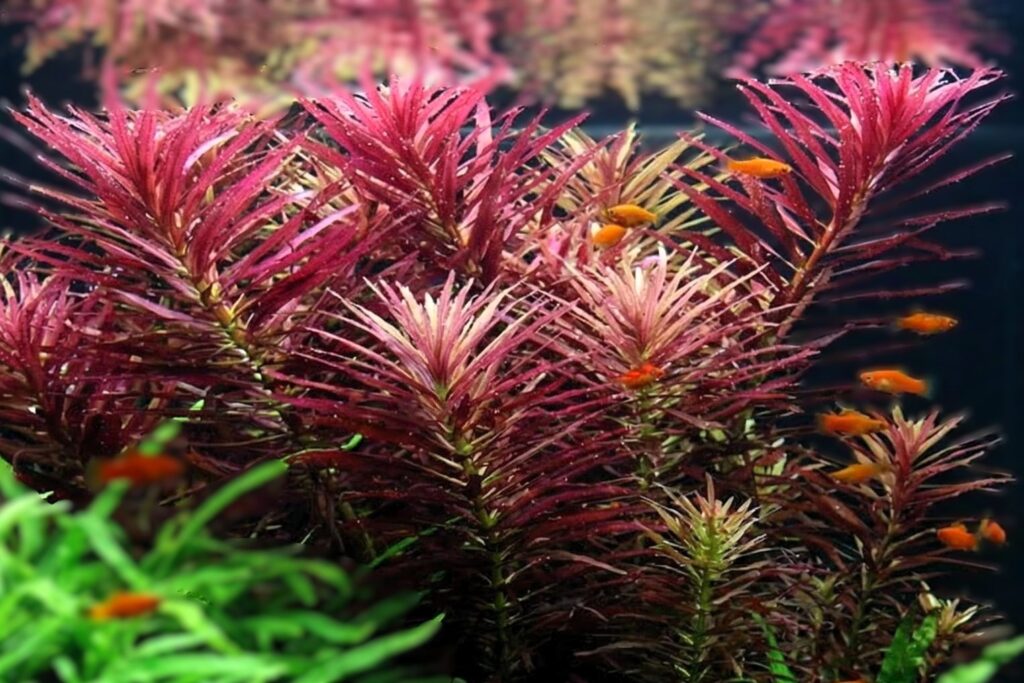
Limnophila hippuridoides is a stem plant from the genus Limnophila, known for its strong visual character with red to deep reddish-purple coloration under optimal conditions. In its submersed form, this species exhibits a whorled leaf arrangement, typically consisting of six to eight leaves per node, which serves as a key morphological distinction from closely related species such as Limnophila aromatica.
The leaves are generally linear to narrow-lanceolate with pointed tips, arranged densely along the stem to form a compact vertical structure. The shoot tips often display a slightly outward-curving orientation, contributing to a dynamic visual texture in aquascape layouts. When crushed, the plant emits a characteristic aromatic scent, indicating the presence of volatile compounds.
In aquascaping, this species functions as a strong color accent in the midground to background. Its visual impact is significantly enhanced when combined with bright green plants, creating contrast and depth within the composition. In emersed conditions, the leaves tend to remain green, and the plant may produce violet flowers under high light intensity.
Care and Requirements
Growth Characteristics
The growth pattern is vertical with a strong tendency for lateral branching after trimming. Cutting the top shoot stimulates the development of side shoots, resulting in a denser and bushier structure. Internodes become significantly shorter under high light conditions, while in lower light, the stems tend to elongate with wider spacing between nodes.
The root system develops relatively well, especially in nutrient-rich substrates, providing good stability once the plant is established.
Lighting
This species falls under the high light category, requiring approximately 90–150 µmol m⁻² s⁻¹. Light intensity is the primary factor influencing both coloration and structural density.
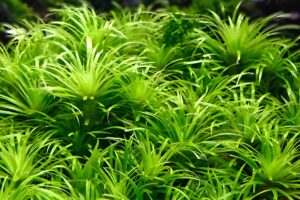
Under high light conditions, the plant develops intense red to reddish-purple hues, along with compact growth and active branching. Under lower light, the coloration shifts toward green with slight reddish tones, internodes become elongated, and the overall structure appears less dense.
CO₂ and Carbon
The carbon requirement is classified as medium to high. The plant can survive without CO₂ injection, but growth performance and coloration will not be optimal. With stable CO₂ levels around 20–40 mg/L, the plant shows significant improvements in growth rate, structural density, and color intensity.
A high-tech system provides the most suitable conditions for achieving its full visual potential.
Nutrients
Nutrient demand is relatively high, particularly under strong lighting. A balanced supply of macronutrients such as nitrate, phosphate, and potassium is essential for stable growth. Micronutrients, especially iron, play a critical role in enhancing red pigmentation.
Variations in nutrient ratios can influence coloration. Lower nitrate levels combined with adequate phosphate often lead to more intense coloration, although such conditions must be carefully managed to avoid destabilizing the system.
Water Parameters
This plant demonstrates moderate tolerance to a range of water parameters, but optimal performance is achieved under stable conditions. The ideal pH range is 6.0 to 7.5, with an optimal temperature between 22 and 27 °C. Water hardness can range from GH 3–12 dGH and KH 2–12 dKH.
Stability is more important than targeting exact values, as significant fluctuations may negatively affect growth and coloration.
Substrate
A nutrient-rich substrate is strongly recommended, as it supports root development and accelerates growth. It also contributes to long-term stability.
In inert substrates, the plant can still grow, but it becomes more dependent on water column fertilization and typically exhibits slower growth.
Propagation
Propagation is primarily done through stem cuttings, especially top cuttings. The upper portion of the plant can be replanted directly into the substrate, while the remaining stem will produce lateral shoots. This method is effective for increasing plant density and maintaining the desired layout structure.
Conclusion
Limnophila hippuridoides is a stem plant with adaptive coloration ranging from green to intense red depending on environmental conditions. It is best suited for aquascapes with high lighting, stable CO₂ supply, and balanced nutrient availability.
Its role as a midground to background plant is highly effective in creating color contrast and vertical structure within a layout. With proper management, it can serve as a dominant visual element without compromising the overall stability of the aquarium ecosystem.