Daftar Isi Show
| Characteristics | Details |
|---|---|
| Genus | Limnophila |
| Species | Limnophila aromatica |
| Family | Plantaginaceae |
| Origin | Tropical and subtropical Asia to northern Australia |
| Common Name | Rice paddy herb, Ngò om, Aromatic Limnophila |
| Light Requirement | Medium–high (±70–150 µmol m⁻² s⁻¹ / PAR) |
| Optimal Temperature | 22–27 °C |
| Growth Rate | Fast |
| Planting Area | Background, midground |
| Plant Height | 30–60+ cm |
| Ideal pH | 6.0–7.5 |
| Water Hardness | GH 3–10 dGH; KH 2–8 dKH |
| CO₂ Requirement | Medium–high |
| Propagation | Stem cuttings |
Additional Information
Limnophila aromatica is a stem plant from the family Plantaginaceae, widely distributed across tropical and subtropical regions of Asia and extending to northern Australia. It is typically found in shallow aquatic environments such as swamps, ditches, and flooded areas including rice paddies, reflecting its adaptability to mildly fluctuating but generally stable environmental conditions.
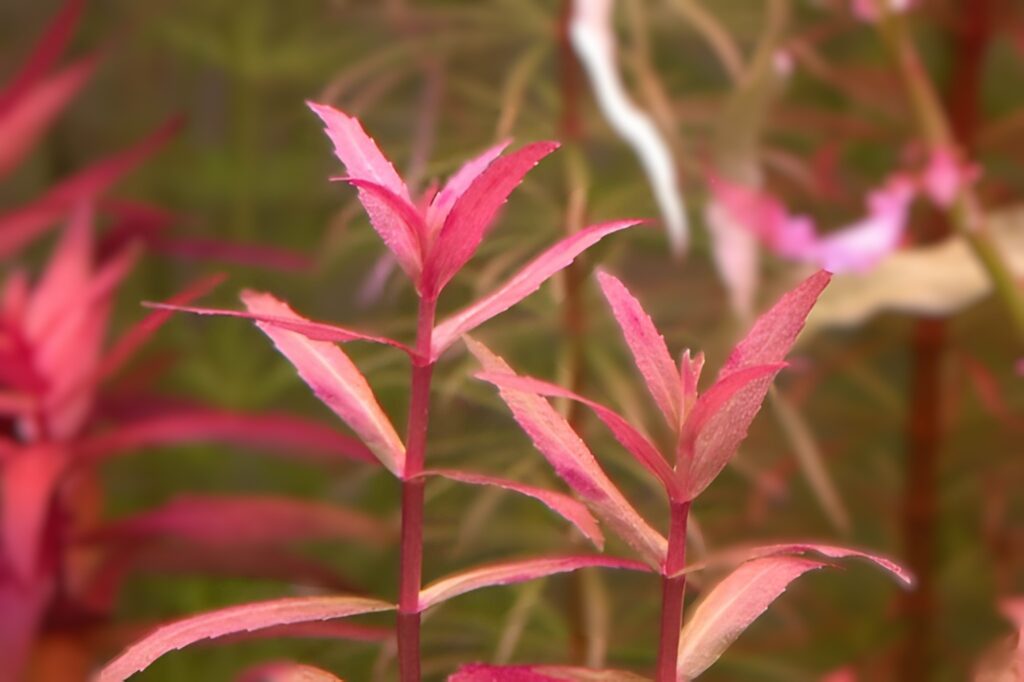
Morphologically, this species features lanceolate leaves with serrated margins, arranged oppositely or in loose whorls with a relatively low number of leaves per node. In submerged form, the leaf count is typically around two to three per node, resulting in a more open and less dense structure compared to other species within the same genus. A distinctive characteristic is the aromatic scent released when the leaves are crushed, due to naturally occurring essential oils.
The plant exhibits considerable variation in coloration, ranging from bright green to reddish tones depending on light intensity and nutrient balance. Compared to many modern stem plants, its texture appears coarser and more open, contributing a natural aesthetic within aquascape compositions.
In aquascaping, Limnophila aromatica is most effectively used as a background plant, forming relatively light and open plant masses. This structural quality allows for more natural layering effects, especially when combined with fine-textured species.
Common Misconceptions in the Aquascape Hobby
One of the most widespread issues in the aquascape hobby is the frequent confusion between Limnophila aromatica and Limnophila hippuridoides. Although both belong to the same genus and share some visual similarities, they are distinct species with clearly different morphological traits.
A common problem arises because plants sold under the name Limnophila aromatica are often actually Limnophila hippuridoides. This mislabeling is largely driven by the more visually appealing characteristics of L. hippuridoides, particularly its intense red coloration and dense leaf structure.
The most reliable distinction lies in the number of leaves per node. Limnophila aromatica typically has two to three leaves per node, whereas Limnophila hippuridoides forms dense whorls with six to eight or more leaves. This results in a significantly fuller and more compact appearance in L. hippuridoides.
In terms of coloration, L. hippuridoides tends to display more consistently intense red hues under strong lighting, while L. aromatica shows a broader range of colors and does not consistently develop deep red tones. Structurally, L. aromatica appears more open and less compact.
This misconception is further reinforced by inaccurate labeling in online content and commercial listings. As a result, many aquascapers develop incorrect expectations regarding plant density and coloration when cultivating L. aromatica.
Understanding this distinction is essential for accurate plant selection and for achieving predictable visual outcomes in aquascape layouts.
Care and Maintenance
Growth Characteristics
Limnophila aromatica grows vertically with a fast growth rate. Under optimal conditions, it can quickly reach the water surface and requires regular trimming to maintain proportion within the layout.
Internode spacing remains shorter under higher light conditions, producing a more compact structure. Under lower light, the plant tends to elongate with increased spacing between nodes. It is relatively tolerant of dense planting and can produce lateral shoots following pruning.
Lighting
The plant falls within the medium to high light category. At approximately ±70–90 µmol m⁻² s⁻¹, it can maintain stable growth with predominantly green coloration. To induce reddish tones, higher light intensity in the range of ±100–150 µmol m⁻² s⁻¹ is required.
Higher light levels also help maintain compact growth and prevent excessive elongation.
CO₂ and Carbon
This species can survive without CO₂ injection, though growth will be slower and less optimal. In systems with stable CO₂ supplementation, growth becomes more vigorous and structural quality improves.
In aquascape practice, CO₂ requirements are considered medium to high for optimal performance.
Nutrients
As a fast-growing stem plant, Limnophila aromatica requires a consistent supply of nutrients. Macronutrients such as nitrogen, phosphate, and potassium are essential for sustaining healthy growth.
Micronutrients, particularly iron, play a role in leaf coloration. Variations in nitrate levels can influence color intensity, especially in the upper portions of the plant.
Water Parameters
The plant is tolerant of a range of water parameters as long as they remain stable. The ideal pH range is slightly acidic to neutral, with an optimal temperature between 22–27 °C.
Low to moderate water hardness is preferred, with overall parameter stability being more critical than exact numerical values.
Substrate
Nutrient-rich substrates such as aquasoil can support early root development, although the plant primarily absorbs nutrients from the water column.
A stable substrate structure helps maintain plant positioning and simplifies replanting after trimming.
Propagation
Propagation is carried out through stem cuttings. The trimmed tops can be replanted directly into the substrate and will develop new roots within a short period.
Regular trimming also serves to maintain plant shape and density within the aquascape.
Conclusion
Limnophila aromatica is a fast-growing stem plant with an open and less compact structure compared to other species within the same genus. It is best suited as a background plant, contributing to a natural and layered aquascape composition.
Misidentification with Limnophila hippuridoides is common and can lead to incorrect expectations in terms of plant density and coloration. Understanding the morphological differences between the two is essential for proper plant selection and layout planning.
In low-tech systems, the plant can still grow steadily, albeit with limited visual performance. In high-tech setups with strong lighting and adequate CO₂, it is capable of expressing a wider range of coloration and more controlled growth structure.