Daftar Isi Show
| Characteristics | Details |
|---|---|
| Genus | Myriophyllum |
| Species | Myriophyllum tuberculatum |
| Family | Haloragaceae |
| Origin | Tropical Asia to Australia (India, Pakistan, Southern China, Malaysia, Indonesia, Australia) |
| Common Name | Red Water Milfoil |
| Lighting Requirements | High (±90–150+ µmol m⁻² s⁻¹ PAR) |
| Optimal Temperature | 18–24°C |
| Growth Rate | Fast |
| Placement | Midground to background |
| Plant Height | Up to ±60 cm |
| Ideal pH | 5–7 |
| Water Hardness | ±3–10 dGH, ±0–6 dKH |
| CO₂ Requirement | High |
| Propagation | Stem cuttings |
Additional Information
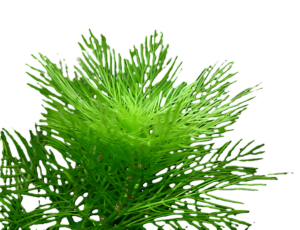
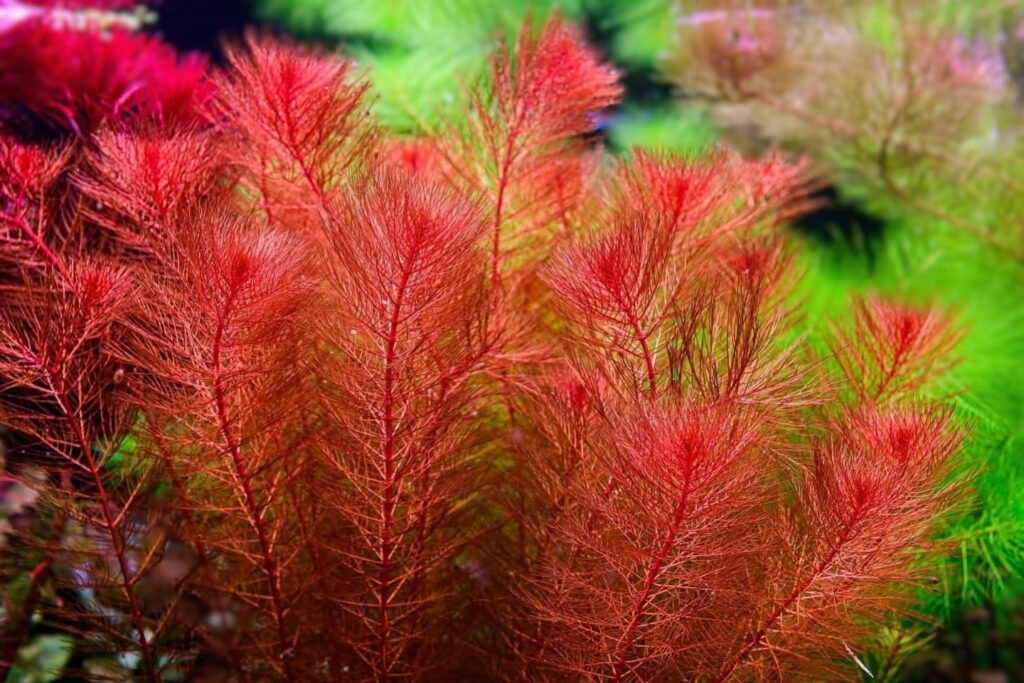
Myriophyllum tuberculatum is a fine-leaved stem plant from the Haloragaceae family, widely recognized in aquascaping for its intense red coloration. Its leaves are arranged in whorls with a very fine, filamentous structure, creating a light texture and strong contrast against broad-leaved plants. Under optimal conditions, the whorl diameter can reach approximately 10 cm, with coloration ranging from rust red to bright orange-red. Color intensity is strongly influenced by lighting, carbon availability, and micronutrient balance, particularly iron.
In its natural habitat, this species grows in calm to stagnant waters across tropical Asia. This adaptation allows it to perform well in aquarium systems, although it requires relatively higher environmental stability compared to most common stem plants. In aquascape layouts, Myriophyllum tuberculatum is typically used as an accent plant to create a visual focal point. Its red coloration is often used to contrast with green species such as green Myriophyllum or Limnophila, especially in Dutch-style and nature aquariums. The fine leaf structure also helps maintain visual proportion even in small to medium-sized tanks.
Requirements and Care
Growth Characteristics
This plant exhibits vertical growth with a fast upward trajectory toward the water surface. Under optimal conditions, stems produce numerous lateral shoots after reaching the surface, forming dense and bushy structures. Older lower stems tend to regenerate slowly, which is why the standard aquascaping practice is top cutting, where the healthy upper portions are trimmed and replanted while the lower sections are often discarded. The plant responds strongly to light and carbon availability, with high intensity producing tighter internodes and more intense coloration, while suboptimal conditions lead to elongated growth, pale color, and reduced compactness.
Lighting
Lighting requirements are high, typically around ±90–150 µmol m⁻² s⁻¹ PAR or more for optimal performance. Under strong lighting, the plant develops more stable and intense red coloration, denser leaf structures, and more active lateral growth. Under low light, the color shifts toward darker or brownish tones, internodes elongate, and the overall structure becomes less aesthetic. This species is not suitable for low-light systems as it will lose its defining visual characteristics.
CO₂ and Carbon
CO₂ demand is high, with injection levels around ±20–40 mg/L being critical for maintaining stable growth and coloration. Without sufficient CO₂, growth slows significantly, color fades, and leaf structures become smaller. In high-tech systems, the combination of strong lighting and stable CO₂ enables optimal performance, including intense red coloration and rapid growth.
Nutrients
Nutrient demand is relatively high compared to most stem plants. Macronutrients such as nitrate (NO₃) and phosphate (PO₄) must be consistently available and should not reach zero, as this can lead to growth stagnation. The plant also requires a steady supply of micronutrients, particularly iron (Fe). Deficiencies may result in very dark or dull coloration, reduced leaf size, and damage to the apical meristem. Maintaining a balanced nutrient profile is more critical than simply increasing dosage.
Water Parameters
Optimal water parameters include a pH range of 5–7, temperature between 18–24°C, low to moderate general hardness, and low carbonate hardness. Stability is more important than absolute values, as sudden fluctuations, especially in CO₂ and nutrient levels, can negatively affect plant health.
Substrate
Although not fully dependent on substrate nutrients, a nutrient-rich substrate provides advantages during the initial growth phase. Active substrates that buffer pH and supply baseline nutrients can improve overall system stability. The root system is relatively simple, so primary nutrient uptake still occurs through the water column.
Propagation
Propagation is carried out through stem cuttings by trimming healthy tops or lateral shoots and replanting them directly into the substrate. This method is more efficient than relying on new growth from older stems, which tends to be slower.
Conclusion
Myriophyllum tuberculatum is a highly decorative red aquascape plant with a strong visual presence and fine leaf texture. Its fast growth rate and high responsiveness to light and nutrients make it an excellent choice for creating focal accents within a layout. However, it is considered a high-difficulty species due to its requirement for intense lighting, stable CO₂, and precise nutrient balance, making it more suitable for high-tech systems rather than low-tech setups. Under optimal conditions, it can serve as a striking focal point and significantly enhance the overall aesthetic quality of an aquascape.