Daftar Isi Show
| Characteristic | Detail |
|---|---|
| Genus | Limnophila |
| Species | Limnophila heterophylla |
| Family | Plantaginaceae |
| Origin | Southeast Asia |
| Common Name | Ambulia, Water Primrose |
| Light Requirement | Medium–high (±70–150 µmol m⁻² s⁻¹ / PAR) |
| Optimal Temperature | 22–28°C |
| Growth Rate | Fast |
| Placement | Background / Midground |
| Plant Height | 30–50 cm |
| Ideal pH | 6.0–7.5 |
| Water Hardness | GH 3–10 dGH; KH 2–12 dKH |
| CO₂ Requirement | Adaptive |
| Propagation | Stem cuttings |
Additional Information
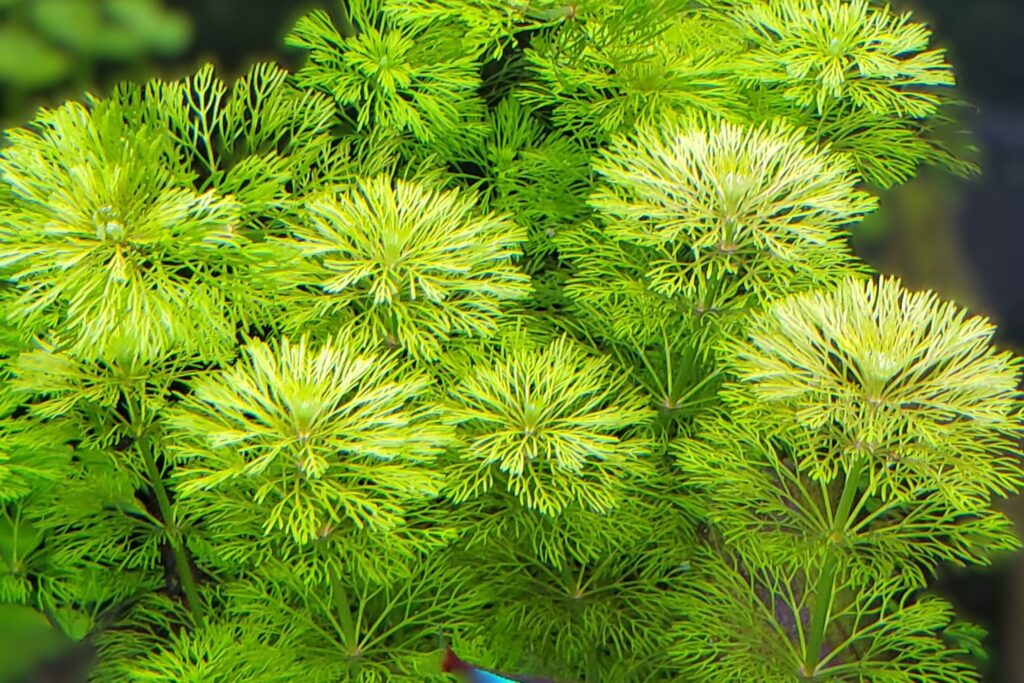
Limnophila heterophylla is a stem plant with highly distinctive morphology, particularly its fine, feathery leaf structure arranged in dense whorls along the stem. The species exhibits heterophylly, allowing significant variation in leaf form between submersed and emersed growth conditions, reflecting strong environmental adaptability.
In aquascaping, this plant delivers a soft, feathery texture that enhances depth and layering, making it highly suitable for background placement or as a transition into the midground. Its bright green coloration, occasionally developing bronze hues under higher light intensity, provides effective contrast against broader-leaved plants.
Its natural habitat consists of slow-moving or still waters rich in organic sediment. This ecological background explains its strong nutrient uptake capability, making it functionally valuable in aquascapes as a biological stabilizer for excess nitrates and phosphates.
Requirements and Care
Growth Characteristics
The growth pattern of Limnophila heterophylla is vertical, dominated by strong apical growth. The main shoot rapidly extends toward the water surface, while trimming stimulates lateral branching from lower nodes, resulting in a denser, bushier structure.
Under optimal conditions, growth can be very rapid, making regular trimming essential to maintain layout balance and prevent shading of lower plants.
Nyctinastic movement is commonly observed, where the top leaves close during the dark phase. This behavior indicates stable physiological activity and healthy metabolic function.
Lighting
The plant requires medium to high lighting, within a range of approximately 70–150 µmol m⁻² s⁻¹.
Under low light conditions (<50 µmol m⁻² s⁻¹), the plant tends to exhibit etiolation, characterized by elongated internodes, sparse leaves, and weakened structure. In contrast, higher light intensity (>90 µmol m⁻² s⁻¹) promotes compact growth, tighter internodes, and improved overall density.
An ideal photoperiod is 8–10 hours per day, maintained consistently to avoid physiological stress and reduce the risk of algae growth.
CO₂ and Carbon
This species is highly adaptable to CO₂ availability. In low-tech systems without CO₂ injection, it can still grow by utilizing naturally dissolved carbon, although at a slower rate.
In high-tech systems, stable CO₂ injection (approximately 15–30 mg/L) significantly enhances plant density, leaf size, and stem strength. Proper synchronization between lighting and carbon availability is critical to prevent carbon deficiency, which may result in leaf drop and fragile stems.
Nutrients
As a fast-growing plant, Limnophila heterophylla has a high nutrient demand. Nutrient uptake occurs through both the water column and root system, requiring a balanced supply of macronutrients (N, P, K) and micronutrients, particularly iron (Fe).
Nitrogen deficiency typically presents as pale new growth and slowed development, while adequate iron supports chlorophyll production and enhances coloration, especially under higher light conditions.
Water Parameters
The plant tolerates a relatively wide range of water parameters, with an ideal pH of 6.0–7.5. Slightly acidic to neutral conditions improve nutrient availability, especially for micronutrients.
Acceptable hardness ranges include GH 3–10 dGH and KH 2–12 dKH. Stability is more critical than precise values, as sudden fluctuations can trigger melting or tissue deterioration.
The optimal temperature range is 22–28°C. At higher temperatures, metabolic rates increase, requiring proportional increases in nutrient and CO₂ availability.
Substrate
Although capable of absorbing nutrients from the water column, substrate quality plays an important role in long-term stability. Active substrates with high cation exchange capacity (CEC) provide a sustained nutrient reservoir for root development.
In inert substrates such as sand, the use of root tabs becomes important to support root growth and maintain consistent plant health.
Propagation
Propagation is performed vegetatively through stem cuttings. Healthy top portions, approximately 10–15 cm in length, are cut and replanted into the substrate after removing the lower leaves.
New roots typically develop from the nodes within 3–7 days. This method is efficient and ensures genetic consistency across propagated plants.
Conclusion
Limnophila heterophylla is an aquascape plant that effectively combines high aesthetic value with strong ecological function. Its fine-textured foliage and rapid growth make it an excellent choice for background or midground placement.
The species is highly versatile, performing well in both low-tech and high-tech systems, although optimal results are achieved under medium to high lighting with stable CO₂ supplementation. Beyond its visual appeal, its strong nutrient uptake capacity makes it a reliable tool for maintaining aquarium balance.
With consistent maintenance, particularly regular trimming and proper nutrient management, Limnophila heterophylla provides long-term stability and a refined visual presence in aquascape layouts.