Daftar Isi Show
| Characteristic | Detail |
|---|---|
| Genus | Limnophila |
| Species | Limnophila sessiliflora |
| Family | Plantaginaceae |
| Origin | Southeast Asia |
| Common Name | Ambulia, Asian marshweed |
| Light Requirement | Low–medium (±30–90 µmol m⁻² s⁻¹ / PAR) |
| Optimal Temperature | 20–26°C |
| Growth Rate | Very fast |
| Placement | Background |
| Plant Height | 30–50 cm |
| Ideal pH | 5–8 |
| Water Hardness | GH 2–15 dGH; KH 2–21 dKH |
| CO₂ Requirement | Adaptive |
| Propagation | Stem cuttings |
Additional Information
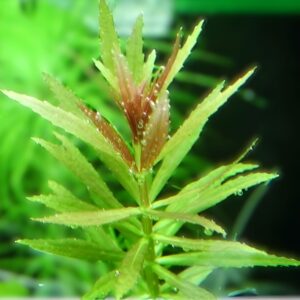
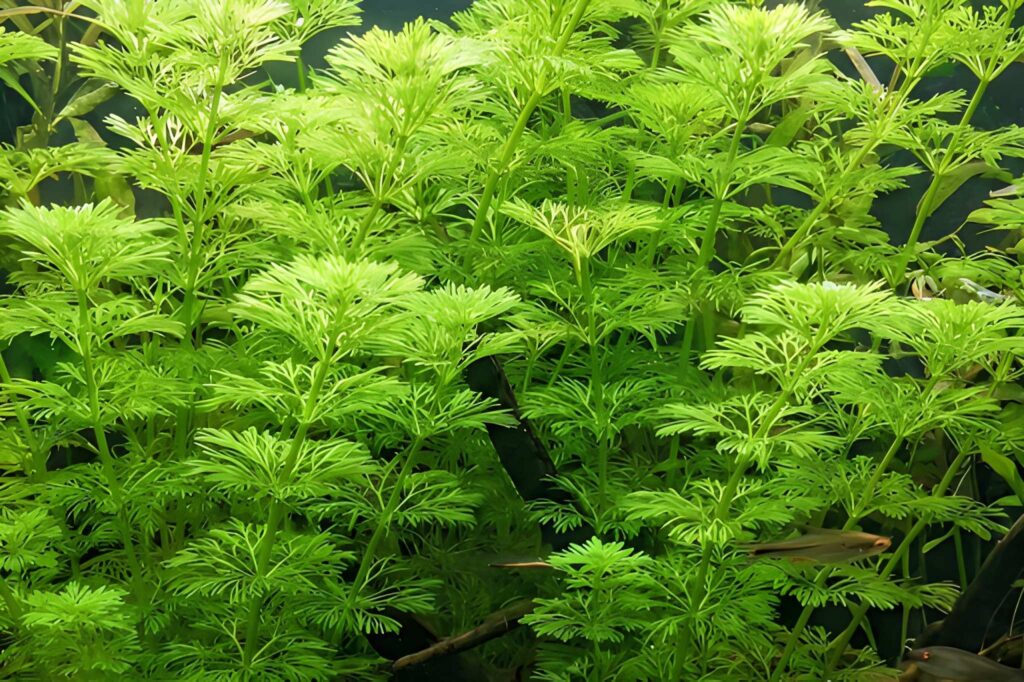
Limnophila sessiliflora is a classic stem plant in aquascaping, recognized for its finely divided, fan-like leaf structure. The submerged leaves are highly dissected, creating a soft, feathery texture that contrasts effectively with broader-leaved aquatic plants.
In its natural habitat, this species grows in calm waters such as swamps, riverbanks, and shallow flood zones. Its ecological adaptability is high, allowing it to tolerate a wide range of water parameters.
Within an aquascape layout, Limnophila sessiliflora is predominantly used as a background plant. Its rapid growth and tendency to form dense masses make it effective for filling rear areas and enhancing depth perception. Under optimal conditions, the shoot tips may display bright green to slightly yellowish tones, with occasional subtle reddish hues under higher light and nutrient availability.
Care and Requirements
Growth Characteristics
This plant exhibits vertical growth with a strong tendency to produce numerous lateral shoots once it reaches the water surface. Internodes tend to elongate under low light conditions, while higher light promotes more compact and dense growth.
Due to its very fast growth rate, regular trimming is essential. Without maintenance, it can quickly overgrow the tank surface and obstruct light penetration to lower plants.
Lighting
The light requirement ranges from low to medium. Under low light conditions (±30–50 µmol m⁻² s⁻¹), the plant remains stable but tends to grow leggy, with elongated internodes.
At medium intensity (±60–90 µmol m⁻² s⁻¹), growth becomes more compact, leaf density increases, and the plant achieves a more aesthetically pleasing form. High light is not mandatory, making it a suitable alternative to more demanding genera such as Cabomba.
CO₂ and Carbon
Limnophila sessiliflora is highly adaptable to varying carbon availability. It can grow well without CO₂ injection in low-tech systems, although with slower growth and reduced density.
In high-tech setups with stable dissolved CO₂ levels (±20–30 mg/L), growth becomes significantly faster, branching increases, and the overall structure becomes more compact. CO₂ enhances performance but is not a strict requirement.
Nutrients
Nutrient demand is moderate to high, corresponding to its rapid growth rate. Macronutrients such as nitrate and phosphate should be maintained at stable levels to prevent growth stagnation.
Micronutrients, particularly iron (Fe), play a role in maintaining healthy, vibrant shoot tips. Deficiencies are typically indicated by pale new growth and reduced vigor.
Water Parameters
This species tolerates a broad range of water conditions, with a pH range of 5–8 and water hardness from soft to hard. Stability is more critical than exact numerical values.
The optimal temperature range is 20–26°C, though it can tolerate temperatures up to around 28°C without significant performance decline.
Substrate
As a stem plant, Limnophila sessiliflora does not rely heavily on nutrient-rich substrates, as it primarily absorbs nutrients from the water column.
However, using an active or nutrient-rich substrate can improve initial stability and root anchoring, especially after replanting cuttings.
Propagation
Propagation is straightforward through stem cuttings. The most common method involves trimming the healthy top portion and replanting it into the substrate.
The plant also naturally produces lateral shoots, particularly after reaching the water surface. Even detached fragments are capable of regrowth, reflecting its high regenerative capacity.
Conclusion
Limnophila sessiliflora is a highly versatile, fast-growing background plant suitable for both low-tech and high-tech aquascapes.
Aesthetically, its fine leaf structure provides strong textural contrast, while functionally, its aggressive growth helps fill space efficiently and contributes to overall aquarium stability.