Daftar Isi Show
| Characteristic | Detail |
|---|---|
| Genus | Limnophila |
| Species | Limnophila repens (Benth.) Benth. |
| Family | Plantaginaceae |
| Origin | Tropical Asia to Australia |
| Common Name | Creeping Marshweed |
| Light Requirement | Medium–high (±70–150 µmol m⁻² s⁻¹ / PAR) |
| Optimal Temperature | 22°C – 28°C |
| Growth Rate | Fast |
| Placement | Midground to background |
| Plant Height | 10–45 cm |
| Ideal pH | 6.0 – 7.5 |
| Water Hardness | GH 3–12 dGH; KH 2–8 dKH |
| CO₂ Requirement | Medium–high |
| Propagation | Stem cuttings and stolons |
Additional Information
Limnophila repens is an aquatic herbaceous species within the family Plantaginaceae, with a broad geographical distribution spanning India, Southeast Asia, and Australia. Morphologically, it is characterized by hirsute stems and opposite leaf arrangement with subsessile attachment.
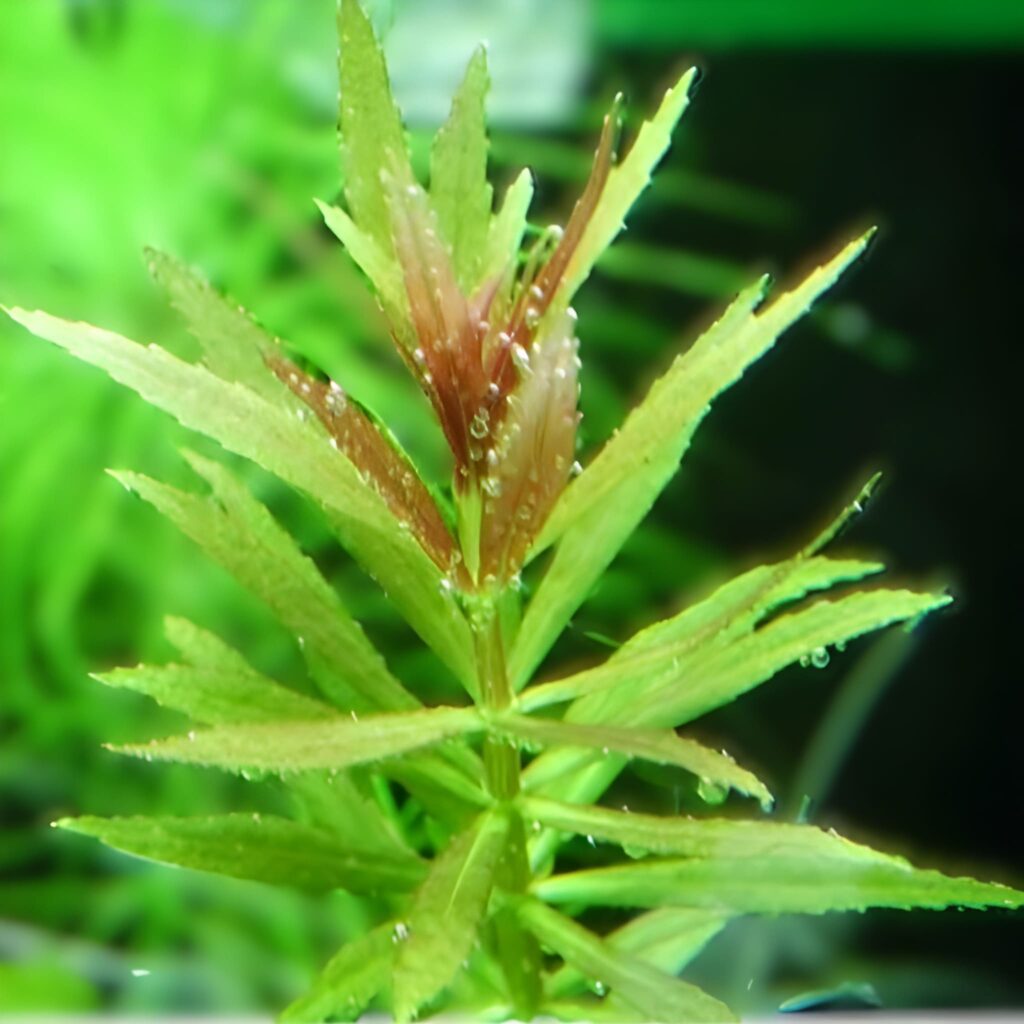
In its submersed form, the plant exhibits relatively coarse leaf texture with finely serrated margins (crenate-serrate). This feature serves as a key diagnostic trait distinguishing it from other Limnophila species that typically display finer or more filamentous foliage. Additionally, the plant contains aromatic glands that release a distinct mango- or spice-like fragrance when mechanically damaged.
From a biochemical perspective, Limnophila repens contains secondary metabolites such as stigmasterol (C₂₉H₄₈O), β-sitosterol (C₂₉H₅₀O), and quercetin (C₁₅H₁₀O₇). These compounds contribute to the plant’s protective mechanisms and define its unique chemical profile.
Within aquascape applications, Limnophila repens functions as a midground to background plant, offering strong textural definition and dynamic coloration that responds directly to light intensity. It is important to note that the term “Limnophila repens Mini” is not a valid botanical classification, but rather a commercial trade name often misapplied to dwarf forms of other species such as Limnophila aromatica.
Care and Requirements
Growth Characteristics
The growth pattern of Limnophila repens is dimorphic. Under submersed conditions, the plant exhibits vertical stem growth while maintaining a basal creeping (procumbent) tendency. This is facilitated through stolon formation, allowing horizontal spread across the substrate before producing upright shoots.
The growth rate is fast. Without pruning, stems can reach heights of up to 45 cm. Apical trimming stimulates axillary bud activation, resulting in vigorous lateral branching and the formation of dense plant clusters.
Light
This species falls within the medium to high light category, requiring approximately ±70–150 µmol m⁻² s⁻¹ PAR.
Under high light conditions (≥100 µmol m⁻² s⁻¹), the plant expresses strong anthocyanin pigmentation. Leaves develop deep reddish-purple to brownish-red tones, while the midrib often remains bright green, creating a pronounced visual contrast.
In low light conditions (<40 µmol m⁻² s⁻¹), red pigmentation is significantly reduced. Leaves appear pale green to yellowish, and etiolation occurs, characterized by elongated internodes and a less compact growth structure.
CO₂ and Carbon
Carbon availability is a limiting factor for Limnophila repens. While the plant can survive without CO₂ injection, its aesthetic quality and foliage density will be significantly reduced.
In high-tech systems, an optimal dissolved CO₂ concentration ranges between 20–40 mg/L. Stable carbon availability is critical, particularly to prevent melting during the transition from emersed to submersed growth.
Nutrients
Balanced macro- and micronutrient availability is essential for optimal growth. Nitrogen supports biomass development, while micronutrients—especially iron (Fe)—play a key role in maintaining deep red coloration.
Micronutrient deficiencies are typically evident in new growth, which may exhibit chlorosis or pigment loss. A stable nutrient regime, supplied through both the water column and substrate, ensures consistent growth and coloration.
Water Parameters
Limnophila repens prefers soft to moderately hard water conditions, with a pH range of 6.0–7.5, GH 3–12 dGH, and KH 2–8 dKH. The species is relatively tolerant, but stability is far more critical than exact numerical values.
Significant parameter fluctuations can lead to tissue damage, particularly due to the plant’s relatively soft and sensitive leaf structure.
Substrate
The use of active substrate is strongly recommended due to its ability to stabilize pH at the root zone. A granular structure of approximately 2–3 mm is ideal for facilitating stolon movement and maintaining oxygen circulation around the root system.
Poor substrate conditions, especially anaerobic zones, can lead to stem base rot and inhibit vegetative spread.
Propagation
Propagation is most efficiently achieved through stem cuttings. Apical sections of at least 5 cm can be replanted to establish new individuals.
The plant also naturally propagates via stolons that spread along the substrate, forming cohesive and dense colonies without intensive intervention.
Conclusion
Limnophila repens is a fast-growing stem plant with adaptive growth behavior and significant color variability depending on light intensity. In high-tech systems with strong lighting and stable CO₂ injection, it is capable of producing deep reddish-purple hues contrasted by bright green midribs.
Its stolon-based growth provides an advantage in forming dense and natural plant groupings, making it highly suitable for midground to background placement. While it can survive in low-tech setups, its full aesthetic potential is only realized under well-controlled, high-performance aquascape conditions.