Daftar Isi Show
| Characteristics | Detail |
|---|---|
| Genus | Hygrophila |
| Species | Hygrophila sp. ‘Chai’ |
| Family | Acanthaceae |
| Origin | Cultivated (mutation derived from Hygrophila araguaia, Southeast Asia) |
| Common Name | Hygrophila Chai, Pink Chai |
| Light Requirement | High (±100–200 µmol m⁻² s⁻¹ / PAR) |
| Optimal Temperature | 22–26 °C |
| Growth Rate | Very slow |
| Placement | Midground – Foreground |
| Plant Height | 3–10 cm |
| Ideal pH | 5.5–7.0 |
| Water Hardness | GH 1–8 dGH; KH 0–4 dKH |
| CO₂ Requirement | High |
| Propagation Method | Stem cuttings |
Additional Information
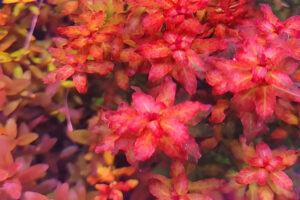
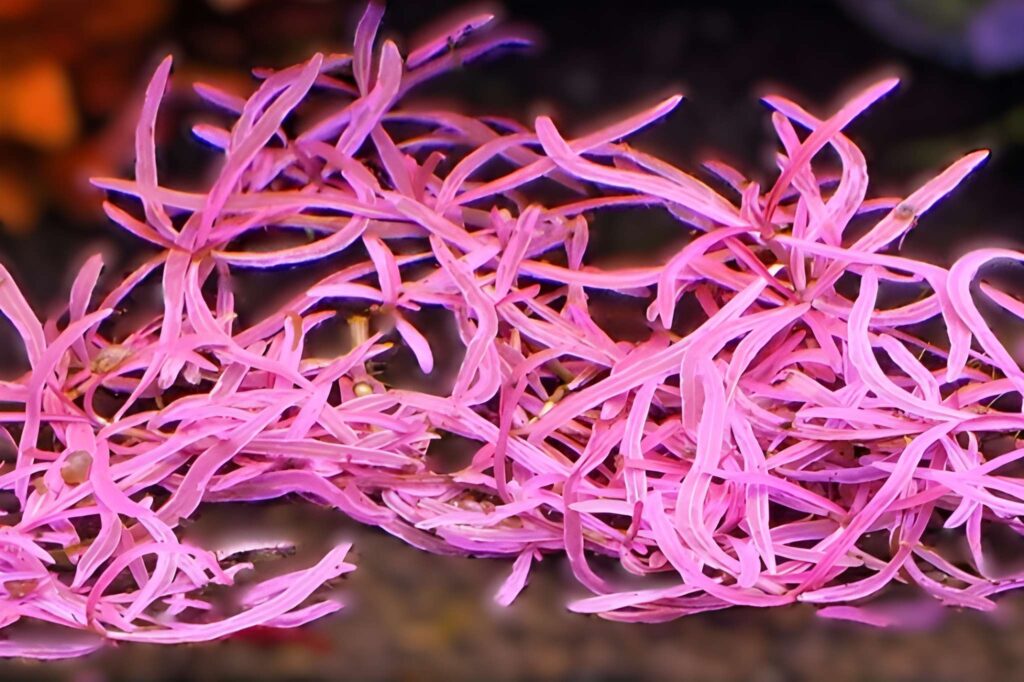
Hygrophila sp. ‘Chai’ is considered a rare and relatively new aquascape plant. It is known as a mutation derived from Hygrophila araguaia, exhibiting a significantly more striking coloration characterized by bright pink tones combined with white or pale green striping.
Morphologically, the plant has small, finely textured leaves and tends to grow in a prostrate (creeping) pattern under high light intensity. In certain conditions, stems may grow slightly vertically, but the plant generally maintains a compact form.
In aquascape layouts, this plant is commonly used as a focal point in the foreground or midground due to its strong color contrast against green plants. However, its use requires a highly stable ecosystem, making it more suitable for high-tech setups.
This plant does not occur naturally in the wild and originates from cultivated environments, meaning its adaptation is highly dependent on optimal and stable aquarium conditions.
Requirements and Care
Growth Characteristics
Hygrophila sp. ‘Chai’ exhibits a very slow growth rate compared to other stem plants within the same genus. Under high light, it tends to grow horizontally, forming a low and dense structure.
Under low light or unstable carbon conditions, the plant loses its compact form, resulting in uneven growth and increased susceptibility to leaf melting, particularly in older leaves.
It is also highly sensitive to spatial competition. Fast-growing plants nearby can create shading, which significantly inhibits its development.
Light
This plant requires high light intensity, typically around 100–200 µmol m⁻² s⁻¹ (PAR) at substrate level.
Under high light:
Pink coloration becomes more intense and stable
Growth remains compact and creeping
Leaf density increases
Under low light:
Color fades to brownish-green
Internodes elongate
Risk of leaf melting increases
High lighting must be balanced with stable CO₂ and nutrient levels to prevent algae issues.
CO₂ and Carbon
This plant has a high CO₂ requirement and depends heavily on carbon injection in high-tech systems.
Optimal CO₂ levels are generally within a higher range (±30–50 ppm), with stability being the most critical factor. Even minor fluctuations can lead to:
Damage or loss of older leaves
Color reversion to brown tones
Growth stagnation
In systems without CO₂ injection (low-tech), the plant is generally unstable and difficult to maintain long-term.
Nutrients
As a plant with dominant pink-red coloration, Hygrophila sp. ‘Chai’ requires a well-balanced nutrient supply, particularly micronutrients such as iron (Fe) to maintain color intensity.
Macronutrients (nitrogen, phosphate, potassium) must be stable but not excessive to avoid triggering algae growth. Nutrient imbalance is often indicated by:
Pale or translucent leaves
Stagnant growth
Deterioration of older leaves
Consistency in nutrient dosing is more important than high concentration levels.
Water Parameters
This plant performs best in soft to moderately soft water with high stability.
Recommended parameter range:
pH: 5.5–7.0
Temperature: 22–26 °C
GH: 1–8 dGH
KH: 0–4 dKH
Lower KH levels help improve CO₂ stability, which is crucial for this species. Slightly cooler temperatures (around 24–25 °C) often help maintain system stability and reduce metabolic stress.
Substrate
Substrate plays a significant role in successfully cultivating Hygrophila sp. ‘Chai’. It performs best in nutrient-rich substrates such as aquasoil, which can provide a consistent supply of nutrients.
Its root system is relatively small and sensitive, so the substrate should:
Be free from excessive detritus accumulation
Allow good water circulation
Support gas exchange around the root zone
Dense or dirty substrates may lead to root rot and melting.
Propagation
Propagation is carried out through stem cuttings. Once the plant reaches a certain size (approximately 5 cm or more), the top portion can be cut and replanted.
This process:
Stimulates new branching
Helps form denser clusters
Maintains layout aesthetics
However, due to its slow growth, propagation also takes longer compared to most other stem plants.
Conclusion
Hygrophila sp. ‘Chai’ is a technically demanding aquascape plant that requires high light, stable CO₂, and a clean, mature aquarium environment.
It is best suited for high-tech systems with precise parameter control. Under optimal conditions, it offers high aesthetic value through its striking pink coloration and compact growth form, making it a strong visual element in the foreground or midground.
However, without proper system stability, the plant is highly prone to stress, algae, and deterioration in visual quality, making it more suitable for experienced aquascapers.