Daftar Isi Show
| Characteristics | Detail |
|---|---|
| Genus | Hygrophila |
| Species | Hygrophila pinnatifida |
| Family | Acanthaceae |
| Origin | Asia (India) |
| Common Name | Hygrophila pinnatifida |
| Light Requirement | Medium–high (±70–140 µmol m⁻² s⁻¹ / PAR) |
| Optimal Temperature | 22–28 °C |
| Growth Rate | Moderate |
| Placement | Midground / epiphyte (hardscape) |
| Plant Height | 15–40 cm |
| Ideal pH | 5.5–7.5 |
| Water Hardness | GH 3–10 dGH; KH 1–6 dKH |
| CO₂ Requirement | Adaptive–medium |
| Propagation Method | Stem cuttings and runners |
Additional Information
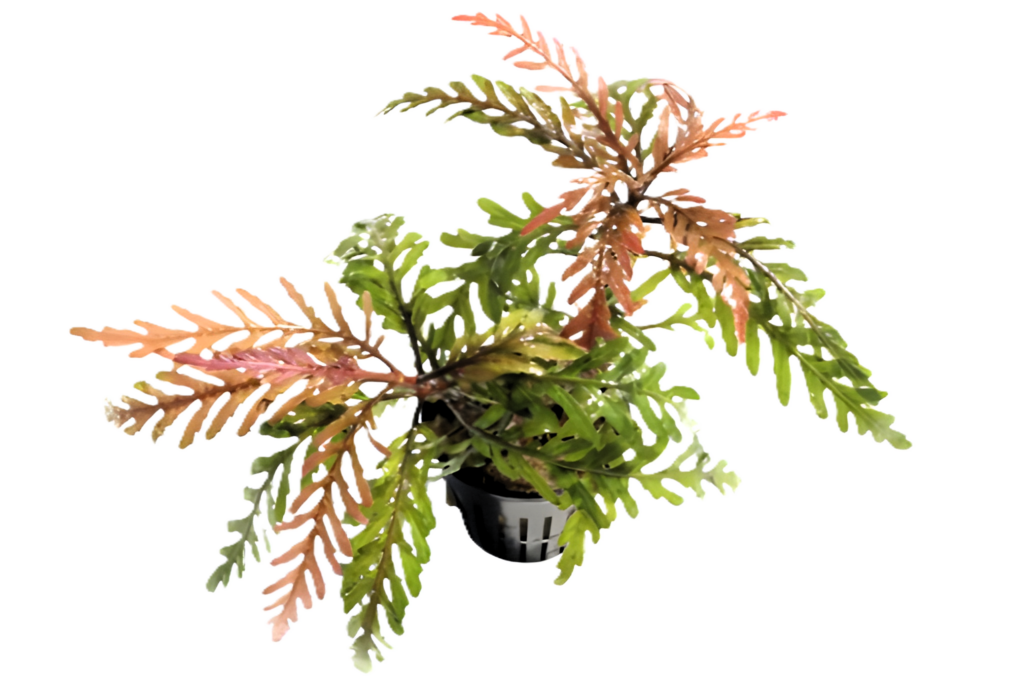
Hygrophila pinnatifida is a stem plant from the Acanthaceae family originating from India. It is characterized by its distinctive morphology, featuring deeply lobed (pinnatifid) leaves and a unique color combination: the upper surface tends to be brownish-green with patterned markings, while the underside displays shades of red to burgundy.
In aquascaping, this plant is often used as a contrasting midground element, primarily due to its leaf texture, which differs from most typical stem plants. One of its unique traits is its ability to grow as an epiphyte, attaching itself to wood or stone, providing high flexibility in layout design—especially in nature-style or jungle-style aquascapes.
In addition to vertical growth, this plant produces horizontal shoots that can spread and attach to hardscape surfaces, creating a natural appearance similar to wild growth in its native habitat.
Requirements and Care
Growth Characteristics
This plant exhibits a combination of vertical and horizontal growth patterns. The main stem grows upward toward the surface, while lateral shoots spread sideways and can attach to hard surfaces.
Trimming the top stimulates the development of lateral shoots, resulting in a denser and more compact form. If left uncontrolled, the plant can spread quite aggressively through runners, potentially covering surrounding areas.
Light
Hygrophila pinnatifida falls within the medium to high light category, requiring approximately 70–140 µmol m⁻² s⁻¹.
Under lower light intensity, growth continues but tends to be more sparse, with greener leaf coloration and less compact structure. Under higher light, the plant displays stronger contrast, particularly with deeper red tones on the underside of the leaves, along with denser growth.
Adequate lighting also helps maintain smaller, more aesthetically balanced leaf sizes within an aquascape layout.
CO₂ and Carbon
This plant is adaptive to CO₂ availability. In systems without CO₂ injection (low-tech), it can survive, although growth tends to be slower and less stable.
In high-tech systems with CO₂ injection, performance improves significantly, with faster growth, healthier leaves, and more intense coloration. CO₂ also aids in smoother adaptation during the transition from emersed to submerged growth forms.
Nutrients
Hygrophila pinnatifida is not considered highly demanding in terms of nutrients but still requires a balanced supply of macronutrients and micronutrients for optimal growth.
Nutrient deficiencies may lead to symptoms such as holes in leaves or discoloration. Potassium plays an important role in maintaining leaf integrity, although excessive dosing is not necessary. Nutrient stability is more important than high concentration levels.
Water Parameters
This plant is relatively tolerant of a range of water parameters, as long as extreme conditions are avoided. The ideal pH range is between 5.5 and 7.5, with an optimal temperature of 22–28 °C.
Low to moderate water hardness (GH 3–10 dGH; KH 1–6 dKH) generally produces the best results. Stability in water parameters is a key factor in maintaining consistent growth and plant health.
Substrate
Although classified as a stem plant, Hygrophila pinnatifida does not strictly require substrate, as it can grow as an epiphyte. Its adventitious roots are capable of firmly attaching to wood and stone.
When planted in substrate, the root system develops normally and contributes to nutrient uptake from the base of the aquarium. However, in aquascaping practice, placement on hardscape is often preferred to highlight the aesthetic value of the leaf undersides.
Propagation
Propagation is relatively easy and can be done through stem cuttings or by separating runners.
Cutting the stem above a node will encourage new shoots to develop from the remaining portion. Additionally, horizontal runners produce small plantlets that can be separated and replanted in other areas.
This method allows for controlled propagation while maintaining the intended layout composition.
Conclusion
Hygrophila pinnatifida is a unique aquascape plant with a distinctive combination of leaf shape and contrasting coloration. Its ability to grow as an epiphyte makes it highly versatile for various layout styles, particularly in midground areas.
It is suitable for both low-tech and high-tech systems, although optimal performance is achieved with sufficient lighting and CO₂ support. With proper maintenance and regular trimming, this plant serves as both a strong visual element and a functional component in creating dynamic and natural aquascape compositions.