Daftar Isi Show
| Characteristic | Detail |
| Genus | Bacopa |
| Species | Bacopa salzmannii |
| Family | Plantaginaceae |
| Origin | South America (Brazil and surrounding regions) |
| Common Name | Bacopa Salzmannii Purple Singapore |
| Light Requirement | Low – High (optimal medium ±60–100 µmol m⁻² s⁻¹ / PAR) |
| Optimal Temperature | 22–28 °C |
| Growth Rate | Moderate |
| Placement | Midground – Background |
| Plant Height | ±20–40 cm |
| Ideal pH | 5.5–7.0 |
| Water Hardness | GH 2–8 dGH; KH 0–4 dKH |
| CO₂ Requirement | Medium – High |
| Propagation | Stem cutting |
Additional Information
Bacopa salzmannii ‘Purple Singapore’ is a selectively farmed trade variant of Bacopa salzmannii developed to maintain more stable purple pigmentation. Taxonomically, it does not differ from the original species, but phenotypically it displays a much stronger and more consistent color expression in aquascape environments.
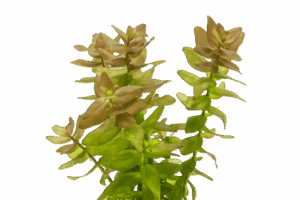
The primary distinction compared to the wild-type form lies in its color response to lighting conditions. In the original species, submerged foliage typically begins green and only develops reddish or purple gradients under high light intensity. Conversely, the ‘Purple Singapore’ variant exhibits dark leaf coloration starting in its emersed terrestrial phase. When planted fully submerged, it develops vibrant purple tones much faster without an extended, dominant green transition period.
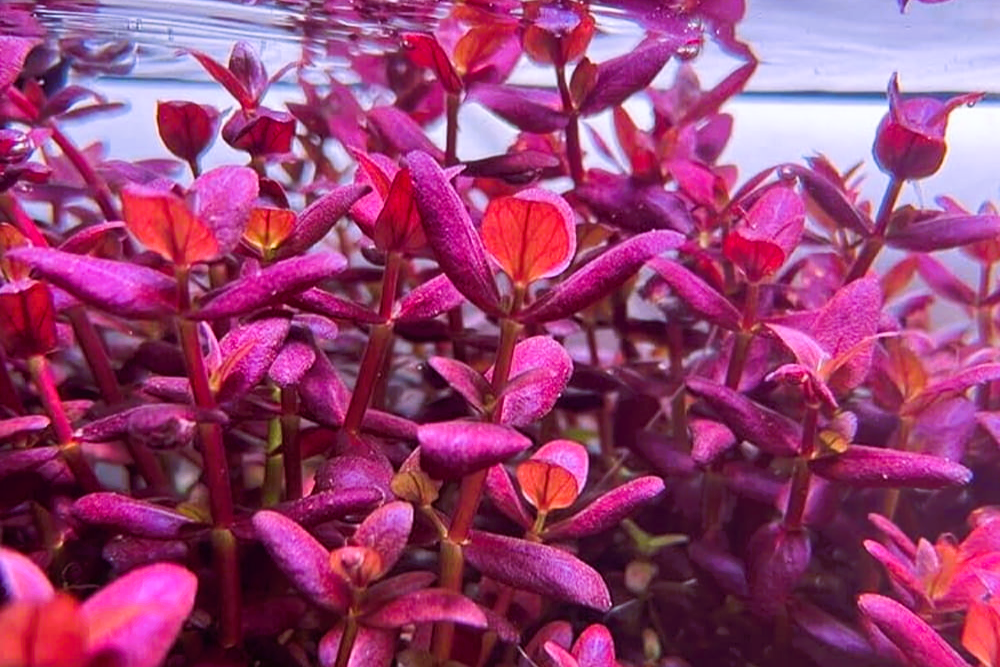
Morphologically, this aquatic stem plant features upright stems with opposite, oval to elliptical leaves that have a relatively thick, fleshy texture. Leaf color ranges from deep purple and magenta to reddish-violet depending on the combination of light levels, nitrogen availability, and carbon stability.
In aquascaping layouts, Bacopa salzmannii ‘Purple Singapore’ is generally positioned in the midground to background areas. Its rich purple color provides a striking contrast against bright green foliage and helps create visual depth. In layouts dominated by green stem plants, this cultivar serves as an effective focal accent to break up visual monotony.
Care and Requirements
Growth Characteristics
This plant follows a classic vertical stem growth pattern. Its growth rate is moderate and highly responsive to favorable conditions. Under stable lighting and CO₂ supply, internodes remain short, allowing it to form dense, bushy stands. When light or nutrients are lacking, stems tend to stretch with wider internodal spacing. Nutrient deficiencies, particularly nitrogen, lead to smaller leaves and thinner stems, while nutrient-depleted substrates frequently cause stunting.
Lighting
While adaptable across a low to high light spectrum, optimal color expression occurs under medium lighting around 60 to 100 µmol m⁻² s⁻¹ PAR. At medium light levels between 70 and 90 µmol m⁻² s⁻¹ PAR, intense purple coloration is easily and stably achieved, which is the primary advantage of ‘Purple Singapore’ since extreme light intensity is unnecessary for maximum pigmentation. Under low light around 20 to 40 µmol m⁻² s⁻¹ PAR, the plant remains viable but leaves shift toward a muted greenish-purple tone with stretched internodes. Under high light exceeding 100 to 130 µmol m⁻² s⁻¹ PAR, coloration shifts toward reddish-purple or bright pink, provided nutrients and carbon are exceptionally stable. Excessive light without balanced nutrients risks physiological stress and algae growth, making stable medium lighting the sweetest spot for health, structure, and color.
CO₂ and Carbon
Carbon requirements fall into the medium to high range. The plant can survive in non-CO₂ injected setups, though foliage density and color intensity will be suboptimal. In high-tech systems with a stable CO₂ concentration of 20 to 30 ppm, growth becomes significantly more compact and pigmentation stays consistent. Fluctuating carbon levels often slow growth down, increasing the risk of algae on lower leaves. Maintaining carbon stability is far more critical than simply pushing high concentrations.
Nutrition
Nutrient demand is relatively high for a colored stem species, with nitrogen having the greatest influence on leaf size and growth speed. Nitrogen deficiency results in stunted, pale foliage and thin stems. Balanced phosphate, potassium, and micronutrients like iron support color intensity, though increasing fertilizer without proper light and carbon coordination will not automatically improve pigmentation. A nutrient-rich substrate greatly assists the plant during its initial acclimation phase.
Water Parameters
Ideal water parameters include a pH range of 5.5 to 7.0 with a general hardness of 2 to 8 dGH and a carbonate hardness of 0 to 4 dKH. The plant proves more stable in soft to moderately hard water with low carbonate hardness, particularly when using CO₂ injection. The optimal temperature ranges from 22 to 28 °C. At higher temperatures, plant metabolism accelerates, raising nutrient and carbon demands accordingly. Parameter consistency is far more important than chasing rigid numbers.
Substrate
The root system develops well, absorbing nutrients from both the substrate and the water column. However, in aquascaping practice, Bacopa salzmannii ‘Purple Singapore’ performs noticeably better in active, nitrogen-rich soil substrates. Nutrient-poor substrates are a primary cause of slow growth and small leaf size, meaning inert gravel setups require highly consistent liquid column dosing.
Propagation
Propagation is carried out via stem cuttings. Healthy terminal shoots measuring 5 to 10 cm in length can be trimmed and replanted directly into the substrate. Under stable conditions, buried nodes produce adventitious roots within a few days to continue vertical growth. Routine trimming helps maintain dense clusters and prevents lower leaf loss caused by self-shading.
Conclusion
Bacopa salzmannii ‘Purple Singapore’ is a cultivated purple stem plant offering superior color stability compared to the wild-type species. Rich, deep purple foliage is easily achieved under medium lighting without requiring extreme PAR levels. It is best used as a midground to background accent in medium-to-high light aquariums equipped with stable CO₂ injection and a nutrient-rich substrate. Under low light, foliage leans toward green, whereas very high light shifts color toward reddish-purple or pink. With balanced light, nutrient, and water parameter management, this plant serves as a powerful and reliable color element in modern aquascaping design.