Daftar Isi Show
| Characteristic | Detail |
| Genus | Rotala |
| Species | Rotala macrandra |
| Family | Lythraceae |
| Origin | India (South Asia) |
| Common Name | Rotala macrandra ‘Type 4 Green’ |
| Light Requirement | High (±100–180 µmol m⁻² s⁻¹ / PAR) |
| Optimal Temperature | 22–28 °C |
| Growth Rate | Moderate |
| Placement | Midground – Background |
| Plant Height | 20–40 cm |
| Ideal pH | 5.5–6.5 |
| Water Hardness | GH 2–8 dGH; KH 0–2 dKH (optimal) |
| CO₂ Requirement | High |
| Propagation | Stem cutting |
Additional Information
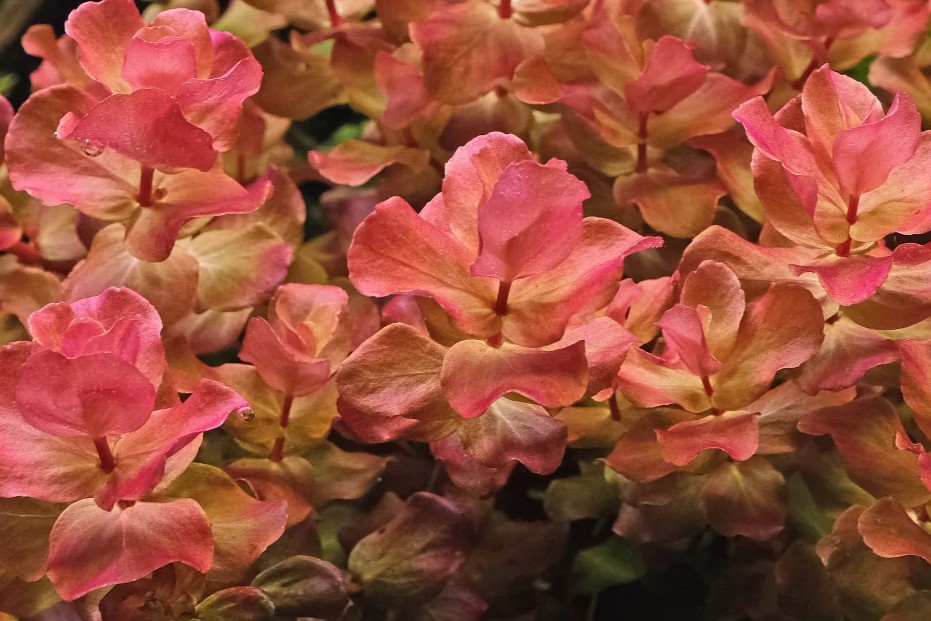
Rotala macrandra ‘Type 4 Green’ is a distinct variant of the species Rotala macrandra, characterized by rounded, relatively thick foliage compared to its classic counterpart. Morphologically, leaves are arranged in opposite pairs along soft, reddish stems. Leaf shape leans obovate to almost orbicular with rounded tips and slightly wavy margins. In high-light aquascape environments, the leaf structure appears compact, featuring a smooth surface texture and clear color gradients.
Under high-light systems, top shoots display a soft pink to salmon and gentle red hue caused by increased anthocyanin pigment production. Lower leaves tend to present a yellowish-green to bronze shade, creating a natural multi-tone color layering on a single stem. Color variations between nodes usually reflect light distribution and carbon availability throughout the water column.
In its natural habitat, the parent species grows in shallow waters with slow to moderate currents and intense sunlight. This wild background explains why the plant requires strong lighting, stable carbon delivery, and soft water to maintain its optimal morphology in planted aquariums. In aquascape layouts, it functions as a soft color transition in midground to background areas, bridging the gap between bright green foliage and deep red stem plants.
Care and Requirements
Growth Characteristics
As a stem plant, Rotala macrandra ‘Type 4 Green’ grows vertically with strong apical dominance. Internodes become tightly packed when light intensity and CO₂ supply are well balanced. Following a trim, lateral shoots emerge from lower leaf nodes to build a bushier cluster. Under insufficient light or carbon, stems stretch, node spacing widens, and leaf size shrinks—a common stress response in systems with fluctuating daily CO₂ or uneven water flow.
Lighting
Lighting requirements fall into the high category, with an optimal range between 100 and 180 µmol m⁻² s⁻¹ PAR at leaf level. Within 100 to 130 µmol m⁻² s⁻¹ PAR, the plant maintains steady growth with delicate pink tones. Above 150 µmol m⁻² s⁻¹ PAR, colors become more intense, though system nutrient and carbon demands increase significantly. Below 80 µmol m⁻² s⁻¹ PAR, the plant remains viable, but red hues fade and the structure grows loose. Intense lighting without balanced nutrition induces physiological stress, making overall system stability far more critical than extreme light output.
CO₂ and Carbon
Carbon requirements are high, calling for a steady dissolved CO₂ concentration of 20 to 30 ppm. The species is notably sensitive to carbon fluctuations, particularly during the initial hours of the daily photoperiod. Uniform gas distribution ensures proper leaf sizing, tight node spacing, and vibrant shoot coloration. Without CO₂ injection, the plant may survive, but growth slows dramatically and foliage reverts to a dominant green. High-tech systems with efficient gas diffusion and steady water circulation yield the most reliable results.
Nutrition
As a colored stem plant, nutrient demand requires a balanced, steady supply. Maintaining low to moderate nitrate levels encourages proper growth without dulling color intensity, while phosphate and potassium support active tissue development and metabolic health. Micronutrients, especially iron, assist in top shoot pigmentation, where deficiencies present as pale new growth or leaf deformities. Consistent daily dosing yields far better results than high, erratic fertilizer amounts.
Water Parameters
The ideal pH range is 5.5 to 6.5, reflecting a preference for slightly acidic water. General hardness between 2 and 8 dGH is well tolerated as long as parameters remain stable. Carbonate hardness should ideally be kept low at 0 to 2 dKH, as low KH helps stabilize acidic pH levels and improves micronutrient availability. When KH exceeds 3 dKH, color intensity often diminishes and post-trimming recovery slows down. Optimal temperatures range between 22 and 28 °C, with peak structure and color performance occurring between 23 and 26 °C. Elevated temperatures above 28 °C accelerate metabolism while increasing nutrient imbalance risks.
Substrate
An active substrate with a strong cation exchange capacity supports root zone nutrient stability. Although the plant absorbs a large portion of its nutrients through foliage, a healthy root system aids adaptation following trimming and replanting. Nutrient-poor substrates delay initial acclimation, while overly compacted soil lacking proper circulation can hinder healthy root development.
Propagation
Propagation is carried out via standard stem cuttings. Healthy top shoots measuring 5 to 10 cm in length can be trimmed and replanted directly into the substrate, which stimulates lower stem branching to build denser plant groups. Controlled, routine pruning maintains desired canopy height while preserving dense foliage on lower stem sections to keep background and midground areas looking full.
Conclusion
Rotala macrandra ‘Type 4 Green’ is a colorful aquatic stem plant featuring rounded leaves and soft pink to salmon gradients that reach peak expression under high light and high CO₂. Requiring PAR levels of ±100–180 µmol m⁻² s⁻¹ and low KH (0–2 dKH), it delivers reliable morphology and color stability in well-managed aquariums. It is best suited for high-tech systems with precise parameter control. Positioned in midground or background zones, it creates a gentle, warm color transition that complements surrounding green and red flora.