Daftar Isi Show
| Characteristic | Detail |
|---|---|
| Genus | Glossostigma |
| Species | Glossostigma elatinoides |
| Family | Phrymaceae |
| Origin | Australia and New Zealand |
| Common Name | Glosso |
| Light Requirement | High (±90–180 µmol m⁻² s⁻¹ / PAR) |
| Optimal Temperature | 20–26 °C |
| Growth Rate | Fast |
| Placement | Foreground |
| Plant Height | 2–5 cm |
| Ideal pH | 5.5–7.2 |
| Water Hardness | GH 1–8 dGH; KH 0–4 dKH |
| CO₂ Requirement | High |
| Propagation | Stolon division |
Additional Information
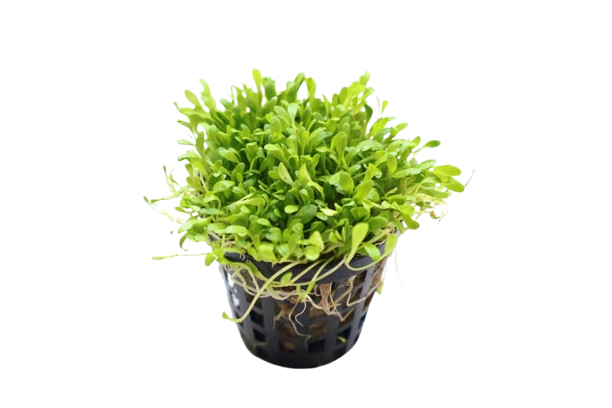
Glossostigma elatinoides is a popular foreground aquascape plant characterized by small oval to spatulate leaves arranged in pairs along horizontal stems. These stems develop into stolons that spread across the substrate, allowing the plant to form a dense, low-growing carpet when environmental conditions are favorable.
The species naturally occurs in shallow wetlands, stream margins, and periodically inundated habitats in Australia and New Zealand. Its adaptation to relatively open, well-lit environments contributes to its strong response to high light intensity when cultivated in aquariums.
In aquascaping, Glossostigma elatinoides is primarily used as a carpeting plant to create a low, continuous foreground. Its small foliage is particularly effective for establishing a sense of scale and enhancing spatial depth in Nature Aquarium and Iwagumi layouts.
Because the leaves remain extremely close to the substrate under suitable conditions, a well-established Glossostigma carpet can create a visually continuous green surface that emphasizes the geometry and negative space of the hardscape.
Care and Requirements
Growth Characteristics
Glossostigma elatinoides grows horizontally through stolons that spread across the substrate. Each stolon can produce additional nodes, leaves, and roots, allowing the plant to gradually establish a dense colony.
Under strong lighting and stable CO₂ availability, the plant maintains a low and compact growth habit. When light intensity is insufficient, however, the stems tend to grow vertically in search of stronger illumination. This process, known as etiolation, significantly reduces its effectiveness as a carpeting plant.
Growth can be rapid in high-tech systems with adequate carbon and nutrients. Regular trimming may therefore be necessary once the carpet becomes established. Removing excessive upper growth helps maintain light penetration into the lower layers and encourages continued horizontal expansion.
Lighting
The lighting requirement of Glossostigma elatinoides is high, with a recommended range of approximately 90–180 µmol m⁻² s⁻¹ PAR.
At intensities below approximately 80 µmol m⁻² s⁻¹, the plant is more likely to exhibit vertical growth and elongated internodes. This produces a taller, more open structure rather than the compact carpet typically desired in aquascaping.
Under stable high-intensity lighting, the stems remain closer to the substrate, leaves develop more densely, and horizontal propagation becomes more vigorous.
High light, however, must be balanced with sufficient CO₂ and nutrients. Increasing illumination without adequate carbon availability can create an ecological imbalance and increase algae pressure.
CO₂ and Carbon
Glossostigma elatinoides has a high CO₂ requirement for optimal carpeting performance.
The plant can survive without injected CO₂, but growth is generally slower and the formation of a dense, low carpet is considerably more difficult. In non-CO₂ systems, it may exhibit more vertical growth and reduced lateral expansion.
In high-tech aquariums with stable dissolved CO₂ concentrations of approximately 20–30 mg/L, growth can become significantly more vigorous, particularly during the establishment phase following planting.
CO₂ stability is more important than simply achieving a high concentration. Large fluctuations can interfere with photosynthetic activity and encourage inconsistent growth, particularly when the aquarium is operated under strong lighting.
Nutrients
As a relatively fast-growing carpeting plant, Glossostigma elatinoides has a substantial demand for macronutrients. Nitrogen, phosphorus, and potassium are required to support continuous stolon production and leaf development.
Nitrogen deficiency can result in slower growth, smaller leaves, and reduced carpet density. Phosphorus and potassium are also important for maintaining active vegetative development.
Micronutrients, particularly iron, contribute to chlorophyll production and healthy green coloration. Deficiencies may reduce overall vigor and cause abnormal foliage development.
A consistent and balanced fertilization strategy is preferable to excessive or irregular dosing. High light and CO₂ increase the plant’s metabolic demand, making nutrient stability particularly important in high-tech systems.
Water Parameters
Suitable water conditions generally fall within a pH range of 5.5–7.2, with low to moderate hardness around GH 1–8 dGH and KH 0–4 dKH.
The species generally performs well in relatively soft water with low carbonate hardness, particularly when cultivated in high-tech aquascapes.
The optimal temperature range is approximately 20–26 °C. Sustained temperatures above 28 °C may slow growth and increase the risk of algae-related problems when other environmental conditions are unstable.
As with most carpeting plants, consistency is more important than targeting a single exact water parameter. Stable temperature, pH, hardness, CO₂, and nutrient availability provide the best foundation for continuous stolon development.
Substrate
A nutrient-rich substrate with a fine to medium granular structure is highly beneficial for Glossostigma elatinoides.
Although its roots are relatively short, they are active and contribute significantly to nutrient acquisition and anchoring. A suitable substrate allows stolons to remain securely positioned while new roots establish at individual nodes.
An excessively compact substrate can restrict root development and interfere with horizontal stolon expansion. Conversely, excessively coarse substrate may make newly planted portions unstable and increase the risk of uprooting.
A stable substrate structure is particularly important during the initial establishment period, when the plant has not yet developed a sufficiently interconnected root and stolon network.
Propagation
Propagation is performed through stolon division.
Healthy stolons containing several nodes and established roots can be carefully cut into smaller sections. These portions can then be replanted at short intervals across open areas of substrate.
Spacing the individual portions appropriately allows each section to develop new stolons and gradually connect with neighboring plants. This technique is widely used in aquascaping because it allows efficient carpet establishment while causing minimal disturbance to the parent colony.
Once the individual sections begin producing lateral runners, the carpet can expand rapidly under favorable light, CO₂, and nutrient conditions.
Conclusion
Glossostigma elatinoides is a classic foreground aquascape plant valued for its small foliage, horizontal stolon growth, and ability to form a dense, low-profile carpet. Its compact morphology makes it particularly effective for creating visual depth and realistic scale within carefully structured layouts.
The species is best suited to high-tech aquariums with high-intensity lighting, stable CO₂ supplementation, and consistent nutrient availability. Although it can survive under lower-tech conditions, maintaining the characteristic horizontal carpeting habit becomes considerably more challenging.
When properly cultivated, Glossostigma elatinoides produces a fine green carpet that emphasizes hardscape geometry and negative space. Its low growth profile and rapid lateral propagation make it an especially effective choice for Nature Aquarium and Iwagumi-style layouts where foreground precision and visual perspective are important.