Daftar Isi Show
| Characteristic | Detail |
| Genus | Rotala |
| Species | Rotala macrandra |
| Family | Lythraceae |
| Origin | India (South Asia) |
| Common Name | Rotala macrandra ‘Type 4 Red’ |
| Light Requirement | High (±120–200 µmol m⁻² s⁻¹ / PAR) |
| Optimal Temperature | 22–28 °C |
| Growth Rate | Moderate |
| Placement | Midground – Background |
| Plant Height | 20–40 cm |
| Ideal pH | 5.2–6.5 |
| Water Hardness | GH 2–6 dGH; KH 0–2 dKH (optimal) |
| CO₂ Requirement | High |
| Propagation | Stem cutting |
Additional Information
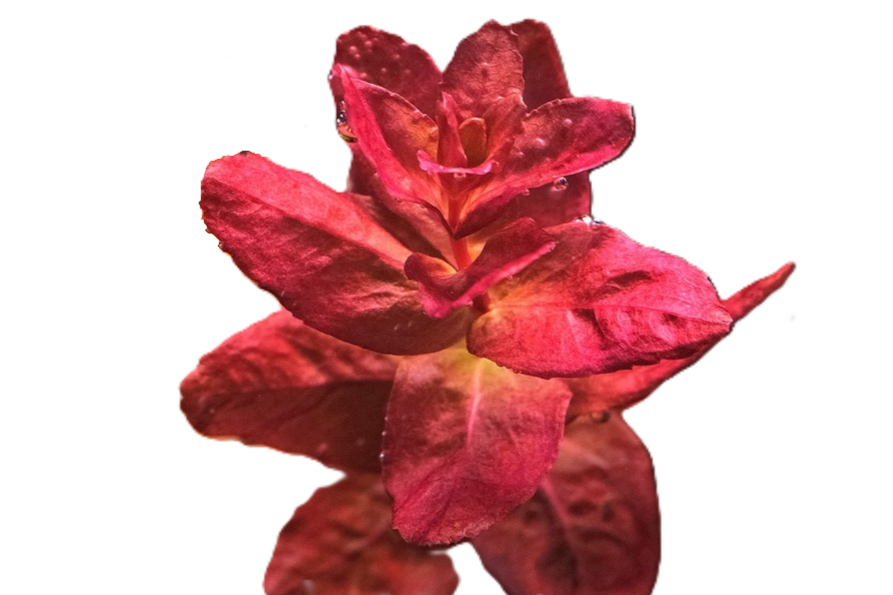
Rotala macrandra ‘Type 4 Red’ is an intensely colored variant of the species Rotala macrandra, characterized by rounded foliage and a relatively thicker leaf texture compared to the classic form. In high-light aquascaping setups, its leaves display an obovate to almost orbicular shape with blunt tips and a subtle surface texture.
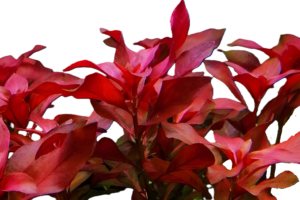
Under high light intensity, the foliage develops a deep red to crimson hue, featuring brighter gradients at the center of new terminal growth. The upper shoot tips exhibit a vibrant, saturated red tone, whereas older lower leaves tend to transition toward a dark crimson with subtle maroon undertones. The color intensity of this variant stays uniform down to the lower stem nodes provided light distribution and carbon supply remain stable.
The stems exhibit a reddish coloration and grow upright with short internodes under optimal conditions. Leaves are arranged in opposite pairs, forming a symmetrical structure that produces a dense, layered appearance. In aquascape compositions, this variant serves effectively as a striking focal accent in the midground or as a high-contrast color block in the background, especially when set against fine-textured or green-dominated foliage.
Ecologically, the parent species originates from shallow tropical waters characterized by intense sunlight and low mineral content. This wild background explains its strong preference for soft water conditions and precise carbon management in planted aquariums.
Care and Requirements
Growth Characteristics
This plant exhibits vertical growth governed by apical dominance. In stable setups, short internodes create tight, compact bushes. Following a trim, lateral shoots emerge from lower nodes to increase cluster density. Under insufficient light or carbon, stems stretch, internodal spacing widens, and coloration fades to a dull brownish-red. The ‘Type 4 Red’ variant shows a higher sensitivity to parameter fluctuations compared to green forms of the species.
Lighting
Lighting requirements fall into the high category, with an optimal range between 120 and 200 µmol m⁻² s⁻¹ PAR at leaf level. Within the 120 to 150 µmol m⁻² s⁻¹ PAR range, the red color becomes solid and uniform, while increasing intensity above 160 µmol m⁻² s⁻¹ PAR deepens crimson tones and yields even more compact foliage. Below 100 µmol m⁻² s⁻¹ PAR, coloration fades and growth structure becomes loose, as this variant rarely reaches optimal performance under medium light.
CO₂ and Carbon
Carbon requirements are high, requiring a stable dissolved CO₂ concentration of 25 to 35 ppm to maintain deep color saturation and ideal leaf size. This plant is particularly sensitive to CO₂ fluctuations, especially at the start of the daily photoperiod. Without CO₂ injection, the plant may survive temporarily, but intense red coloration becomes impossible to achieve and growth becomes inconsistent. A high-tech system providing uniform gas diffusion and consistent circulation delivers the most reliable results.
Nutrition
As an intensely red stem plant, balanced nutrition serves as a critical success factor. Maintaining low to moderate nitrate levels preserves strong color saturation without hindering growth. Phosphate and potassium are needed in balanced ratios to support healthy tissue development. Micronutrients, particularly iron, play an essential role in vibrant shoot color formation, where micronutrient deficiencies manifest as pale tips or leaf deformation. A steady, consistent nutrient supply yields far better results than temporary, heavy dosing.
Water Parameters
The ideal pH range is 5.2 to 6.5, reflecting a preference for soft, acidic water. General hardness should be maintained around 2 to 6 dGH, as higher hardness levels diminish color intensity and prolong acclimation times. Carbonate hardness should be kept low at 0 to 2 dKH, which helps preserve low pH stability and enhances micronutrient availability in the water column. Optimal temperature ranges between 22 and 28 °C, with peak color expression usually occurring around 23 to 26 °C, since temperatures above 28 °C accelerate metabolic rates and increase nutrient stress.
Substrate
An active substrate with mild buffering capacity supports system stability and healthy root development. Although the plant absorbs a significant portion of its nutrients through its foliage, strong roots assist post-trimming acclimation and sustain steady growth rates. Inert substrates can still be used provided liquid column fertilization remains consistent and water parameters are tightly controlled.
Propagation
Propagation is performed via standard stem cuttings. Healthy terminal shoots measuring 5 to 8 cm in length can be trimmed and replanted directly into the substrate. Regular pruning stimulates lateral branching, producing a dense, bushy cluster with uniform color distribution from base to tip. Gradual, phased trimming is recommended to preserve base density and avoid shading lower leaves.
Conclusion
Rotala macrandra ‘Type 4 Red’ is an intensely red aquatic stem plant featuring rounded leaves and a compact structure under high lighting. Requiring high light levels (±120–200 µmol m⁻² s⁻¹ PAR), abundant CO₂, and low KH (0–2 dKH), it presents a deep crimson color in controlled high-tech aquariums. It is best suited for experienced aquascapers who maintain precise control over lighting, carbon, and nutrition. Positioned in midground or background areas, this variant delivers a bold color block that brings sharp contrast and visual depth to any aquascape layout.