Daftar Isi Show
| Characteristic | Detail |
| Genus | Rotala |
| Species | Rotala macrandra |
| Family | Lythraceae |
| Origin | India (South Asia) |
| Common Name | Rotala macrandra ‘Mini Butterfly’ |
| Light Requirement | High (±120–200 µmol m⁻² s⁻¹ / PAR) |
| Optimal Temperature | 22–28 °C |
| Growth Rate | Moderate |
| Placement | Midground – Background |
| Plant Height | ±15–35 cm |
| Ideal pH | 5.0–7.0 |
| Water Hardness | GH 1–6 dGH; KH 0–2 dKH |
| CO₂ Requirement | High |
| Propagation | Stem cutting |
Additional Information
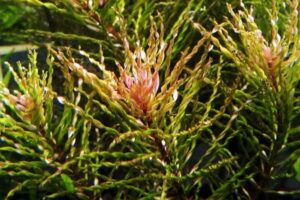
Rotala macrandra ‘Mini Butterfly’ is a small-leafed cultivar of Rotala macrandra within the Lythraceae family. Morphologically, it features narrow linear to lanceolate leaves with pointed tips arranged in opposite pairs along the stem. The leaf dimensions are significantly more miniature compared to the standard Rotala macrandra form, presenting a tight, compact shoot structure under high lighting.
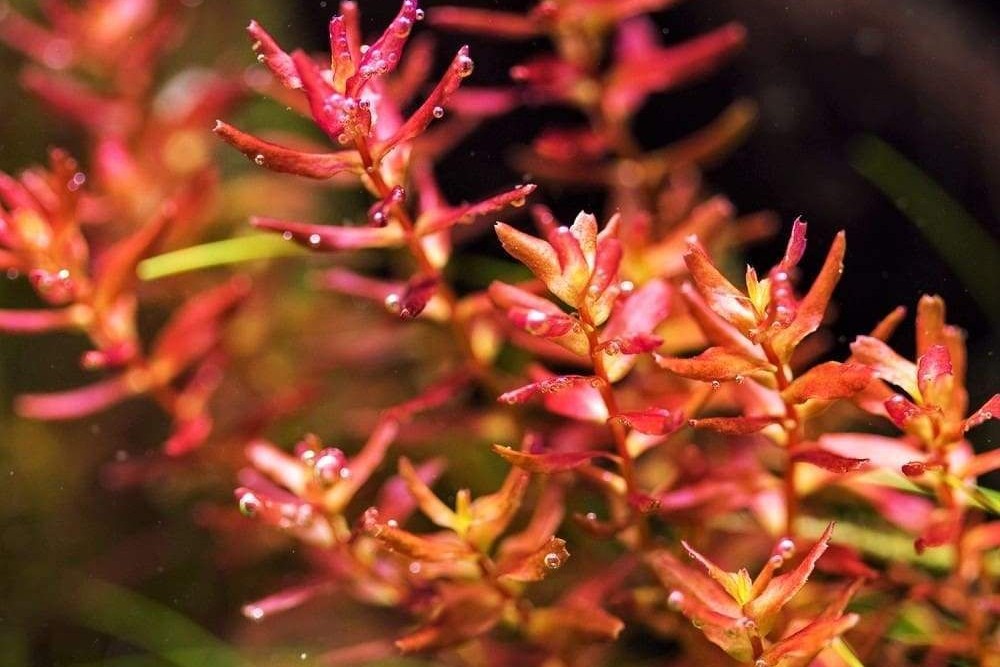
In high-light aquascaping setups, the foliage exhibits an intense deep red to ruby-red coloration with soft orange gradients on young terminal shoots. Color intensity is strongly governed by light levels, carbon stability, and water softness. Under optimal conditions, the internodal spacing remains short, producing a dense, highly structured plant cluster.
The natural habitat of the parent species Rotala macrandra consists of shallow, slow-moving waters characterized by soft water parameters. This wild origin explains its preference for low carbonate hardness and slightly acidic water conditions in planted aquariums.
In aquascape layouts, this cultivar serves as a powerful color accent in the midground to background transition zones. Its vivid red hue functions effectively as a visual focal point when set against fine-textured or broad-leafed green flora.
Care and Requirements
Growth Characteristics
This plant grows vertically as a typical stem species, branching from stem nodes following a trim. Its growth rate is moderate, though heavily dependent on parameter stability. Under high lighting and stable carbon delivery, the internodes remain short with tightly packed leaves. Conversely, if light or carbon is insufficient, the stems stretch, the leaves shrink, and the coloration fades to a dull brownish-red. Routine pruning of the top shoots stimulates lateral branching, helping build denser, more aesthetically pleasing bushes for aquascaping layouts.
Lighting
Lighting requirements fall into the high category, with an effective range of 120 to 200 µmol m⁻² s⁻¹ PAR at leaf level. As a demanding cultivar of Rotala macrandra, ‘Mini Butterfly’ achieves peak performance under intense illumination. Below approximately 90 µmol m⁻² s⁻¹ PAR, coloration loses intensity and stem structure becomes leggy. At PAR levels above 150 µmol m⁻² s⁻¹ supported by proper nutrient and carbon management, the red tones deepen substantially and terminal shoots remain compact. High light without balanced nutrients increases the risk of algae issues.
CO₂ and Carbon
Carbon requirements are high, as the plant is exceptionally responsive to dissolved CO₂ stability. A constant dissolved CO₂ concentration of 20 to 30 ppm is generally required to maintain compact growth and optimal red pigmentation. While the plant may survive in some setups without injected CO₂, growth slows dramatically, color saturation diminishes, and the risk of shoot deformation increases. Fluctuations in carbon supply cause more harm than slightly lower but stable levels. In high-tech environments, uniform carbon distribution and gentle circulation help sustain consistent growth.
Nutrition
As a red-pigmented stem plant, macronutrient demand is relatively high, requiring a balanced ratio of nitrogen, phosphate, and potassium. Nitrogen deficiency causes lower foliage to shed prematurely. Micronutrients like iron assist in color expression, though maximum saturation relies far more on high light intensity, stable carbon, and soft water than on excessive dosing of micronutrients. Daily nutrient consistency yields far better results than large, periodic doses.
Water Parameters
The ideal pH range is 5.0 to 7.0, with peak performance occurring in slightly acidic conditions. Recommended water hardness includes a general hardness of 1 to 6 dGH and a carbonate hardness of 0 to 2 dKH. Soft water with low alkalinity maintains stable pH levels during CO₂ injection and encourages richer red pigmentation. Elevated KH levels reduce pH control flexibility and impair dissolved carbon efficiency. Optimal temperature ranges between 22 and 28 °C, as excessively high temperatures in high-light systems increase metabolic stress.
Substrate
An active substrate capable of buffering water to a slightly acidic pH while supplying basic root nutrients greatly assists the initial acclimation phase. The root system of Rotala macrandra is relatively fine, yet highly responsive to nutrient availability in the root zone. In inert substrates, liquid column fertilization must remain consistent because the plant absorbs nutrients through both its leaves and roots.
Propagation
Propagation is performed via standard stem cuttings. Healthy terminal shoots measuring 5 to 8 cm in length can be cut and replanted directly into the substrate, while the remaining lower stems will sprout lateral shoots from buried and exposed nodes. To maintain a clean layout in the midground or background, aquascapers frequently uproot aged lower stems and replant only the healthiest top cuttings.
Conclusion
Rotala macrandra ‘Mini Butterfly’ is an intensely red stem plant ideal for high-tech aquariums equipped with high lighting (±120–200 µmol m⁻² s⁻¹ PAR), abundant CO₂, and soft, low-KH water. It is most effective when positioned in midground to background areas as a contrasting visual highlight. In low-tech, non-CO₂ aquariums, its color and structural performance remain suboptimal. Given precise parameter control and ecosystem stability, Rotala macrandra ‘Mini Butterfly’ provides exceptional aesthetic value and a striking architectural presence in professional aquascapes.