Daftar Isi Show
| Characteristic | Detail |
|---|---|
| Genus | Rotala |
| Species | Rotala indica |
| Family | Lythraceae |
| Origin | South Asia and Southeast Asia |
| Common Name | Indian Toothcup; Rotala ammania sp. ‘Bonsai’ (trade name) |
| Light Requirement | Medium (±60–100 µmol m⁻² s⁻¹ / PAR) |
| Optimal Temperature | 22–28 °C |
| Growth Rate | Moderate |
| Placement | Midground – Background |
| Plant Height | 15–40 cm |
| Ideal pH | 5.5–7.5 |
| Water Hardness | GH 2–10 dGH; KH 1–6 dKH |
| CO₂ Requirement | Adaptive – Medium |
| Propagation | Stem cutting |
Additional Information
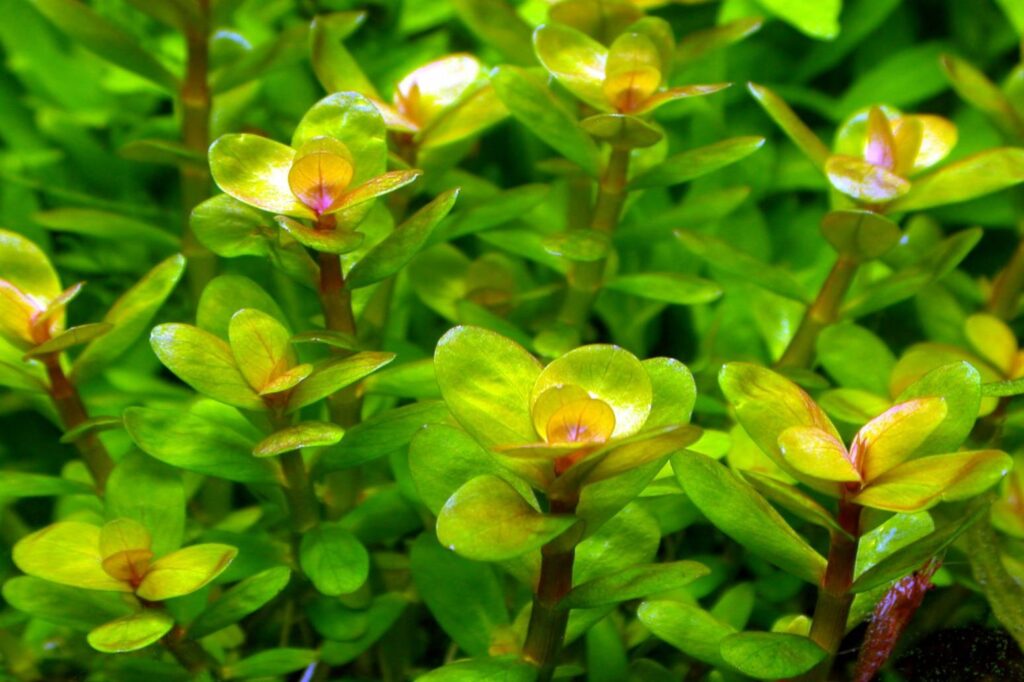
Rotala indica is an aquatic stem plant belonging to the family Lythraceae, recognized for its compact growth habit and small, rounded foliage structure. In aquascaping practice, it is widely appreciated for creating tidy, controlled mini-bushes. Morphologically, the stems grow strictly erect with a reddish-brown to deep red hue, particularly along the older lower sections.
Leaves are arranged in opposite pairs at each node along the stem. The leaf shape ranges from rounded to broadly oval with blunt tips and a smooth surface. In its submerged form, the foliage appears small, thick, and fleshy, differing noticeably from the larger, thinner emersed leaf form. Short internodes produce a tight leaf arrangement, allowing Rotala indica to form a dense vegetative mass resembling a miniature shrub.
The upper shoot tips display bright green foliage with subtle yellow to soft orange gradients at the center of new growth. Under optimal lighting, these warm undertones become more pronounced, though they remain less intense than red Rotala species. The combination of reddish stems and bright green leaves provides a natural, balanced contrast within an aquascape layout.
In the trade, Rotala indica is frequently marketed under the commercial name “Rotala ammania sp. ‘Bonsai'”. This name is not a scientifically valid taxonomic name, but rather a trade designation referring to its compact growth habit. The term ‘Bonsai’ highlights its small leaf size and dense, shrub-like growth. Botanically, the plant remains classified as Rotala indica.
In aquascaping layouts, Rotala indica is typically positioned in the midground. In larger aquariums, it also functions well as a low background plant to create tiered transitions toward taller stem species. Its fine foliage texture makes it an effective space filler without overpowering the surrounding composition.
Care and Requirements
Growth Characteristics
Rotala indica follows a vertical growth pattern with a tendency to develop side shoots after trimming. Left unpruned, stems grow straight upward in single columns. Cutting the terminal tips prompts lower nodes to produce lateral branches, establishing a fuller, denser structure. Internodal spacing is strongly influenced by light intensity and carbon availability; adequate lighting yields short internodes with tightly packed leaves, while low light leads to leggy stems and sparser bush density. Its moderate growth rate makes it easily manageable and non-invasive within the layout.
Lighting
Lighting requirements for Rotala indica fall into the medium category, around 60 to 100 µmol m⁻² s⁻¹ PAR. At lower levels near 60 µmol m⁻² s⁻¹ PAR, the plant maintains healthy green growth with a tidy form. Increasing light to 80–100 µmol m⁻² s⁻¹ PAR produces smaller, thicker, and more densely packed leaves, while top shoots develop yellow to soft orange accents under balanced micronutrients. PAR levels below 40 µmol m⁻² s⁻¹ PAR can cause etiolation and sparse foliage density.
CO₂ and Carbon
Carbon requirements are adaptive to medium. Rotala indica survives in low-tech setups without injected CO₂, albeit with slower growth. Achieving maximum canopy density relies on a stable CO₂ concentration of 20 to 30 ppm. In high-tech systems with medium lighting and consistent carbon delivery, the plant responds with tighter internodes and increased branching. Maintaining uniform CO₂ distribution is far more crucial than targeting high concentrations.
Nutrition
As a stem plant, Rotala indica absorbs nutrients primarily from the water column. Nitrogen keeps leaf size proportional, while phosphate and potassium support stem strength and new tissue development. Micronutrients like iron contribute to subtle color intensity on top shoots, with imbalances manifesting as stunted or pale tips. A balanced supply of macronutrients and micronutrients ensures consistent, healthy development.
Water Parameters
Recommended water parameters include a pH range of 5.5 to 7.5, an optimal temperature of 22 to 28 °C, a general hardness of 2 to 10 dGH, and a carbonate hardness of 1 to 6 dKH. The plant tolerates mild variations provided adjustments occur gradually. Soft to moderately hard water generally supports the most stable growth performance.
Substrate
Rotala indica grows well in both active soil and inert substrates. Its root system is modest, serving mainly to anchor the vertical stems upright. Porous substrate structures promote root development and facilitate replanting during maintenance. Planting stems tightly in groups accelerates the formation of a dense midground bush.
Propagation
Propagation is performed using standard stem cuttings. Healthy terminal shoots measuring 3 to 7 cm in length can be trimmed and replanted directly into the substrate. The remaining lower stems will produce new side branches from buried and exposed nodes. Routine trimming allows aquascapers to maintain a compact, well-defined shape within the composition.
Conclusion
Rotala indica is an aquatic stem plant characterized by small, rounded leaves and short internodes that form compact, shrub-like stands. Although widely known in the trade as “Rotala ammania sp. ‘Bonsai'”, it is scientifically classified as Rotala indica. Ideally suited for midground placement or low background transitions, it adapts well to low-tech setups while reaching peak density in high-tech systems with medium light and stable CO₂ injection. Regular trimming and steady water parameters preserve its clean, controlled structure across various aquascaping styles.