Daftar Isi Show
| Characteristics | Details |
|---|---|
| Genus | Ludwigia |
| Species | Ludwigia palustris |
| Family | Onagraceae |
| Origin | North America, Europe, parts of Asia |
| Common Name | Super Red Ludwigia |
| Light Requirement | Medium–high (±70–140 µmol m⁻² s⁻¹ / PAR) |
| Optimal Temperature | 20–28 °C |
| Growth Rate | Moderate |
| Placement | Midground – background |
| Plant Height | 15–40 cm |
| Ideal pH | 5.5–7.5 |
| Water Hardness | GH 2–10 dGH; KH 0–5 dKH |
| CO₂ Requirement | Medium–high |
| Propagation | Stem cuttings |
Additional Information
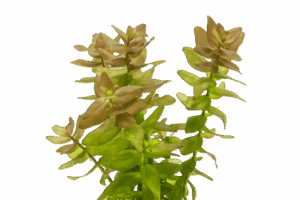
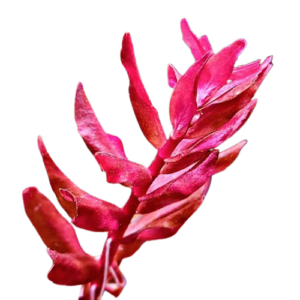
Ludwigia palustris ‘Super Red’ is a cultivated selection of Ludwigia palustris, known for its stronger red coloration compared to the standard form. Morphologically, it features upright stems with opposite leaves that are oval to slightly elongated, with a relatively small to medium size.
Under optimal conditions, leaf coloration can develop from reddish-green to deep red or maroon. Color intensity is strongly influenced by light, carbon availability, and nutrient balance, particularly nitrogen levels.
In aquascaping, this plant is commonly used as a color accent in the midground to background. Its orderly stem structure and strong response to trimming make it ideal for forming dense bushes with high visual contrast against surrounding green plants.
Its natural habitat includes shallow waters, swamps, and riverbanks with open to partially shaded light conditions. This adaptation explains its flexibility across different aquascape setups, although optimal performance is achieved in stable systems with sufficient lighting.
Requirements and Care
Growth Characteristics
This plant grows vertically as a stem plant. Growth remains compact under adequate lighting but tends to become elongated (leggy) under low light conditions.
It responds very well to trimming. Cutting the top will stimulate lateral branching, resulting in a fuller and denser appearance. Internodes become shorter under high light and stable CO₂ conditions.
Light
The light category ranges from medium to high, with an effective range of ±70–140 µmol m⁻² s⁻¹ (PAR).
Under low light:
Color tends to remain green or pale red
Internodes elongate
Leaf density decreases
Under high light:
Red coloration becomes more intense and stable
Growth becomes more compact
Plant structure becomes denser and more aesthetic
Even light distribution is important to prevent shading and leaf drop in the lower stem sections.
CO₂ and Carbon
This plant can survive without CO₂ injection, but performance will be limited. In non-CO₂ systems:
Growth is slower
Coloration is less optimal
Structure tends to be less compact
In systems with CO₂ (20–30 ppm):
Red coloration becomes more vivid
Growth is more stable and consistent
Response to trimming improves
In aquascaping practice, Ludwigia palustris ‘Super Red’ is considered a plant that shows significant improvement in high-tech systems.
Nutrients
Nutrient requirements are moderate, with emphasis on balanced macro and micronutrients.
Nitrogen (NO₃):
High levels can reduce red coloration intensity
Moderate levels help maintain balance between growth and color
Phosphate (PO₄) and Potassium (K):
Support tissue development and plant metabolism
Micronutrients (Fe, Mn, etc.):
Play a role in pigment formation
Nutrient imbalance may lead to pale shoots, unstable growth, or algae development.
Water Parameters
Stable parameter ranges are essential:
pH: 5.5–7.5
Temperature: 20–28 °C
GH: 2–10 dGH
KH: 0–5 dKH
This plant adapts well to soft to moderately hard water. Extreme fluctuations may induce stress, indicated by leaf drop or stagnated growth.
Substrate
There are no strict substrate requirements, but optimal performance is achieved in nutrient-rich active substrates.
Roots function primarily as additional support, while the main nutrient uptake occurs through the water column. A stable substrate contributes to overall ecosystem balance, especially in high-tech systems.
Propagation
Propagation is performed through stem cuttings.
General steps:
Cut the top or a healthy section of the stem
Replant into the substrate
Ensure adequate light and CO₂ for rapid adaptation
Routine trimming not only maintains shape but also serves as the primary propagation method in aquascaping.
Conclusion
Ludwigia palustris ‘Super Red’ is a stem plant with a strong visual character, defined by its intense red coloration under optimal conditions. It is well suited for midground to background placement as a contrasting accent within aquascape layouts.
In low-tech systems, the plant can still grow but with limited performance, particularly in terms of color intensity and density. In high-tech systems with medium–high lighting and stable CO₂, it reaches its full potential both aesthetically and structurally.
Overall, this plant offers high functional value as a color and structural element, with flexibility across various aquascape styles as long as environmental parameters remain stable.